
essay
Minute of Dissent by Mr. M.R. Masani, M.P. & Mr. R.V. Bade, M.P.
Select Committee on Companies (Amendment) Bill, 1962
By Minoo Masani
Secretary, Swatantra Party Parliamentary Group Office. · New Delhi · 1963
2 pages
Summary
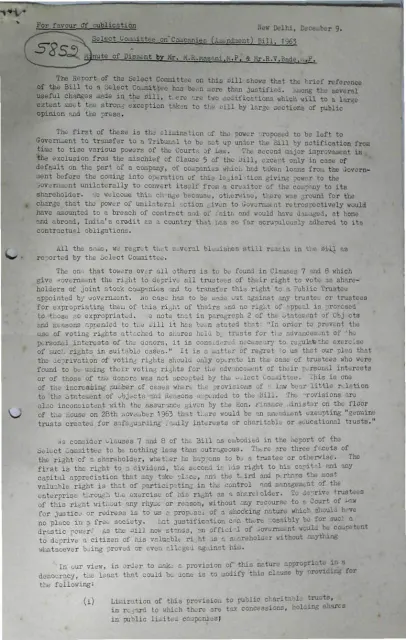
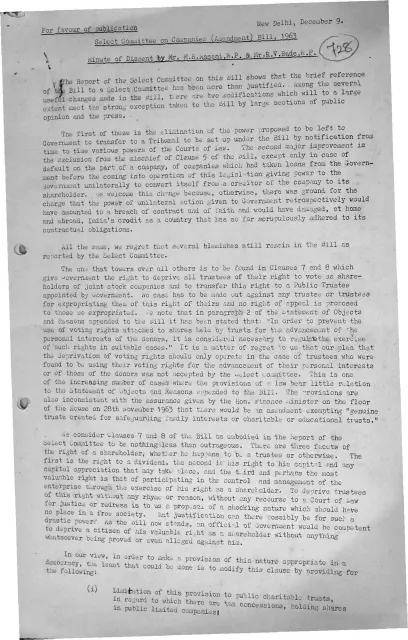
This two-page minute of dissent by M. R. Masani and R. V. Bade argues that the Select Committee reference of the Companies (Amendment) Bill, 1962 was justified, but that the reported Bill still contains serious defects. The authors welcome the removal of a proposed power allowing the Government to transfer judicial powers to a tribunal, and the exclusion of a retrospective power that could have converted the Government from a creditor into a company’s shareholder. They regard these changes as important to preserving confidence in India’s contractual obligations and creditworthiness.
The principal objection concerns Clauses 7 and 8, which would permit the Government to deprive trustees of voting rights in companies and transfer those rights to a public trustee without adequate safeguards or appeal. The dissent characterises this as an unwarranted interference with shareholders’ property and participation rights, especially where no wrongdoing has been proved. It proposes limiting the provision to public charitable trusts and cases involving conduct adverse to the trust, while guaranteeing the affected trustee a hearing and a right of appeal. The authors also seek broader appeal rights against tribunal findings, removal of vague standards of commercial prudence from Clause 9, and restriction of the Central Government’s prior-approval power over appointments.
Key points
- The dissent supports referring the Companies (Amendment) Bill to a Select Committee but finds that important defects remain in the Committee’s reported version.
- It welcomes removing the proposed power to transfer court powers to a Government-created tribunal.
- It approves excluding a retrospective power that could convert the Government from a creditor into a company’s shareholder after default.
- It condemns Clauses 7 and 8 for allowing trustees to lose shareholder voting rights without proof of wrongdoing, a hearing, or an appeal.
- It proposes narrowing the trustee provision to public charitable trusts and cases where trustees act against the trust’s interests.
- It argues that questions of commercial prudence should not be decided by tribunals lacking business experience.
- It recommends extending appeals from tribunal findings beyond questions of law and limiting Central Government approval requirements for successor appointments.
Metadata and summary are AI-extracted from the source PDF and reviewed for editorial accuracy. The original work is available via the Read PDF tab above (where present); paragraph-level citation inside the PDF is deferred to a future engagement.
People in this work
Related across the archive
 Primary workSelect Committee on Companies (Amendment) Bill, 1963
 Primary workInterventions by Mr. K.R.Masani in the course of the second reading of the Companies (Amendment) Bill, 1963 in the Lok Sabha on December 16, 1963
 Primary workMinute of Dissent
 ExcerptSTATE MONOPOLIES AND THE CITIZEN IN A DEMOCRACY
 ExcerptDemocracy in India