speech · parliamentary
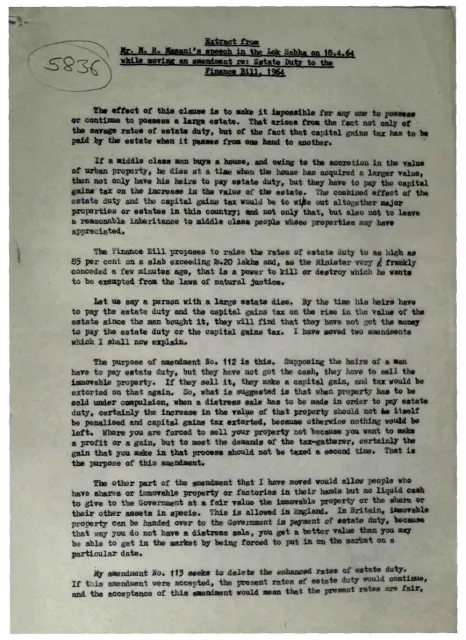
Extract from Mr. M. R. Masani's speech in the Lok Sabha on 18.4.64 while moving an amendment re: Estate Duty to the Finance Bill, 1964
By Minoo Masani
1964
2 pages
Summary
In this two-page extract from his 18 April 1964 Lok Sabha speech, Minoo Masani argues that the Finance Bill’s proposed estate-duty regime would make it increasingly difficult to own and transmit substantial property. He emphasizes the combined burden of estate duty and capital-gains tax, arguing that this could eliminate major estates, penalize middle-class homeowners whose property had appreciated, and leave heirs without sufficient cash to meet tax demands.
Masani supports amendments Nos. 112 and 113. Amendment No. 112 would exempt from capital-gains tax increases realized when heirs are compelled to sell property to pay estate duty, and would permit payment in kind—through shares, factories, or immovable property—at a fair value where liquid cash is unavailable. Drawing on British practice, he presents these measures as protections against distress sales. Amendment No. 113 seeks to delete the enhanced estate-duty rates. The extract closes with a denunciation of the government’s allegedly destructive and vindictive fiscal policy.
Key points
- Masani contends that estate duty and capital-gains tax together could make the inheritance of appreciated property financially impossible.
- He argues that middle-class homeowners may face both estate duty and capital-gains tax when their houses appreciate in value before death.
- He criticizes the Finance Bill’s proposed estate-duty rate of up to 85 per cent on estates exceeding Rs. 20 lakhs.
- Amendment No. 112 would prevent capital-gains tax from applying to gains arising from a compelled sale undertaken to pay estate duty.
- The amendment would also allow taxpayers without liquid cash to transfer shares, factories, or immovable property to the government at fair value.
- Masani invokes British practice as a model for avoiding distress sales and allowing payment of estate duty in property.
- Amendment No. 113 seeks to remove the enhanced estate-duty rates.
Metadata and summary are AI-extracted from the source PDF and reviewed for editorial accuracy. The original work is available via the Read PDF tab above (where present); paragraph-level citation inside the PDF is deferred to a future engagement.