speech
The Union Budget — 1970-71
Published by M. R. PAI for the Forum of Free Enterprise, "Sohrab House", 235 Dr. Dadabhai Naoroji Road, Bombay-1. and printed by Michael Andrades at Bombay Chronicle Press, Syed Abdullah Brelvi Road. Fort, Bombay-1. · Bombay · 1970
11 pages
Part of The Union Budget
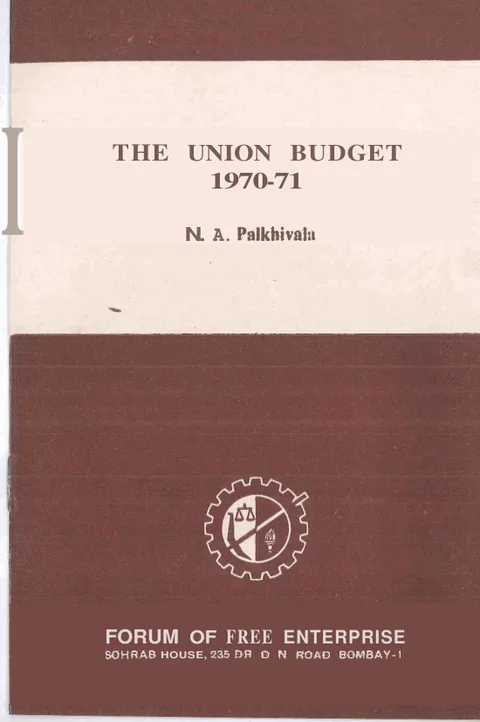
The Union Budget — 1970-71
By N. A. Palkhivala
Summary
In this Forum of Free Enterprise booklet, based on a public lecture delivered in Bombay on 5 March 1970, N. A. Palkhivala analyses the Union Budget for 1970-71. He opens with a mordant flourish — where ancient India gave imperishable expression to ‘thoughts that wander through eternity’, modern India has made three contributions to civilization: the Bandh, the Gherao, and the ‘pre-Budget technique’, the last being the practice of conditioning the public mind through February to expect such crushing taxation that when the Budget arrives with 93.5 per cent income-tax and 12 per cent wealth-tax as the maximum marginal rates, it evokes a cheerful response. Invoking Justice Holmes’s observation that most men judge things dramatically rather than quantitatively, he sets out to judge the Budget quantitatively against five ‘calamitous realities’: mounting unemployment, stagnant per capita income, a tardy gross national product, poor performance on the export front, and a paucity of public and private savings.
Palkhivala argues that India is, in plain logic if not in official discourse, the highest-taxed nation in the world: only 28 lakhs of a population of 546 million pay income-tax, half of whom will be exempt under this Budget, yet the non-agricultural direct-tax burden of about Rs. 17,000 crores and the wealth-tax of Rs. 780 crores are the heaviest anywhere, while agricultural income — bearing only about Rs. 11 crores — escapes almost entirely, savaging the productive minority. He compares India unfavourably with the twelve developing countries of Asia, where the fastest-growing economies cap the top marginal income-tax rate at 50 per cent, and with Pakistan, whose exemption limits and dividend reliefs are more generous and whose growth he attributes partly to a lower tax burden.
He acknowledges some fair provisions — notably a proposed amendment clarifying the definition of ‘capital asset’ under Section 2(14A) so that agricultural land near towns is taxed on sale, and clearer export incentives — but criticises the new charitable-trust rules (which compel trusts to spend income within the accounting year or lose exemption) and the confiscatory 12 per cent wealth-tax on urban immovable property, which he says amounts to expropriation without compensation, hampering building activity and driving honest owners toward the black market. His gravest warning is intangible: the heaviest cost of the Budget is the death of public morality, since when honesty becomes unprofitable, black-market money corrupts public life and a parallel government rises on an unprecedented scale — ‘the laws of human nature are far stronger than any fiscal laws.‘
Key points
-
Analyses the Union Budget 1970-71; based on a public lecture in Bombay on 5 March 1970.
-
Names modern India’s three ‘contributions to civilization’: the Bandh, the Gherao, and the ‘pre-Budget technique’.
-
Cites maximum marginal rates of 93.5% income-tax and 12% wealth-tax.
-
Frames the analysis against five ‘calamitous realities’: unemployment, stagnant per capita income, tardy GNP, weak exports, low savings.
-
Argues India is the highest-taxed nation; only 28 lakhs of 546 million pay income-tax, half now exempt.
-
Compares unfavourably with fast-growing Asian economies (50% top rate) and with Pakistan’s lighter burden.
-
Welcomes the capital-asset (Section 2(14A)) amendment and clearer export incentives but criticises new charitable-trust rules.
-
Calls the 12% urban-property wealth-tax confiscatory expropriation; warns the gravest cost is the death of public morality.
Generated by the v1.5 extraction pipeline. Awaiting editorial review.
Metadata and summary are AI-extracted from the source PDF and reviewed for editorial accuracy. The original work is available via the Read PDF tab above (where present); paragraph-level citation inside the PDF is deferred to a future engagement.