speech · parliamentary
MR. M.R. MASANI'S SPEECH IN THE COURSE OF THE DISCUSSION ON THE COMPANIES (AMENDMENT) BILL, 1963, IN THE LOK SABHA ON 13TH DECEMBER, 1963.
By Minoo Masani
1963
4 pages
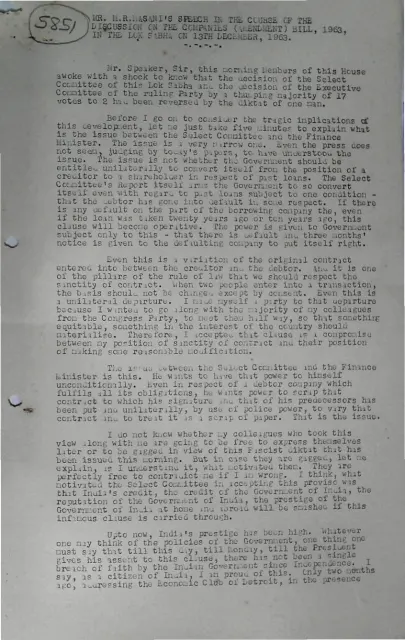
Summary
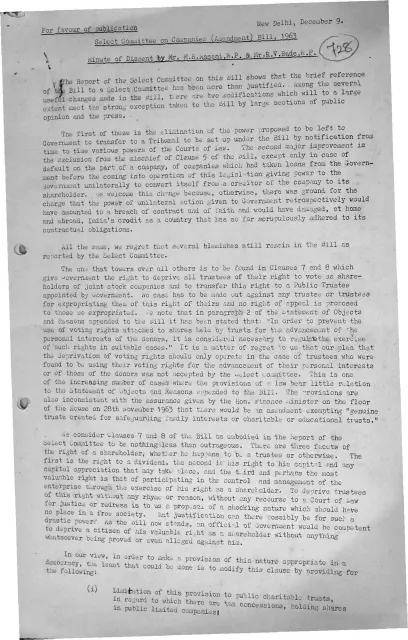
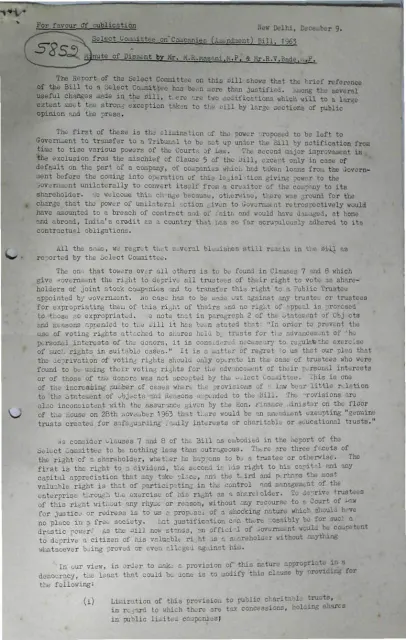
In this speech, delivered during the Lok Sabha debate on the Companies (Amendment) Bill, 1963, M. R. Masani argues that the Select Committee’s proposed provision would allow the government to convert itself unilaterally from a creditor into a shareholder in respect of past loans. He presents this as a violation of contractual sanctity and the rule of law, while accepting that limited modification may be justified where a borrowing company has defaulted and been given an opportunity to remedy the default. Masani characterizes the Finance Minister’s position as an attempt to acquire sweeping, unconditional power over companies and to treat existing contracts as “a scrap of paper.”
Masani broadens the argument into a defence of parliamentary procedure and constitutional government. He criticizes the government for disregarding the Select Committee’s decision, bypassing the convention that committee members should act without party whips, and weakening the authority of Parliament. He also rejects the government’s claim that the Bill is needed to prevent concentration of economic power, citing official income statistics and a Reserve Bank study as evidence of increasingly dispersed share ownership and wealth. The speech closes by warning that the more serious concentration of power lies in the hands of the government and by attacking Communist influence within the Congress Party. The four-page transcript contains the complete speech as rendered here.
Key points
- Masani objects to giving the government unilateral power to convert loans to companies into equity shares.
- He defends contractual sanctity while allowing modification of contracts in cases of borrower default.
- He argues that the government’s treatment of the Select Committee violates parliamentary conventions and constitutional practice.
- He criticizes party whips in a committee that was expected to reach decisions through discussion and consensus.
- He disputes the claim that the Bill is necessary to prevent concentration of economic power.
- He cites income statistics and a Reserve Bank study as evidence of wider share ownership and dispersal of wealth.
- He argues that excessive concentration of power is occurring in the government rather than among private enterprises.
- He concludes with a warning about the erosion of parliamentary liberty and Communist influence within the Congress Party.
Metadata and summary are AI-extracted from the source PDF and reviewed for editorial accuracy. The original work is available via the Read PDF tab above (where present); paragraph-level citation inside the PDF is deferred to a future engagement.