
speech · parliamentary
Mr. M.R.Masani's speech in the course of the discussion on the Income-tax Bill, 1961, in the Lok Sabha on 19.8.61
By Minoo Masani
1961
9 pages
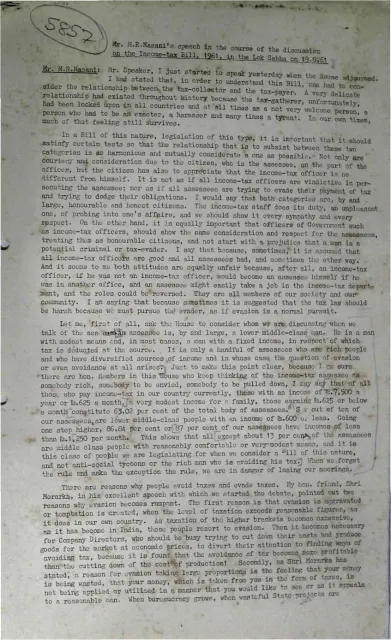
Summary
In this nine-page Lok Sabha speech on the Income-tax Bill, 1961, M. R. Masani argues that taxation must preserve a respectful, reciprocal relationship between the tax officer and the taxpayer. He emphasizes that most assessees are modest-income, lower-middle-class citizens rather than wealthy evaders, and warns that excessive rates, bureaucratic waste, and an overly complex law encourage evasion. He supports making the Bill simpler and clearer while acknowledging improvements introduced by the Select Committee, including limited tax relief for gratuities and creative professionals.
Masani then turns to provisions he considers departures from established legal and economic principles. He attacks clause 179 for weakening limited liability and imposing a quasi-criminal, potentially retrospective burden on company directors; he argues that this threatens confidence in private enterprise and violates the presumption of innocence. He similarly criticizes clause 79 for disregarding the separate legal personality of corporations. In the discussion of charitable institutions, he opposes tax discrimination based on caste, community, religion, race, or language, insisting that legislation cannot manufacture nationalism through coercion and that charity should be universal rather than narrowly communal.
Finally, Masani objects to a proposed amendment delaying interest on income-tax refunds when an assessee has mixed sources of income. He argues that this would allow the department to retain citizens’ money indefinitely and would penalize ordinary taxpayers for administrative delays. The speech closes with his broader demand that tax administration be simple, prompt, legally fair, and compatible with economic confidence and individual rights.
Key points
- Masani calls for courtesy and mutual respect between income-tax officers and assessees.
- He stresses that the typical assessee is a modest-income, lower-middle-class citizen, not a wealthy tax evader.
- He links tax evasion to excessive taxation, wasteful public expenditure, and the complexity of the tax law.
- He supports simplifying the Bill and welcomes limited improvements made by the Select Committee.
- He opposes clause 179 as an attack on limited liability, the presumption of innocence, and confidence in private enterprise.
- He argues that charitable deductions should not discriminate on grounds of religion, caste, race, or language.
- He objects to delaying interest on tax refunds, especially for ordinary taxpayers dependent on timely repayment.
Metadata and summary are AI-extracted from the source PDF and reviewed for editorial accuracy. The original work is available via the Read PDF tab above (where present); paragraph-level citation inside the PDF is deferred to a future engagement.
People in this work
Related across the archive
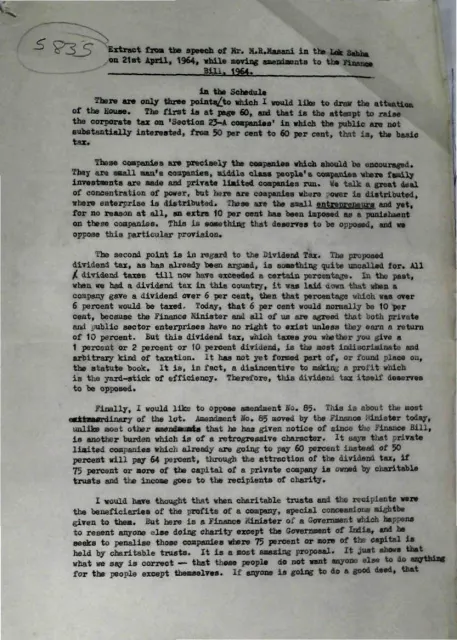 Primary workExtract from the speech of Mr. M.R.Masani in the Lok Sabha on 21st April, 1964, while moving amendments to the Finance Bill, 1964.
 Primary workINCOME-TAX BILL PENALISES HONEST TAX-PAYERS
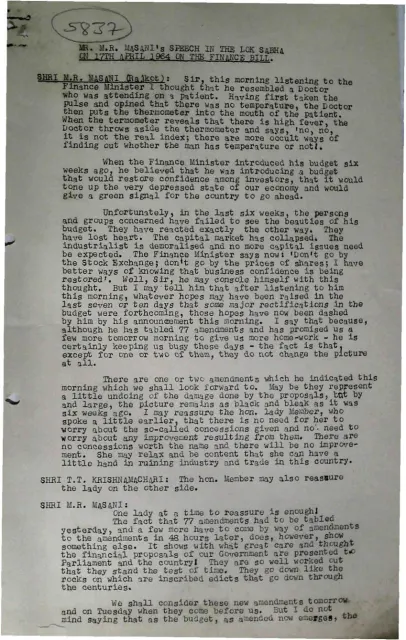 Primary workMR. M.R. MASANI's SPEECH IN THE LOK SABHA ON 17TH APRIL 1964 ON THE FINANCE BILL.
 ExcerptCrushing Burden of Taxation - Nani Palkhivala
 ExcerptThe Budget Versus The People