
speech
Extract from the speech of Mr. M.R.Masani in the Lok Sabha on 21st April, 1964, while moving amendments to the Finance Bill, 1964.
1964
2 pages
Summary
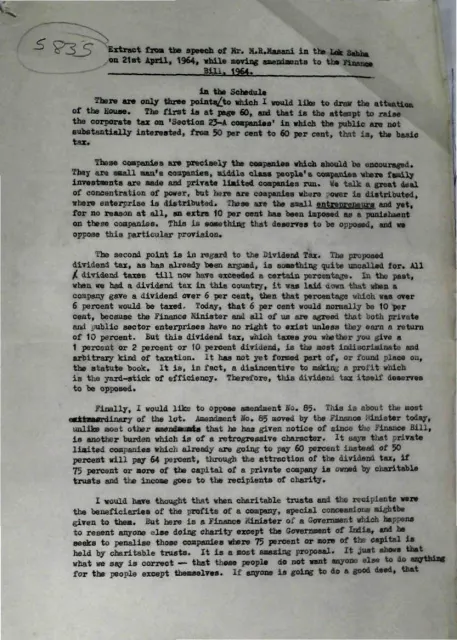
In this extract from his 21 April 1964 Lok Sabha speech, M. R. Masani urges the House to reject three Finance Bill provisions. He objects first to raising the corporation tax on “Section 23-A companies” from 50 to 60 per cent, arguing that these are small, middle-class-owned companies in which ownership and enterprise are more widely distributed. In his view, the additional levy discourages precisely the forms of private investment that should be encouraged.
Masani also attacks the proposed dividend tax as indiscriminate and arbitrary, claiming that it penalises companies regardless of the size of their dividend and undermines the use of profits as a measure of efficiency. Finally, he opposes Amendment No. 85, which would raise the effective tax on private limited companies substantially when charitable trusts hold at least 75 per cent of their capital. He argues that the amendment penalises both charitable and non-charitable shareholders, strikes at private charity, and expands the government’s monopoly over social provision.
Key points
- Masani opposes raising corporation tax on Section 23-A companies from 50 to 60 per cent.
- He presents these companies as small or middle-class-owned enterprises with dispersed ownership and enterprise.
- He characterises the proposed dividend tax as indiscriminate, arbitrary, and a disincentive to profitable operation.
- He argues that a 10 per cent return should be the relevant efficiency benchmark for private and public-sector enterprises.
- He opposes Amendment No. 85 because it would increase the tax burden on companies substantially owned by charitable trusts.
- He argues that the amendment penalises both charitable and non-charitable interests and encroaches on private charity.
Metadata and summary are AI-extracted from the source PDF and reviewed for editorial accuracy. The original work is available via the Read PDF tab above (where present); paragraph-level citation inside the PDF is deferred to a future engagement.
Related across the archive
 Primary workMr. M. R. Masani's speech in the Lok Sabha on 22.4.64 in the course of the discussion on Companies (Profits) Surtax Bill, 1964
 Primary workMr. M. R. Masani's speech in the Lok Sabha on December 4, 1963
 Primary workMr. M.R.Masani's speech in the course of the discussion on the Income-tax Bill, 1961, in the Lok Sabha on 19.8.61
 ExcerptThe Budget Versus The People
 ExcerptThe Liberal Budget: Building an Equitable Society