
speech
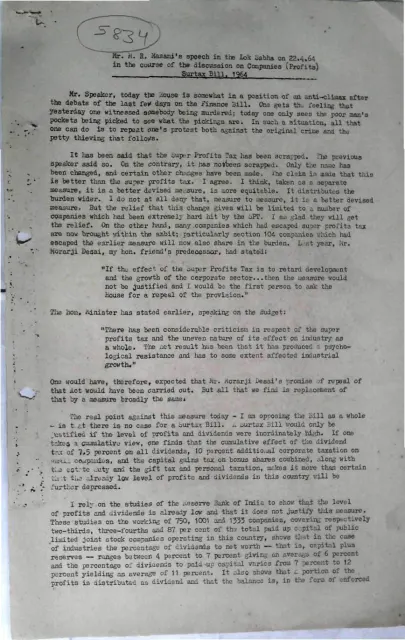
Mr. M. R. Masani's speech in the Lok Sabha on 22.4.64 in the course of the discussion on Companies (Profits) Surtax Bill, 1964
1964
4 pages
Summary
In this four-page Lok Sabha speech delivered on 22 April 1964, M. R. Masani opposes the Companies (Profits) Surtax Bill, arguing that it is essentially a renamed and slightly redesigned version of the Super Profits Tax rather than a genuine repeal. He accepts that the revised measure may distribute the burden more equitably and relieve companies previously hit hard by the earlier tax, but objects that companies that escaped the earlier tax will now be brought within its scope. His central economic objection is that existing profit and dividend levels are already modest and that the combined burden of dividend tax, additional corporation tax, capital-gains taxation, gift tax, and personal taxation will further depress investment and industrial growth.
Masani cites Reserve Bank studies of companies to argue that dividend rates and retained earnings do not justify the proposed measure, and warns that taxing productive capital amounts to “industrial conscription.” He broadens the attack to the Budget and the Planning Commission’s growth targets, portraying the government’s policy as treatment for high blood pressure imposed on an economy suffering from low blood pressure. In the final pages, he criticizes sections of Indian business for pursuing short-term interests and supporting the government, while insisting that capital formation and increased productivity are necessary alternatives to communist dictatorship. The speech closes by presenting the parliamentary debate as an educational moment that may make citizens and business leaders more aware of their civic responsibilities.
Key points
- Masani argues that the Companies (Profits) Surtax Bill is substantially a renamed successor to the Super Profits Tax.
- He accepts that the revised tax may be more equitably designed and may relieve companies that were heavily burdened by the earlier measure.
- He contends that dividends and profits in India are already too low to justify additional taxation.
- Reserve Bank studies are cited to show dividend rates, retained earnings, and internal company resources supporting investment and growth.
- Masani criticizes the Budget as an attempt at industrial conscription and warns against policies that deplete productive capital.
- He attacks the Planning Commission’s growth ambitions as inconsistent with the government’s economic record.
- He criticizes business leaders who support government policy for short-term advantage while neglecting their civic and national responsibilities.
Metadata and summary are AI-extracted from the source PDF and reviewed for editorial accuracy. The original work is available via the Read PDF tab above (where present); paragraph-level citation inside the PDF is deferred to a future engagement.
Related across the archive
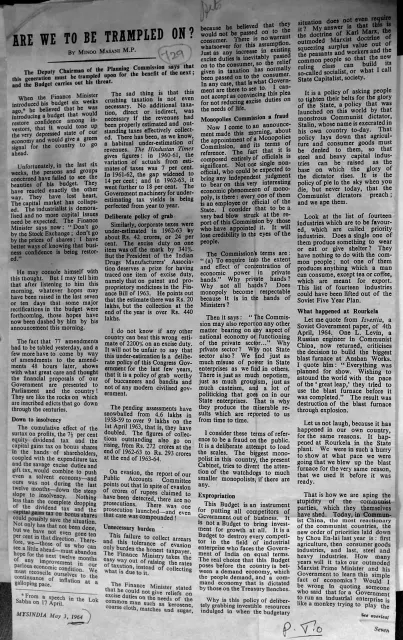 Primary workARE WE TO BE TRAMPLED ON?
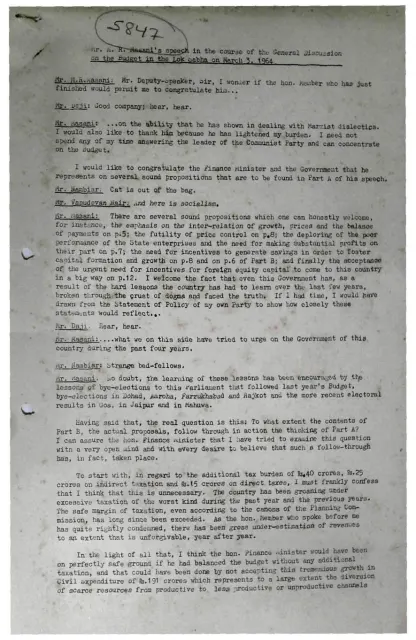 Primary workMr. M. R. Masani's speech in the course of the General discussion on the Budget in the Lok Sabha on March 3, 1964
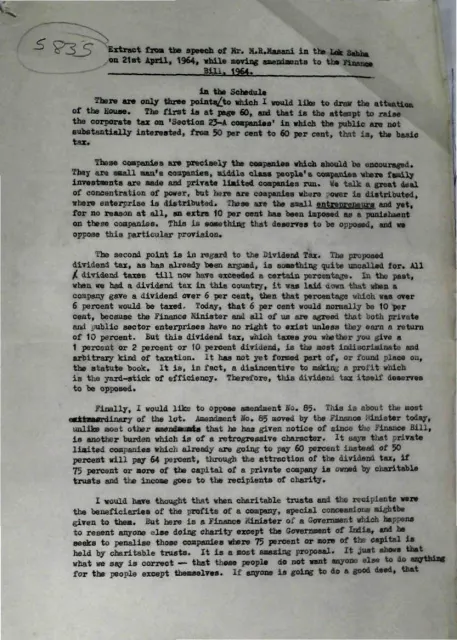 Primary workExtract from the speech of Mr. M.R.Masani in the Lok Sabha on 21st April, 1964, while moving amendments to the Finance Bill, 1964.
 ExcerptThe Budget Versus The People
 ExcerptThe Liberal Budget: Building an Equitable Society