
speech · parliamentary
Mr. M. R. Masani's speech in the course of the General discussion on the Budget in the Lok Sabha on March 3, 1964
By Minoo Masani
1964
10 pages
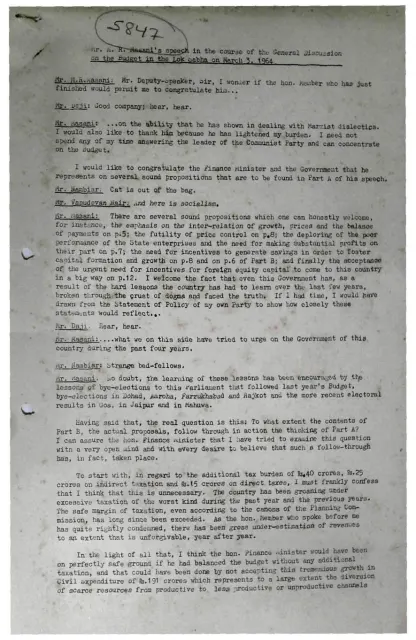
Summary
In this speech delivered during the Lok Sabha’s general discussion of the Budget on 3 March 1964, Minoo Masani welcomes several stated government objectives—especially incentives for savings, capital formation, growth, and foreign equity—but argues that the budget’s detailed measures fail to follow through on those principles. He criticises the additional Rs.40 crore tax burden, saying indirect taxes will fall disproportionately on poor rural consumers, while direct-tax proposals and compulsory or annuity deposits will discourage investment and capital formation. He acknowledges limited relief for fixed-income taxpayers below Rs.15,000 annually, but regards it as inadequate and illusory for those above that threshold.
Masani’s central criticism is directed at the budget’s treatment of enterprise and capital. He attacks the wealth, expenditure, estate, gift, capital-gains, dividend, and surtax proposals as disincentives to saving, equity finance, and business expansion, and warns that tax secrecy reforms could facilitate blackmail and corruption. He supports an inquiry into monopoly and concentration, but insists that it cover public as well as private monopolies and operate without arbitrary industrial discrimination. The speech closes by arguing that the budget will not promote industrial or agricultural growth, will intensify inflation by favouring capital-intensive projects over labour-intensive employment, and neglects the poorest and weakest members of the population.
Key points
- Masani welcomes the budget’s stated commitment to growth, savings, capital formation, and foreign equity, but finds a sharp contradiction between its principles and its operative proposals.
- He opposes the additional Rs.25 crore of indirect taxation, arguing that it burdens basic necessities consumed disproportionately by poor rural households.
- He considers relief for taxpayers with incomes below Rs.15,000 useful but insufficient, and says the annuity deposit scheme merely postpones taxation while tying up investible funds.
- He criticises wealth, expenditure, estate, gift, capital-gains, dividend, and surtax measures as punitive and likely to discourage capital formation.
- He argues that dividend taxation, development-rebate uncertainty, and excessive corporate taxation will reduce equity finance and encourage borrowing or concealment of wealth.
- Masani supports investigating monopoly and concentration, but says the inquiry must include state enterprises and avoid arbitrary selection of favoured industries.
- He concludes that the budget does little for industrial or agricultural growth and risks worsening inflation by sustaining unproductive civil expenditure and favouring capital-intensive activity.
- He frames the poorest and weakest citizens as the budget’s neglected constituency.
Metadata and summary are AI-extracted from the source PDF and reviewed for editorial accuracy. The original work is available via the Read PDF tab above (where present); paragraph-level citation inside the PDF is deferred to a future engagement.
People in this work
Related across the archive
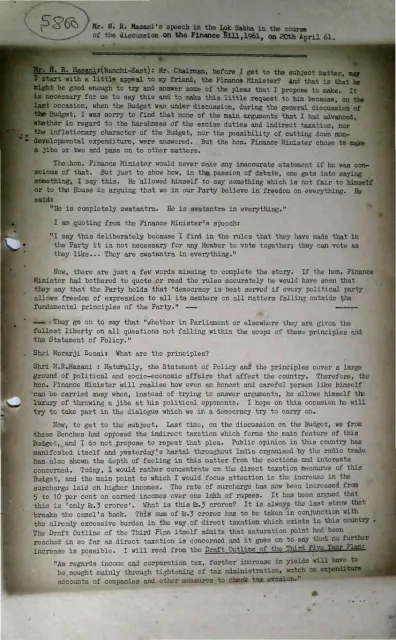 Primary workMr. M. R. Masani's speech in the Lok Sabha in the course of the discussion on the Finance Bill, 1961, on 20th April 61.
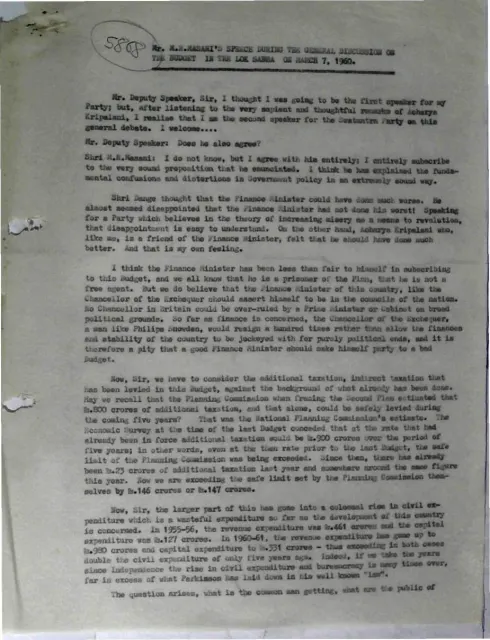 Primary workMr. M.R. MASANI'S SPEECH DURING THE GENERAL DISCUSSION ON THE BUDGET IN THE LOK SABHA ON MARCH 7, 1960.
 Primary workThe Missed Opportunity
 ExcerptThe Budget Versus The People
 ExcerptCrushing Burden of Taxation - Nani Palkhivala