
speech · parliamentary
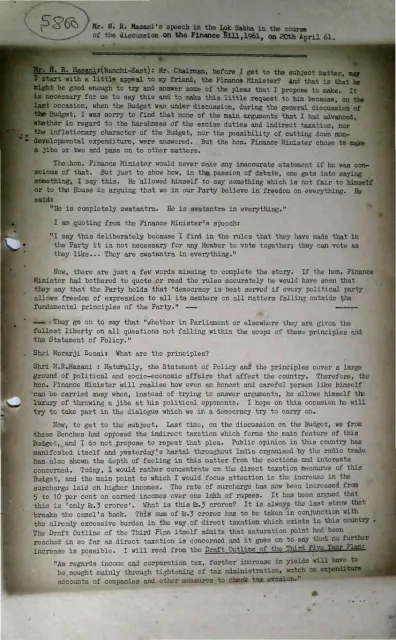
Mr. M. R. Masani's speech in the Lok Sabha in the course of the discussion on the Finance Bill, 1961, on 20th April 61.
By Minoo Masani
1961
14 pages
Summary
This compilation contains two Lok Sabha speeches by Minoo Masani on the Finance Bill, 1961: one delivered on 20 April and a separately headed speech delivered on 15 March. Across both speeches, Masani argues that India’s tax burden is already excessive and that the Budget’s direct and indirect taxation will discourage saving, investment, industrial growth, and individual initiative. He challenges the Finance Minister’s presentation of the Swatantra Party’s commitment to freedom, insisting that party members are free to dissent outside its fundamental principles and Statement of Policy.
Masani’s economic case rests on the importance of private profit and capital formation. He cites figures on declining industrial profitability and stagnant savings, contrasts India’s progressive taxation with Britain’s relief for earners, and argues that fiscal policy should leave resources with citizens rather than divert them into inefficient public projects. In the second speech, he extends this critique to inflation, rising civil expenditure, state-sector projects, nuclear power, and defence priorities, while proposing reduced civil expenditure, labour-intensive development, lower taxation, more efficient tax collection, less state capital outlay, and greater reliance on foreign equity rather than foreign loans. He closes by arguing that the Budget lacks a current democratic mandate and that voters may reject its underlying planning policies at the next election.
Key points
- Masani criticises the Finance Bill’s higher surcharge and indirect taxes as burdens on earners, consumers, small producers, and the poor.
- He argues that private saving, profit, and capital accumulation are indispensable to India’s economic development.
- He uses figures from the National Council of Applied Economic Research and other reports to claim that industrial growth, profitability, and savings have weakened.
- He presents economic liberty and consumer choice as an alternative to state-directed production and socialist planning.
- He argues that inflation results from monetary and financial policies, and that it harms investment, saving, production, and exports.
- He criticises inefficient state enterprises, excessive civil expenditure, uneconomic development projects, steel plants, and premature nuclear-power investment.
- He proposes expenditure reductions, more efficient tax collection, lower taxation, private-sector-led development, and foreign equity rather than foreign loans.
- He claims that the government’s additional taxation has exceeded the mandate presented to voters and that Parliament has become a ‘lame duck’ Parliament.
Metadata and summary are AI-extracted from the source PDF and reviewed for editorial accuracy. The original work is available via the Read PDF tab above (where present); paragraph-level citation inside the PDF is deferred to a future engagement.
People in this work
Related across the archive
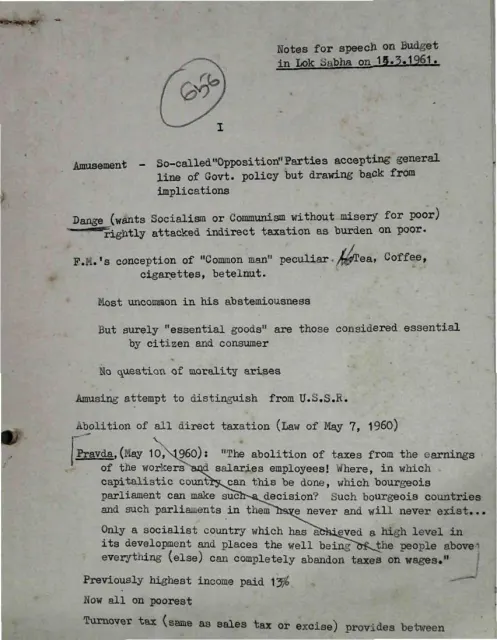 Primary workNotes for speech on Budget in Lok Sabha on 15.3.1961.
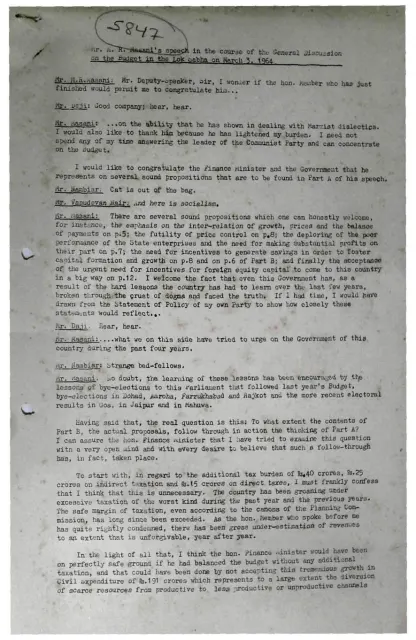 Primary workMr. M. R. Masani's speech in the course of the General discussion on the Budget in the Lok Sabha on March 3, 1964
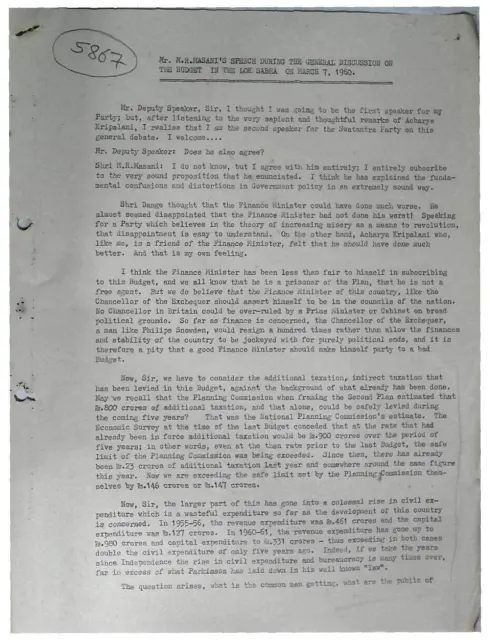 Primary workMR. M.R. MASANI'S SPEECH DURING THE GENERAL DISCUSSION ON THE BUDGET IN THE LOK SABHA ON MARCH 7, 1960.
 ExcerptThe Budget Versus The People
 ExcerptThe Liberal Budget: Building an Equitable Society