
speech · parliamentary
MR. M.R. MASANI'S SPEECH DURING THE GENERAL DISCUSSION ON THE BUDGET IN THE LOK SABHA ON MARCH 7, 1960.
By Minoo Masani
1960
7 pages
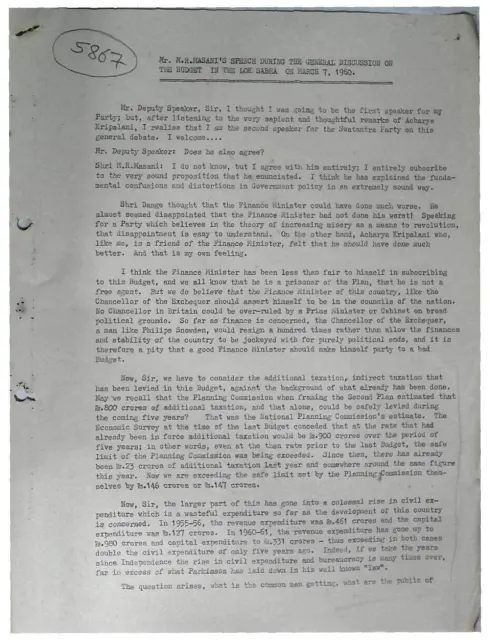
Summary
In this speech during the Lok Sabha’s general discussion on the 1960 Budget, M. R. Masani argues that taxation, planning, and public expenditure are imposing rising burdens on the Indian public without producing commensurate gains. He criticizes the Finance Minister for being “a prisoner of the Plan,” points to the rapid growth of civil expenditure, and contrasts the rise in per-capita income with substantially higher price increases. Masani attributes these failures to forced industrialisation on the Soviet pattern, expansion of the State sector, and inadequate public information about the returns from State enterprises.
Key points
- Masani argues that additional taxation has exceeded the limits anticipated by the Planning Commission and is contributing to inflation.
- He distinguishes excise duty from a sales tax, presenting excise as a tax on production that burdens both producers and consumers.
- He contends that indirect taxation is regressive, particularly when imposed on industrial raw materials and essential goods.
- He warns that the Budget will produce cumulative inflation and reduce the purchasing power of ordinary people.
- He criticizes the neglect of agriculture, arguing that agricultural growth has lagged behind growth in national income.
- He calls for substantially greater capital investment in agriculture during the Third Five Year Plan.
- He opposes the concentration of resources on giant steel plants and heavy industrialisation at the expense of agriculture and transport.
- He concludes that economic forces will eventually compel the government to reverse its current policies, but urges it to change course before further public suffering.
Metadata and summary are AI-extracted from the source PDF and reviewed for editorial accuracy. The original work is available via the Read PDF tab above (where present); paragraph-level citation inside the PDF is deferred to a future engagement.
People in this work
Related across the archive
 Primary workMr. M.R. MASANI'S SPEECH DURING THE GENERAL DISCUSSION ON THE BUDGET IN THE LOK SABHA ON MARCH 7, 1960.
 Primary workMr. M. R. Masani's speech in the Lok Sabha in the course of the discussion on the Finance Bill, 1961, on 20th April 61.
 Primary workNotes for speech on Budget in Lok Sabha on 15.3.1961.
 ExcerptFifteen Years of Indian Planning
 ExcerptThe Budget Versus The People