speech
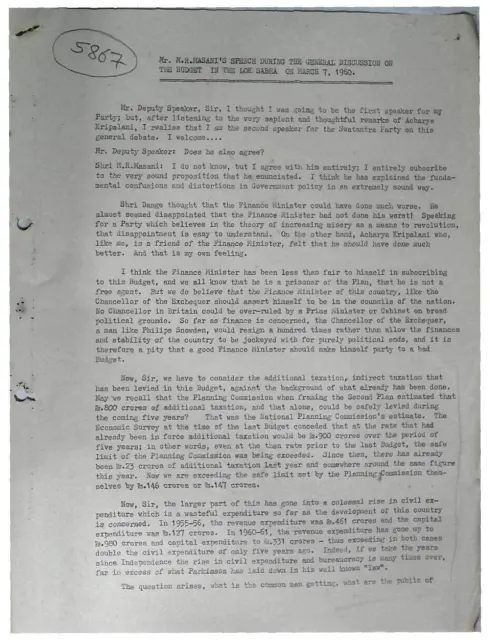
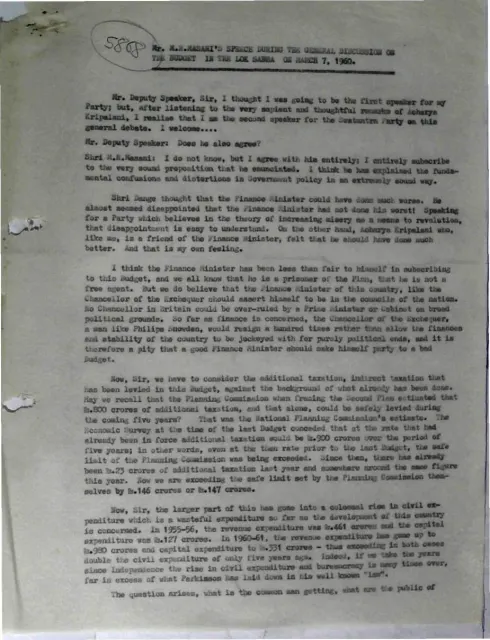
Mr. M.R. MASANI'S SPEECH DURING THE GENERAL DISCUSSION ON THE BUDGET IN THE LOK SABHA ON MARCH 7, 1960.
By Minoo Masani
1960
7 pages
Summary
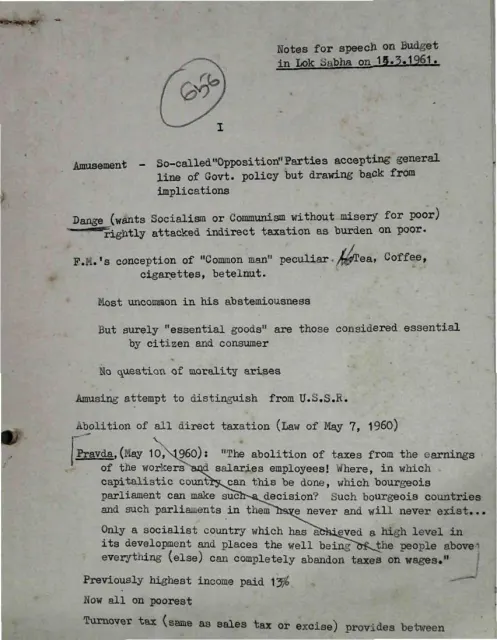
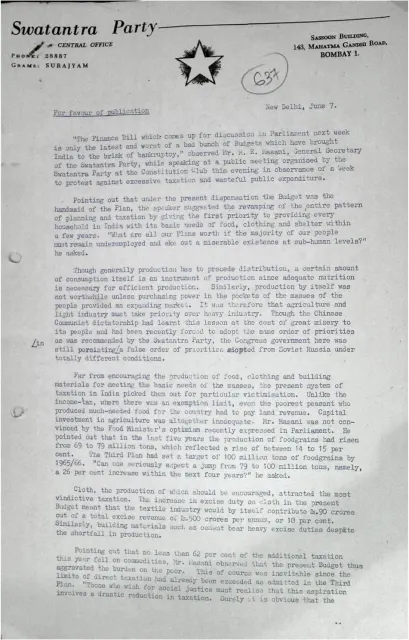
In this seven-page Lok Sabha speech delivered on 7 March 1960, M. R. Masani criticizes the Union budget as subordinate to the Planning Commission and its commitment to rapid industrialization. He argues that additional taxation has exceeded earlier planning estimates, while civil and capital expenditure have expanded sharply. The resulting burden, he contends, falls disproportionately on ordinary people through taxation and inflation, with indirect taxes particularly harmful to poorer households.
Masani also attacks the expansion of the state sector and the lack of public information about state enterprises. He argues that excise duties function as taxes on production as well as consumption, raising industrial costs and prices. The speech links inflation to the neglect of agriculture: agricultural production is growing more slowly than national income, while food prices rise. Drawing on Professor Arthur Lewis’s estimates, Masani argues that substantially greater capital investment in agriculture is required. He concludes by urging a choice between restoring agriculture and pursuing heavy industrialization, and criticizes excessive taxation of road transport and resistance to technological change.
Key points
- Masani presents the budget as a prisoner of the Planning Commission and its industrialization strategy.
- He argues that additional taxation has exceeded earlier estimates and provides little return to taxpayers.
- Indirect taxation and inflation are described as regressive burdens that fall especially heavily on poorer people.
- Excise duties are characterized as taxes on production that also raise consumer prices and discourage industrial activity.
- Masani criticizes the state sector for being unaccountable, unprofitable, and insufficiently transparent.
- He argues that agricultural production is lagging behind national-income growth and is contributing to inflationary pressure.
- The speech calls for substantially greater investment in agriculture and questions the priority given to heavy industrialization.
- Masani concludes by criticizing the taxation of road transport and the government’s resistance to diesel and other technological changes.
Metadata and summary are AI-extracted from the source PDF and reviewed for editorial accuracy. The original work is available via the Read PDF tab above (where present); paragraph-level citation inside the PDF is deferred to a future engagement.