speech · parliamentary
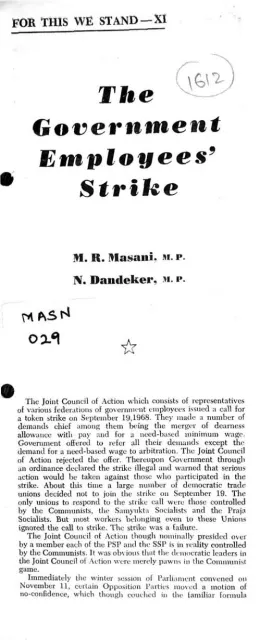
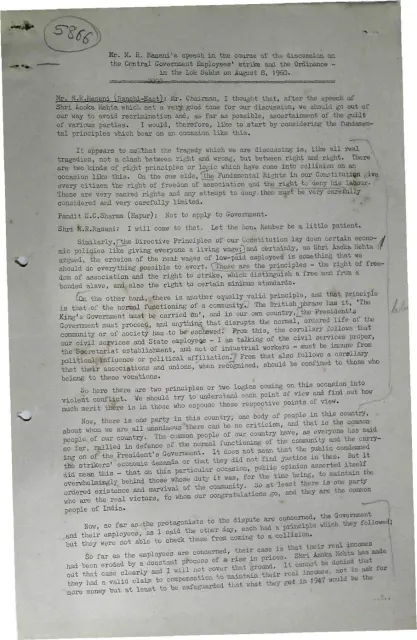
Mr. M. R. Masani's speech in the course of the discussion on the Central Government Employees' strike and the Ordinance - in the Lok Sabha on August 8, 1960.
By Minoo Masani
1960
4 pages
Summary
In this speech delivered in the Lok Sabha on 8 August 1960, Minoo Masani presents the dispute over the Central Government employees’ strike and the subsequent Ordinance as a conflict between two legitimate principles rather than a simple contest between right and wrong. He sets constitutional freedom of association and the right to strike against the requirement that government services maintain the orderly functioning of the community. Masani argues that civil servants must remain insulated from political affiliation, while their unions should be confined to those who actually belong to the relevant services.
Masani attributes the employees’ economic grievance to inflation produced by government planning, excessive taxation, and neglect of ordinary consumption needs in favour of capital-intensive projects. He maintains that the Government bears responsibility for the growth of a large class of underpaid and underworked civil servants, but distinguishes the Pay Commission’s advisory role from that of a binding judicial tribunal. Although he accepts the employees’ claims in principle, he argues that the strike became unjustified after concessions, partial de-neutralisation of wages, and agreement to arbitration had been offered.
The speech ultimately defends the rule of law while criticising both the Government’s earlier refusal to provide arbitration and the strikers’ failure to call off their action. Masani opposes a general ban on strikes, proposing instead limited restrictions for essential services and proper civil servants, together with compulsory or agreed arbitration. He closes by calling for a conciliatory rather than vindictive response and for legislation that distinguishes among different categories of government employees.
Key points
- The strike is framed as a collision between freedom of association and the need for orderly government functioning.
- Masani links the employees’ loss of real income to inflation arising from government planning and fiscal policy.
- He accepts that the employees had a principled claim to compensation and protection of their real wages.
- The Government is held responsible for the expansion of an underpaid and underworked civil-service bureaucracy.
- The Pay Commission is described as an advisory body charged with reconciling justice for employees with wider political and economic constraints.
- Masani argues that the strike became unjustified after concessions and arbitration had been offered.
- He supports restricting strikes only in essential services and among civil servants, not imposing a universal ban.
- The proposed remedy is arbitration, legal procedures, differentiated treatment of government employees, and a non-vindictive political settlement.
Metadata and summary are AI-extracted from the source PDF and reviewed for editorial accuracy. The original work is available via the Read PDF tab above (where present); paragraph-level citation inside the PDF is deferred to a future engagement.