
pamphlet
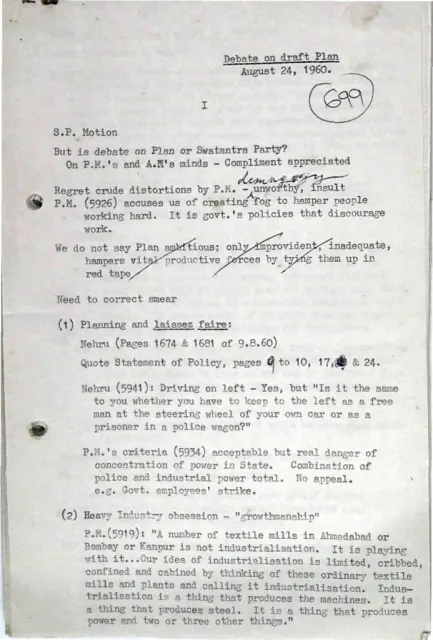
Debate on draft Plan
1960
29 pages
Summary
In the rendered pages, this undated-author memorandum dated August 24, 1960 argues against the Third Plan as an example of centralized, capital-intensive development. It challenges the Planning Commission’s estimates of savings, foreign aid, national-income growth, and industrial output, while criticizing the diversion of public resources toward steel and other heavy industries at the expense of agriculture, lighter industry, and private enterprise. The memorandum presents monetary stability, production-oriented investment, reduced disparities, and the expansion of employment as alternatives to state-led planning.
In the rendered pages, the discussion broadens from planning to cooperation, democracy, inflation, foreign exchange, and civil liberties. It argues that deliberate inflation erodes savings, redistributes wealth toward speculators and politically connected beneficiaries, and invites controls that weaken democratic freedom and private choice. The memorandum concludes that the Third Plan should be rejected. The final rendered pages contain a separate memorandum on the August 1960 Central Government employees’ strike, which defends freedom of association and the right to strike while also criticizing strike leaders for rejecting compromise and the government for failing to submit the dispute to impartial adjudication.
Key points
- The memorandum disputes the government’s claim that the Third Plan is ambitious but viable, arguing instead that its estimates and priorities are unsound.
- It criticizes heavy-industry investment, especially a proposed fourth steel plant, as capital-intensive, employment-poor, premature, and insufficiently related to export demand.
- It advocates directing capital toward agriculture and lighter industries, alongside monetary stability, private enterprise, employment expansion, and reduction of disparities.
- It argues that inflation is an outcome of unscientific planning and functions as a concealed levy on citizens, particularly people on fixed incomes and savers.
- The memorandum links inflation and expanding state controls to bureaucratic centralization, weakened democracy, and the erosion of personal and economic freedoms.
- It opposes dependence on government-to-government loans and favors foreign equity investment, which it presents as sharing risk with the investor rather than placing repayment obligations on the country.
- The separate strike memorandum frames the dispute as a conflict between two legitimate principles: workers’ freedom of association and the need for the normal life of the community to continue.
- The strike memorandum criticizes both the government’s treatment of employees and the unions’ refusal to accept compromise or arbitration.
Metadata and summary are AI-extracted from the source PDF and reviewed for editorial accuracy. The original work is available via the Read PDF tab above (where present); paragraph-level citation inside the PDF is deferred to a future engagement.
Related across the archive
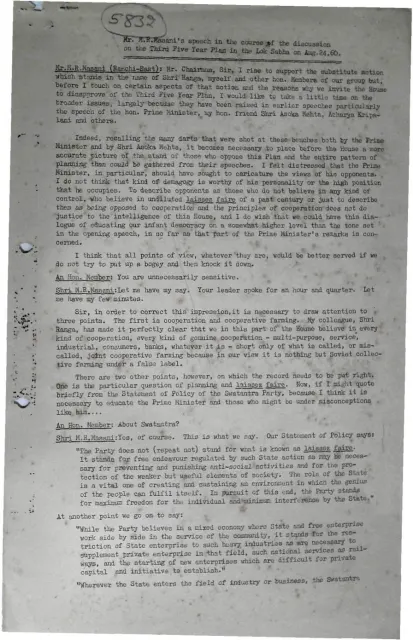 Primary workMr. M.R.Masani's speech in the course of the discussion on the Third Five Year Plan in the Lok Sabha on Aug.24,60.
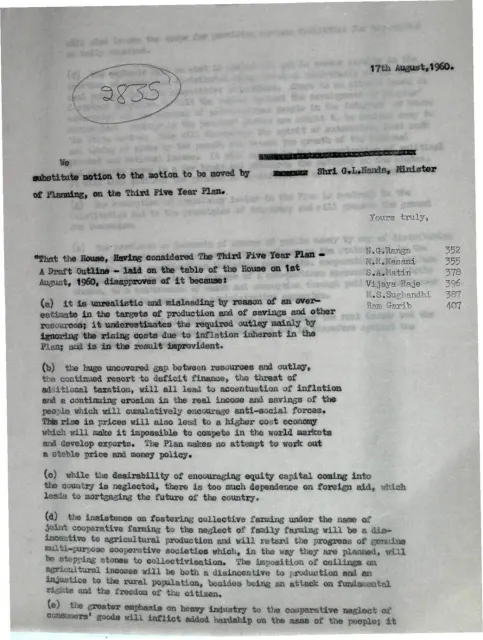 Primary workSubstitute Motion to the Motion to be Moved by of Planning
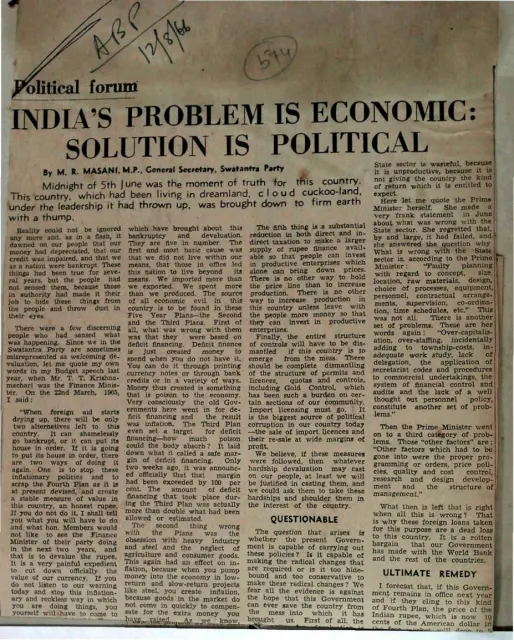 Primary workINDIA'S PROBLEM IS ECONOMIC: SOLUTION IS POLITICAL
 ExcerptFifteen Years of Indian Planning
 ThePrintSocialist planners aggravated unemployment problem