speech · convention address
SWATANTRA IN THE FUTURE
Achievements & Aspirations
New Delhi · 1967
8 pages
Summary
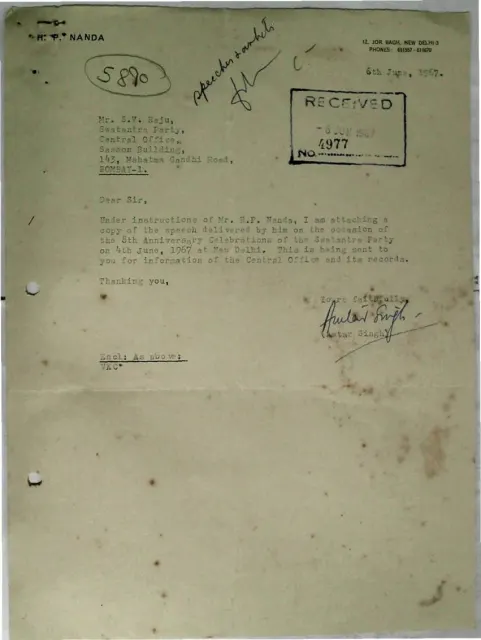
“Swatantra in the Future: Achievements & Aspirations” is the text of H. P. Nanda’s address to the Swatantra Party’s eighth-anniversary celebrations, delivered at Sapru House, New Delhi, on 4 June 1967. Nanda presents the anniversary as an occasion for stock-taking rather than sentiment, recounting the party’s emergence under C. Rajagopalachari (Rajaji) in opposition to Congress dominance, socialist rhetoric, and what he calls the “steam roller” methods of Congress leadership. He credits Swatantra with restoring political sanity, defending national traditions, and challenging the idea of the state as a disguised welfare-state authority.
Key points
- Nanda frames the eighth anniversary as an opportunity for introspection and assessment of Swatantra’s achievements and future aspirations.
- The speech attributes Swatantra’s formation to widespread disillusionment with Congress incompetence, socialist slogans, and centralized political leadership.
- Nanda interprets the 1967 election results as a popular rejection of Congress policies, including the licence-permit system and failures in foreign relations.
- The speech argues that political independence is incomplete without economic and individual freedom, and warns against expanding statism and state coercion.
- Nanda describes India’s economic condition as alarming, citing stagnating industrial production, inflation, food insecurity, weak investment, and administrative paralysis.
- Swatantra’s immediate political task is presented as removing Congress from office and preparing to participate in a democratic coalition government.
- The proposed “Friends of the Farmer” or “Shanti-Dal for Kisan” movement would help farmers obtain agricultural inputs at fair prices and oppose hoarding and excessive food prices.
- The speech concludes by identifying Swatantra’s future with prosperity, freedom from state controls, and fidelity to its founding principles.
Metadata and summary are AI-extracted from the source PDF and reviewed for editorial accuracy. The original work is available via the Read PDF tab above (where present); paragraph-level citation inside the PDF is deferred to a future engagement.