speech
India's Neglected Backyard
Bombay · 1965
12 pages
Summary
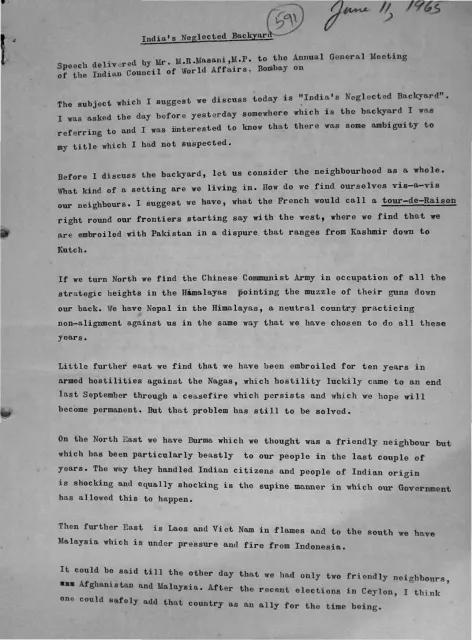
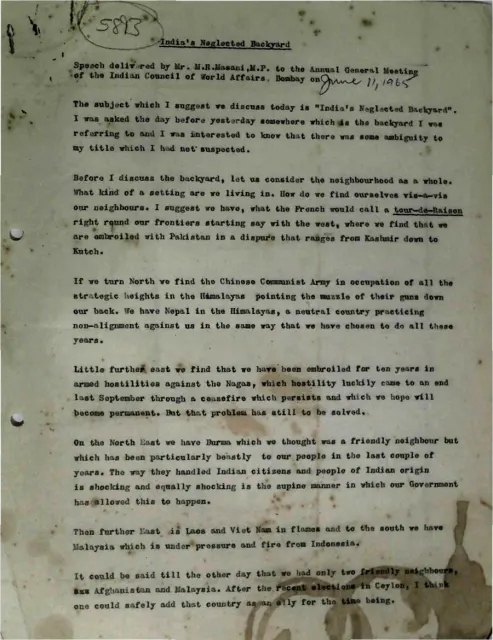
In this speech, delivered by M. R. Masani to the Annual General Meeting of the Indian Council of World Affairs in Bombay, the speaker argues that India has neglected its South-East Asian “backyard” while concentrating on threats along its Himalayan frontier. He surveys India’s difficult relations with Pakistan, China, Nepal, Burma, Laos, Vietnam, Malaysia, and Indonesia, contrasting India’s limited regional engagement with what he presents as the expanding communist influence of China and the Soviet Union. The speech particularly criticizes India’s failure to build a regional security relationship with the countries of South-East Asia, recalling a 1961 report by Jayaprakash Narayan and Samar Guha that urged India to treat the region as part of its own strategic frontier.
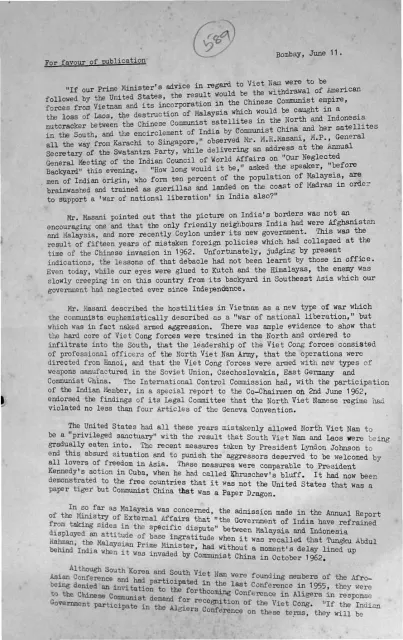
Masani then turns to Laos and Vietnam, presenting the Geneva agreements and the communist advances in both countries as evidence that neutrality has been exploited by communist forces. He characterizes the Vietnam conflict as an international war directed from North Vietnam rather than a purely civil or national-liberation struggle, citing the International Control Commission’s findings on the movement of personnel, weapons, and supplies from north to south. He praises President Lyndon Johnson’s decision to abandon the “privileged sanctuary” principle and escalate American action, while condemning the Indian government’s calls for negotiations and for stopping the bombing of North Vietnam. The closing pages warn that a communist victory in Vietnam and the occupation of Malaysia would expose India to encirclement, and conclude that India’s foreign policy should support, rather than undermine, states resisting communist expansion.
Key points
- Masani frames South-East Asia as India’s neglected strategic backyard and argues that India has focused too narrowly on the Himalayas.
- The speech surveys regional conflicts involving Pakistan, China, Nepal, Burma, Laos, Vietnam, Malaysia, and Indonesia.
- A 1961 report by Jayaprakash Narayan and Samar Guha is invoked to criticize India’s failure to cultivate South-East Asian neighbours.
- The Geneva agreements on Vietnam and Laos are presented as having been violated by communist forces.
- Masani rejects the description of the Vietnam conflict as a merely domestic civil war and emphasizes direction and support from North Vietnam and communist powers.
- The speech cites the International Control Commission’s findings as evidence of the movement of troops, weapons, and supplies into South Vietnam.
- Masani supports Lyndon Johnson’s more forceful policy in Vietnam and criticizes Indian neutrality and negotiation proposals.
- The conclusion links the fate of Malaysia and Vietnam to India’s own security and calls for a more strategically realistic foreign policy.
Metadata and summary are AI-extracted from the source PDF and reviewed for editorial accuracy. The original work is available via the Read PDF tab above (where present); paragraph-level citation inside the PDF is deferred to a future engagement.