Summary
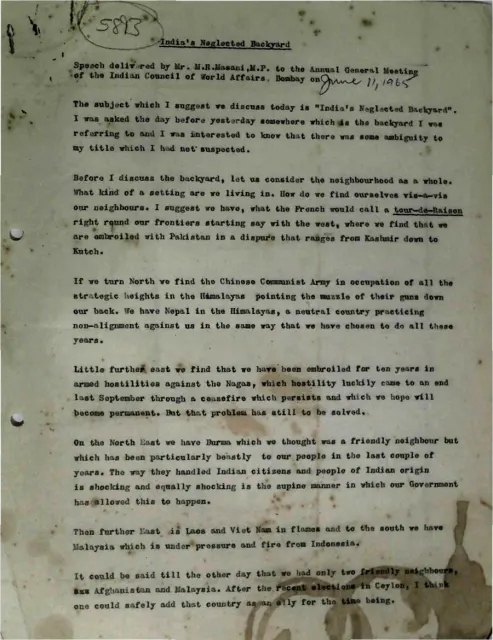
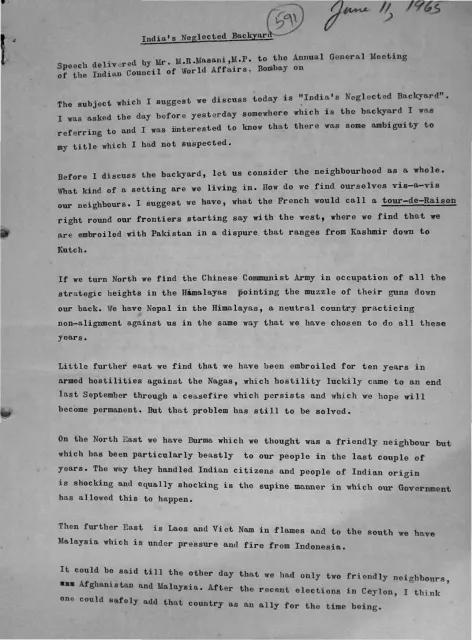
In this speech delivered in Bombay on 11 June 1965, M. R. Masani argues that India’s strategic attention is fixed on its northern and western frontiers while its “backyard”—South-East Asia—is being neglected. He surveys India’s strained relations with Pakistan, China, Nepal, the Naga movement, Burma, Laos, Vietnam, Malaysia, and Indonesia, and contends that India has failed to cultivate regional friendships or recognize the interconnectedness of Asian security. Drawing on a 1961 report by Samar Guha commissioned by Jayaprakash Narayan, Masani presents South-East Asian governments as having sought greater Indian leadership and regional cooperation.
Key points
- Masani frames South-East Asia as India’s neglected strategic backyard and links regional conflicts to India’s own security.
- He criticizes Indian foreign policy for excessive neutrality and insufficient support for friendly states, especially Malaysia.
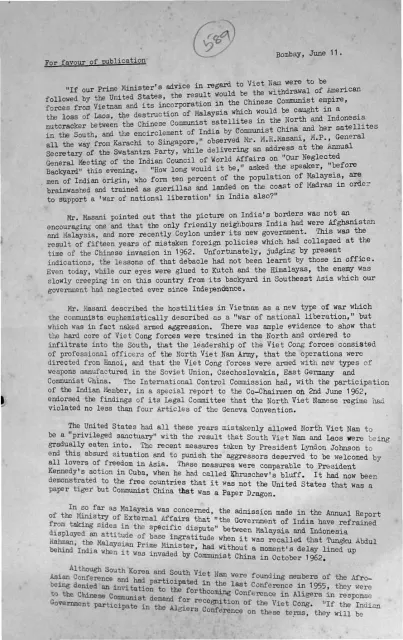
- He portrays the wars in Vietnam and Laos as communist-backed international aggression rather than merely civil conflicts.
- He cites the International Control Commission’s findings that North Vietnam supplied personnel and material to hostile forces in South Vietnam.
- He argues that India’s calls for unconditional negotiations and a halt to American bombing undermine the containment of communist expansion.
- He warns that communist domination of Vietnam, Laos, and Malaysia would bring Chinese power closer to India and expose its eastern and southern approaches.
- The speech concludes that effective international influence requires a country to support its advice with material resources rather than offer advice while refusing strategic commitments.
Metadata and summary are AI-extracted from the source PDF and reviewed for editorial accuracy. The original work is available via the Read PDF tab above (where present); paragraph-level citation inside the PDF is deferred to a future engagement.