Summary
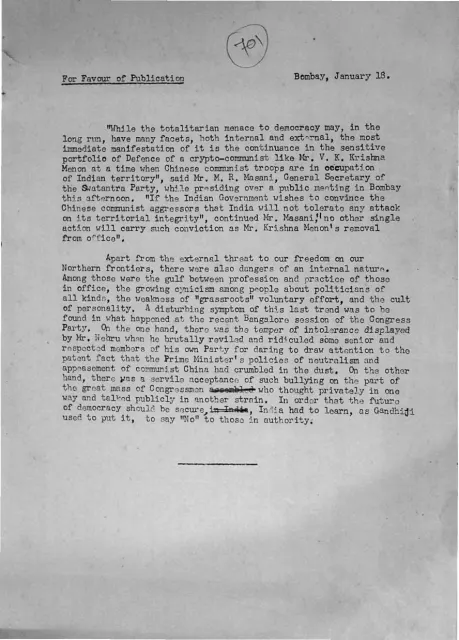
In this three-page essay, M. R. Masani argues that a democratic state depends on a free press to connect the people, political parties, and governmental authority. He contrasts democratic accountability with autocratic systems, where power moves from the apex without a visible link to public opinion. Newspapers may be factional, partisan, or mistaken, but their central democratic function is to bring authority under the discipline of informed public criticism.
Masani contends that India’s constitutional freedoms are weakened when citizens and newspapers become deferential to political power. He criticizes the press for echoing official language, minimizing failures, and accepting the Prime Minister’s position without sufficient scrutiny, particularly during the China crisis and after the handling of the Krishna Menon controversy. The essay closes by urging the press, political parties, and the public to resist servility, preserve dissent, and defend the free way of life on which democracy depends.
Key points
- Democratic authority must be connected to public opinion through visible channels of criticism and consent.
- A free press is indispensable to human liberty and democratic government, even when newspapers are imperfect or partisan.
- The press should prevent governments from becoming insulated from criticism and should hold authority accountable to the electorate.
- Masani criticizes Indian newspapers for repeating official positions and adopting fashionable slogans instead of independent viewpoints.
- The essay condemns excessive deference toward the Prime Minister and the government during debates over China, Tibet, and the Defence portfolio.
- Political support for a government does not remove the press’s duty to expose defects and oppose policies it considers wrong.
- The essay calls on parties, the press, and the people to act together in defence of democratic freedoms.
Metadata and summary are AI-extracted from the source PDF and reviewed for editorial accuracy. The original work is available via the Read PDF tab above (where present); paragraph-level citation inside the PDF is deferred to a future engagement.