Summary
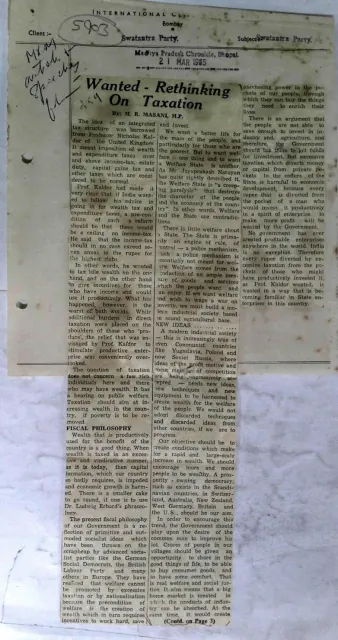
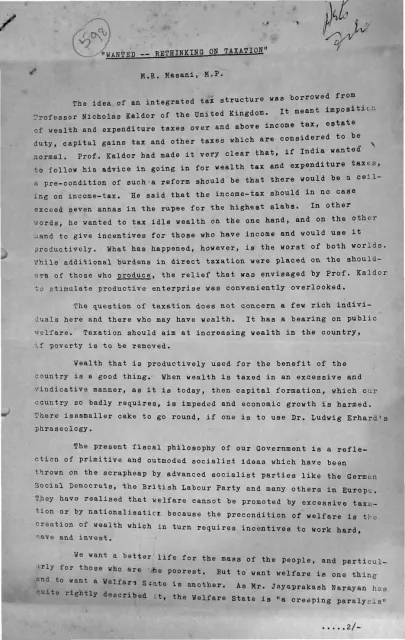
In this two-page pamphlet, M. R. Masani argues that India needs to rethink its tax structure. He describes the integrated tax system associated with Professor Nicholas Kaldor as having been intended to tax idle wealth while preserving incentives for income earners to use their resources productively. Masani contends that India adopted the burdens without the corresponding relief: direct taxation fell heavily on producers, while excessive and punitive taxation impeded capital formation and economic growth. He presents taxation as a question of public welfare rather than merely a matter concerning wealthy individuals, arguing that poverty can be removed only by increasing national wealth.
Masani contrasts welfare with an expansive Welfare State, which he says weakens individual initiative and economic vitality. In the rendered pages, he advocates a modern industrial society grounded in agricultural development, private investment, competition, and the creation of wealth. He supports a “prosperity-owning democracy” in which more people can become wealthy and rural populations gain purchasing power and access to consumer goods. He rejects the argument that the state should tax private savings for investment, maintaining that excessive taxation diverts capital from potentially productive enterprise into inefficient state enterprises.
Key points
- Masani criticizes India’s tax regime for imposing additional burdens without retaining the incentives that Nicholas Kaldor associated with tax reform.
- He argues that excessive taxation impedes capital formation, economic growth, and productive enterprise.
- The pamphlet treats taxation as a public-welfare issue because poverty reduction depends on increasing national wealth.
- Masani distinguishes welfare from the Welfare State, which he associates with excessive state control and weakened initiative.
- He advocates a modern industrial society supported by sound agriculture, competition, new techniques, and private investment.
- A prosperity-owning democracy, including greater rural purchasing power and access to consumer goods, is presented as the preferred social objective.
- He rejects using taxation to transfer private savings into state investment, arguing that government enterprises commonly waste diverted capital.
Metadata and summary are AI-extracted from the source PDF and reviewed for editorial accuracy. The original work is available via the Read PDF tab above (where present); paragraph-level citation inside the PDF is deferred to a future engagement.