Summary
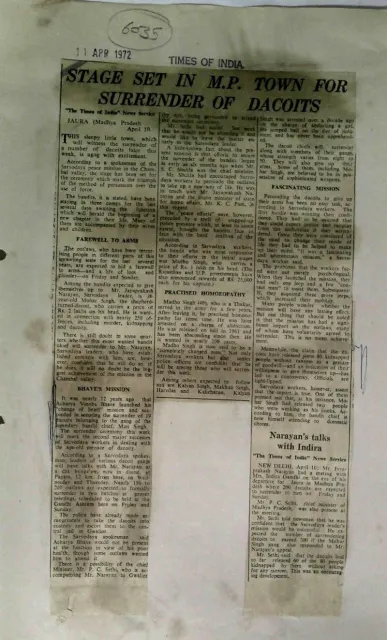
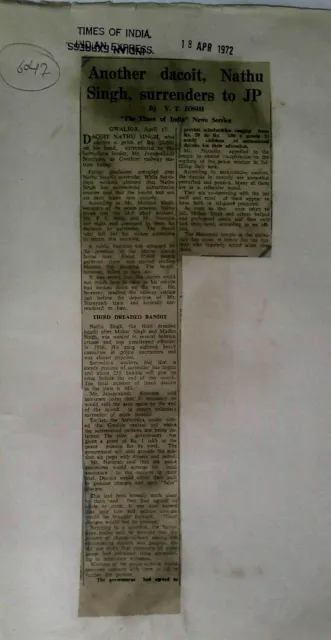
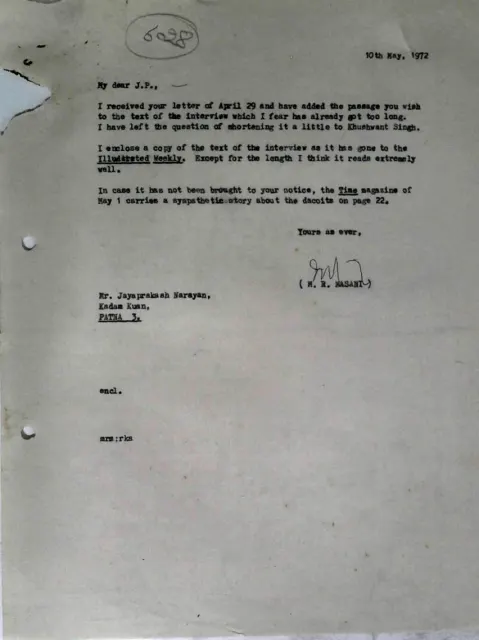
This archival bundle records correspondence and interview preparation between M. R. Masani and Jayaprakash Narayan in April–May 1972 concerning the Chambalghati dacoit surrenders. Masani sends Narayan draft questions for an interview for the Illustrated Weekly of India, while Narayan supplies corrections and clarifications, including a request to describe the surrendering men’s repentance without “lionising or glamourising” them. The papers also include Narayan’s 10 April press release explaining his involvement in the surrender negotiations and acknowledging the roles of Vinoba Bhave, Sarvodaya workers, dacoit leaders, and government officials.
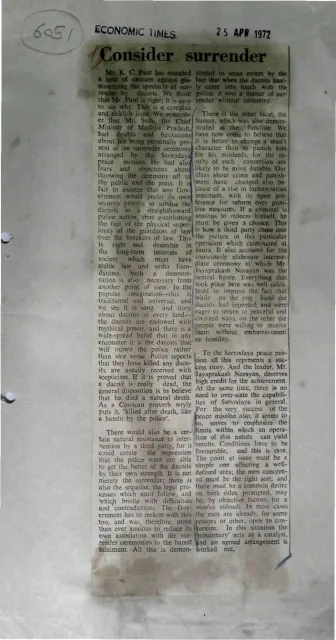
In the interview materials visible here, Narayan presents the surrender campaign as a social-work and reform effort rather than merely a law-and-order operation. He links its philosophy to Vinoba’s Bhoodan and Gramdan, Gandhi’s idea of Trusteeship, and modern penology, arguing that criminals should be reformed rather than simply punished. He stresses that surrender is only the beginning: lasting change requires legal defence, humane and constructive detention, education and rehabilitation for former dacoits, assistance to their families and victims, and sustained action against the psychological, social, and economic causes of the problem. The surviving pages also show Masani pressing Narayan on political, legal, media, and security questions, including the supply of sophisticated weapons, the release of hostages, press access to the surrender ceremony, and whether former dacoits should enter politics.
Key points
- The bundle contains letters, a press release, draft interview questions, and a marked-up interview transcript dated April and May 1972.
- Masani’s interview questions focus on the origins, philosophy, practical terms, legal consequences, and public significance of the Chambalghati dacoit surrenders.
- Narayan attributes the campaign’s progress to Vinoba Bhave’s earlier work, the initiative of dacoit leaders such as Madho Singh, and cooperation from central and state governments.
- Narayan rejects a purely law-and-order interpretation and describes the dacoit problem as psychological, social, and economic as well as criminal.
- The surrender is presented as a process requiring rehabilitation, legal defence, family support, education, and development-oriented work.
- Narayan proposes open-jail or ashram-like arrangements in which reformed dacoits could cultivate land, receive training, and contribute to rural development.
- Masani’s questions test the campaign’s credibility by raising issues of hostage release, weapons, media access, public relations, political representation, and the treatment of accused persons.
- The papers preserve extensive handwritten editorial changes, showing how Narayan’s public account was revised before publication.
Metadata and summary are AI-extracted from the source PDF and reviewed for editorial accuracy. The original work is available via the Read PDF tab above (where present); paragraph-level citation inside the PDF is deferred to a future engagement.