essay
Consider surrender
ECONOMIC TIMES. · 1972
1 pages
Summary
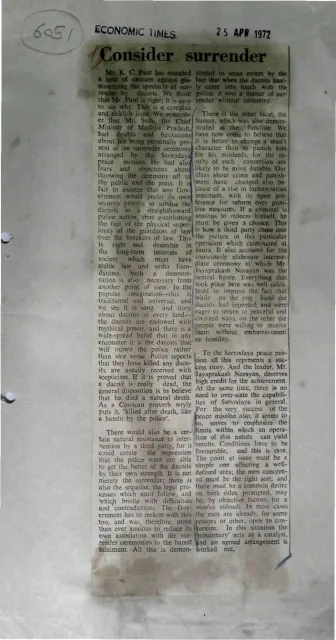
This Economic Times editorial considers whether the state should accept the surrender of dacoits through the Sarvodaya peace mission rather than rely solely on police force. It acknowledges the public’s understandable desire to see criminals punished, but argues that police action must remain subordinate to law and that the state should not assume that every dacoit can be subdued by force alone. The article also notes the practical and legal complications involved in surrender ceremonies, including the need for police authority and judicial process to be reconciled.
The editorial presents rehabilitation as a legitimate third perspective between romanticising dacoits and insisting on punishment. It describes the surrender ceremony associated with Jayaprakash Narayan as deliberately humane, allowing former dacoits to return peacefully while preserving public order. The success of the mission, it argues, depends on favourable conditions, the right participants, and a genuine desire on both sides to reach an agreement. The clipping contains no byline, and only this single page was available.
Key points
- The editorial weighs the Sarvodaya peace mission’s negotiated surrender of dacoits against conventional police action.
- It argues that the authority of law and the security of the public must not be weakened in the process.
- It cautions against assuming that force alone can produce a durable solution to the dacoit problem.
- It identifies rehabilitation and humane treatment as a legitimate alternative to an exclusively punitive response.
- It presents Jayaprakash Narayan’s leadership of the surrender ceremony as central to its success.
- It stresses that successful negotiated settlements require favourable conditions, suitable participants, and mutual willingness.
Metadata and summary are AI-extracted from the source PDF and reviewed for editorial accuracy. The original work is available via the Read PDF tab above (where present); paragraph-level citation inside the PDF is deferred to a future engagement.