speech · convention address
Role of Opposition in National Emergency
(Commerce Graduates' Association)
1962
10 pages
Summary
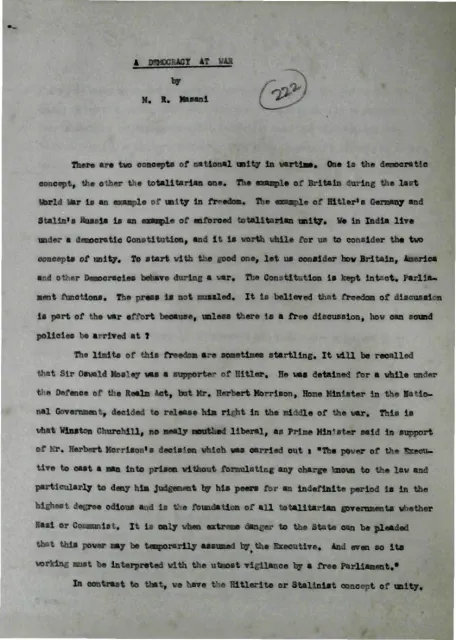
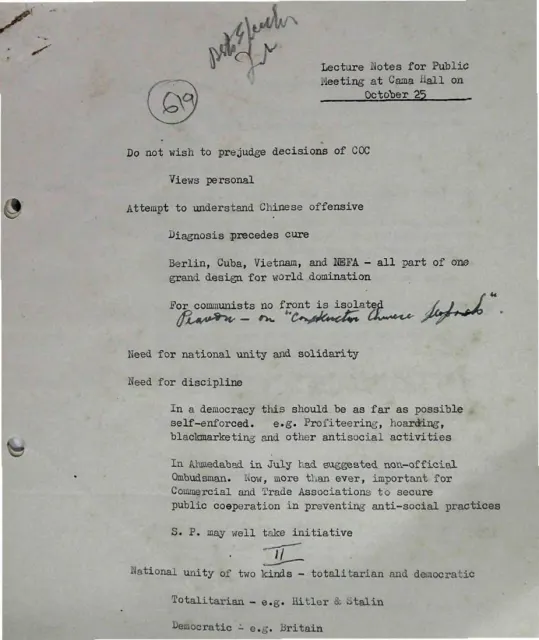
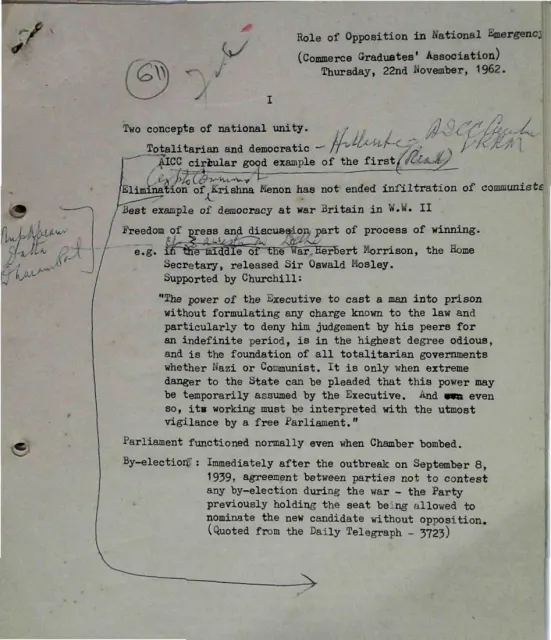
Dated 22 November 1962, these ten pages contain typewritten notes for an address titled “Role of Opposition in National Emergency” to the Commerce Graduates’ Association. The notes begin by contrasting totalitarian and democratic concepts of national unity and argue that free discussion, a free press, parliamentary scrutiny, and an organised opposition remain essential even during wartime. Britain during the Second World War is presented as the principal example: Parliament continued to function despite bombing, Labour MPs remained in opposition within the wartime national government, and opposition parties combined support for the war effort with criticism of government policy. The fall of Neville Chamberlain in May 1940 is used to illustrate how parliamentary opposition could replace a failing leadership without undermining national unity.
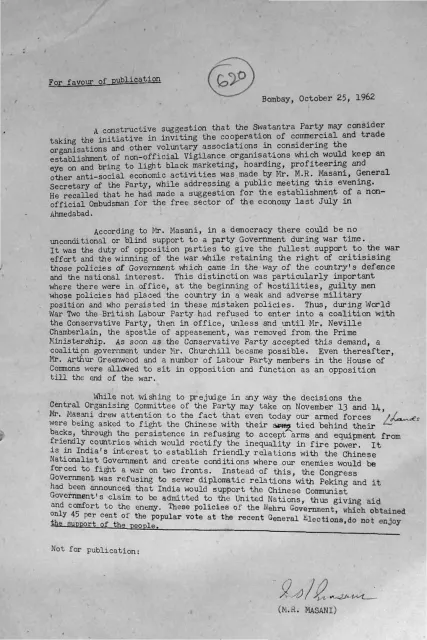
The later sections apply this framework to India’s 1962 crisis with China. The notes criticise a decade of alleged neutrality, appeasement, and failure to understand communism, citing policy toward Mao’s China, Tibet, Panchsheel, and Chinese incursions into Ladakh. They argue that the opposition’s role is dual: to support the war effort while pressing the government toward stronger military, diplomatic, and strategic action. The document records demands associated with the Swatantra Party and other opposition groups, including military assistance, recognition of the Dalai Lama, cooperation with Pakistan, and abandonment of what the notes call an outdated concept of non-alignment. It closes by questioning whether the prime minister can break with past inhibitions and become an effective war leader, while affirming the need for vigilance as the price of liberty.
Key points
- The notes distinguish democratic national unity from totalitarian unity, linking democracy to free discussion and parliamentary oversight.
- Britain in the Second World War is offered as an example of opposition functioning during a national emergency.
- The opposition is assigned a dual role: wholehearted support for the war effort and critical evaluation of government policy.
- The 1940 parliamentary challenge to Neville Chamberlain is presented as a case in which opposition helped produce a change of wartime leadership.
- India’s response to China is criticised as the outcome of prolonged neutrality, appeasement, and misjudgment of communist strategy.
- The opposition proposals include military counter-action, foreign assistance, recognition of the Dalai Lama, cooperation with Pakistan, and a rejection of non-alignment.
- The final pages stress that wartime leadership requires a break with past assumptions and continuing vigilance to preserve liberty.
Metadata and summary are AI-extracted from the source PDF and reviewed for editorial accuracy. The original work is available via the Read PDF tab above (where present); paragraph-level citation inside the PDF is deferred to a future engagement.