Summary
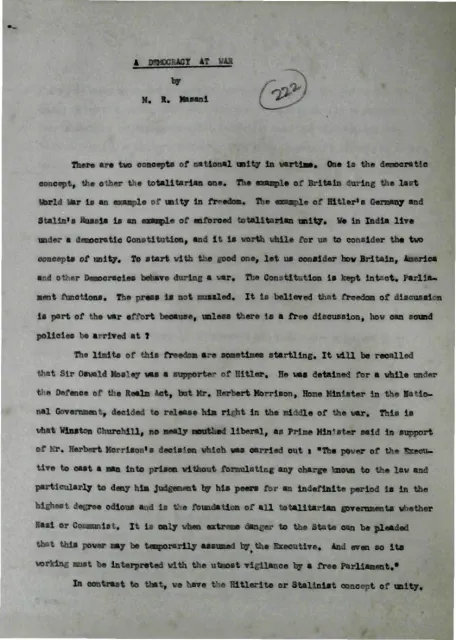
In this 1962 address, M. R. Masani contrasts democratic national unity with the enforced unity of totalitarian regimes. Drawing on Britain’s wartime experience, he argues that a democracy can maintain constitutional government, parliamentary functioning, and an uncensored press while still pursuing military victory. The wartime Opposition, he contends, owed unconditional support to the defence effort but not automatic support to the government of the day; its proper role was loyal, critical, and constitutional.
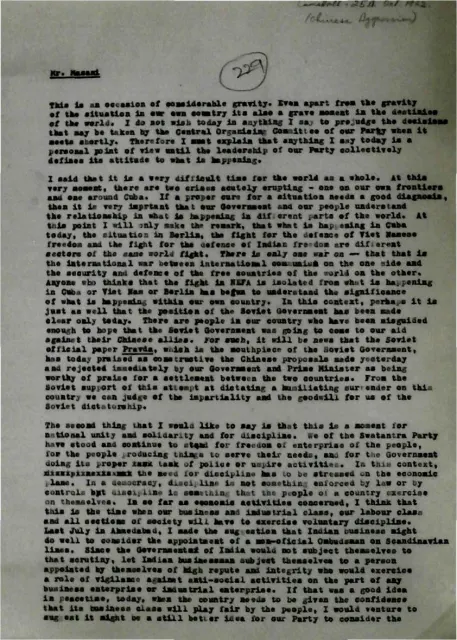
Masani then applies this framework to India’s response to Chinese expansionism. He attributes the 1962 crisis to years of appeasement, misplaced faith in Panchsheel, secrecy about Chinese incursions, and a failure to understand international communism. He criticises the government’s handling of Tibet, Ladakh, and parliamentary debate, and describes a widening gap between the Prime Minister, Parliament, the Opposition, and the Army. The closing section defends an active democratic Opposition: it should cooperate in the national defence effort while freely criticising policies it considers harmful to the country.
Key points
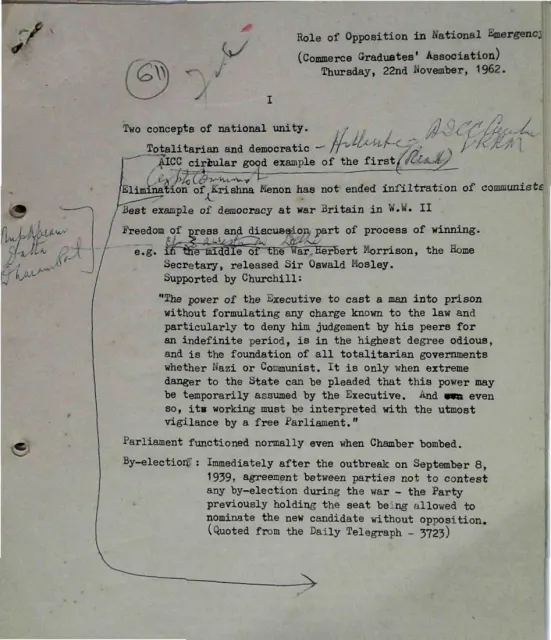
- Masani distinguishes democratic unity in freedom from totalitarian unity imposed by the state.
- He presents Britain during the Second World War as an example of constitutional democracy functioning under military pressure.
- He defines the wartime Opposition as fully committed to national defence but independent of the government’s policies.
- The Labour Party’s refusal to join Neville Chamberlain’s government is presented as an example of responsible opposition leading to necessary political change.
- Masani blames India’s 1962 crisis on appeasement, neutrality, secrecy, and a failure to understand communist expansionism.
- He criticises the government’s policies toward China and Tibet, including the suppression of information about incursions into Indian territory.
- He argues that democratic parties must preserve free and frank criticism even during an emergency.
- The speech concludes that an Opposition can be a cooperative part of the national defence effort without surrendering parliamentary democracy.
Metadata and summary are AI-extracted from the source PDF and reviewed for editorial accuracy. The original work is available via the Read PDF tab above (where present); paragraph-level citation inside the PDF is deferred to a future engagement.