
office record
Management Training at Tata Institute of Social Sciences
1962
1 pages

Summary
This single-page typescript, headed “Tata Institute of Social Sciences” and dated 13 October 1962, records evaluative comments on a trade-union training course. The notes compare the course with trade-union administration training, criticize its limited duration and low cost, and suggest that its most valuable material concerned the topics covered by Mohan Das. They also connect the course to concerns about the poverty of unions, weak leadership and organization, political influence, and outside leadership of trade unions.
The page argues that employers should support trade-union training and that suspicions between unions and employers may be unfounded. It stresses the importance of employee loyalty in an adverse public-opinion climate, while distinguishing firmness from appeasement. A quotation attributed to Graham Hutton endorses bold, resolute leadership over timid efforts to avoid unpopularity. Extensive handwritten annotations supplement, question, and cross-reference the typed observations, but their full meaning and authorship are not always legible.
Key points
- The document evaluates a trade-union training course held in connection with the Tata Institute of Social Sciences.
- It compares a 40-hour course with 45 hours allotted to trade-union administration.
- The notes criticize the course as offering “too much law” and as being too cheap.
- The material emphasizes poor union leadership and organization, political influence, and outside leadership of trade unions.
- It argues that employers have a duty to encourage trade-union training and constructive industrial relations.
- The notes regard union suspicions of employers as unfounded and advocate breaking through them.
- Employee loyalty is presented as especially important when public opinion is hostile.
- The page rejects appeasement and praises bold, firm, and somewhat unconventional leadership.
Metadata and summary are AI-extracted from the source PDF and reviewed for editorial accuracy. The original work is available via the Read PDF tab above (where present); paragraph-level citation inside the PDF is deferred to a future engagement.
Related across the archive
 Primary workThe First Tata Personnel & Labour Officers Conference
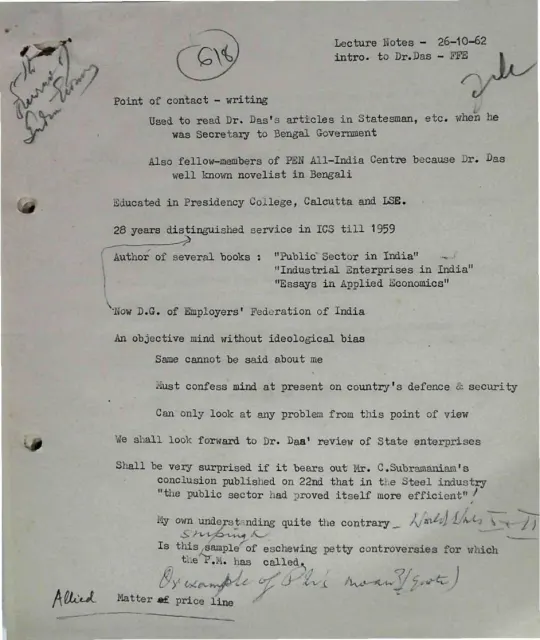 Primary workLecture Notes
 Primary workMinutes of the meeting of Trade Union Workers belonging to the Swatantra Party held in Bombay on July 28 and 29, 1962.
 ExcerptWHAT MAKES JAPAN TICK: SOME LESSONS FOR INDIA
 ExcerptSatyagraha and the Political System