letter
Letter to Mr Minoo Masani
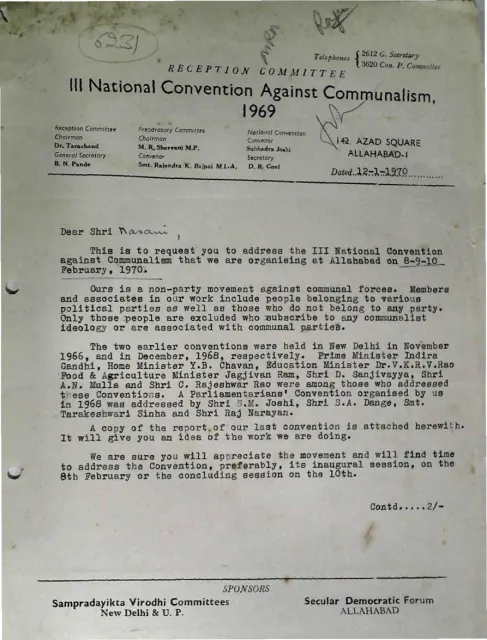
RECEPTION COMMITTEE, III National Convention Against Communalism, 1969 · ALLAHABAD-I · 1970
5 pages
Summary
This document is a letter dated 12 January 1970 from Subhadra Joshi, writing as secretary of the III National Convention Against Communalism, to “Shri Masani” (Minoo Masani). It invites him to address the convention in Allahabad on 8–10 February 1970, explains that the movement is non-party and excludes only those committed to communalist ideology or associated with communal parties, and refers to earlier conventions held in New Delhi in 1966 and 1968. The letter also mentions a report of the previous convention and asks Masani to send a message if he cannot attend.
The attached report, headed “Report on Sampradayikta Virodhi Committee,” presents the committee’s rationale and activities. Joshi grounds opposition to communalism in a pluralist Indian tradition associated with Gandhi and Nehru, while describing communal riots as products of fear, rumor, propaganda, administrative inaction, and political sectarianism. The report criticizes both minority and majority communalism, but argues that majority communalism poses the greater danger to India’s existence as a united and free nation. It identifies the RSS as the principal ideological opponent under discussion, calls for scrutiny of its methods and possible prohibition, and describes the committee’s work studying riots, publishing research, coordinating secular organisations, and promoting secularism and communal harmony through conferences, seminars, exhibitions, study groups, and literature.
Key points
- The letter invites Minoo Masani to address the III National Convention Against Communalism in Allahabad in February 1970.
- The convention is presented as a non-party movement open to people across political affiliations, except communalists and those associated with communal parties.
- The attached report links Indian secularism and communal harmony to a historical tradition represented by Gandhi, Nehru, Vivekananda, Chishti, Nanak, Akbar, Ashoka, and Buddha.
- The report attributes communal violence to fear, rumor, false propaganda, organised targeting, and failures of administration.
- It distinguishes between minority and majority communalism while arguing that the latter threatens India’s unity and freedom more fundamentally.
- The Sampradayikta Virodhi Committee studies the RSS, publishes material on riots, and advocates resistance to communalist and sectarian politics.
- The committee seeks to coordinate secular organisations and advance communal harmony through public education and collaborative activities.
Metadata and summary are AI-extracted from the source PDF and reviewed for editorial accuracy. The original work is available via the Read PDF tab above (where present); paragraph-level citation inside the PDF is deferred to a future engagement.