periodical issue
Freedom First
By Adam Adil, R. N. Karnik, Analyst, (Contributed), K.V.B., V. K. Karkaria
Edited and published for the Democratic Research Service by V. B. Karnik at 127 Mahatma Gandhi Road, Bombay 1, and printed by him at Inland Printers, 55 Gamdevi Road, Bombay 7. · Bombay · 1970
12 pages
Freedom First
Summary
This issue of Freedom First (No. 217, June 1970), edited by V. B. Karnik for the Democratic Research Service in Bombay, opens with Adam Adil’s essay on the persistence of communal rioting in independent India, arguing that responsibility lies less with anti-social elements than with an educated elite that has failed to modernise its communities, and citing the recent Ahmedabad, Bhiwandi, and Jalgaon riots. R. N. Karnik contributes a detailed legal analysis of the Golak Nath judgment and the pending Nath Pai Constitution (Amendment) Bill, opposing Parliament’s bid to reclaim power to abridge fundamental rights. A Bengal Report column by ‘Analyst’ surveys Governor’s Rule in West Bengal and manoeuvring among the CPM, CPI, Congress, and Naxalites ahead of expected 1972 elections, followed by a short item quoting C. D. Deshmukh on waste in public-sector project execution. A contributed report summarises a Srinagar seminar on freedom of the press organised with the Friedrich Naumann Stiftung. The issue closes with reader letters on coalition politics, three book reviews (on M. N. Roy, Jamnadas Dwarkadas’s political memoirs, and an anthology of Khushwant Singh’s writing), and the regular ‘With Many Voices’ page of press quotations.
Key points
-
Adam Adil’s “Communal Riots” surveys 321 communal riots since Independence, including recent outbreaks in Ahmedabad, Bhiwandi and Jalgaon, arguing an educated elite’s failure to modernise its communities is the deeper cause rather than anti-social elements alone.
-
R. N. Karnik’s “Nath Pai’s Bill” lays out the legal background to the Golak Nath judgment and the pending Constitution Amendment Bill, giving eight reasons the Prime Minister should not press the Bill given her government’s lack of a parliamentary majority.
-
Writing as “Analyst,” a “Bengal Report” surveys Governor’s Rule in West Bengal, noting weakening Naxalite violence after police action at Debra and Gopiballabhpur and a failed pro-Soviet CPI proposal to revive the fourteen-party United Front.
-
A short item quotes C. D. Deshmukh estimating that a quarter to a third of state development funds are wasted through incompetence or venality, illustrated by a public-sector steel plant tender scandal.
-
A contributed report on a Srinagar seminar on press freedom, organised with the Friedrich Naumann Stiftung and attended by M. R. Masani, Piloo Mody and Khushwant Singh, affirms unanimous support for press freedom while debating whether newspaper monopoly exists.
-
Reader letters call for coalition among like-minded parties, Swatantra, Jana Sangh, Congress (O), and criticise “Socialism a la Indira” as vote-driven rather than principled.
-
Book reviews cover Samaren Roy’s The Restless Brahmin on M. N. Roy’s early revolutionary life, Jamnadas Dwarkadas’s Political Memoirs, and Khushwant Singh’s India.
Essays
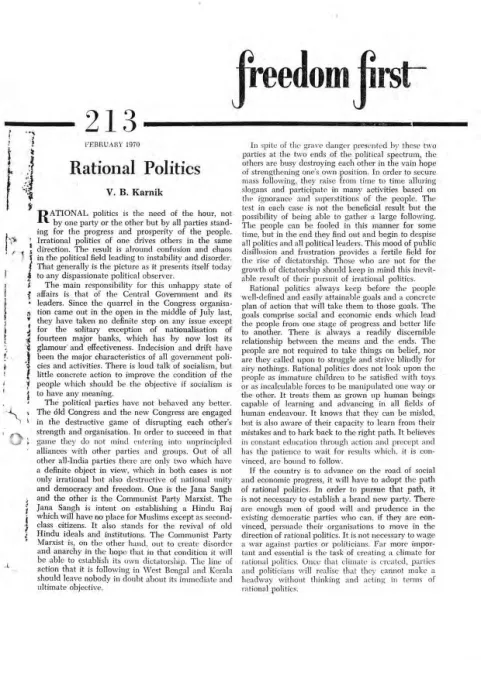
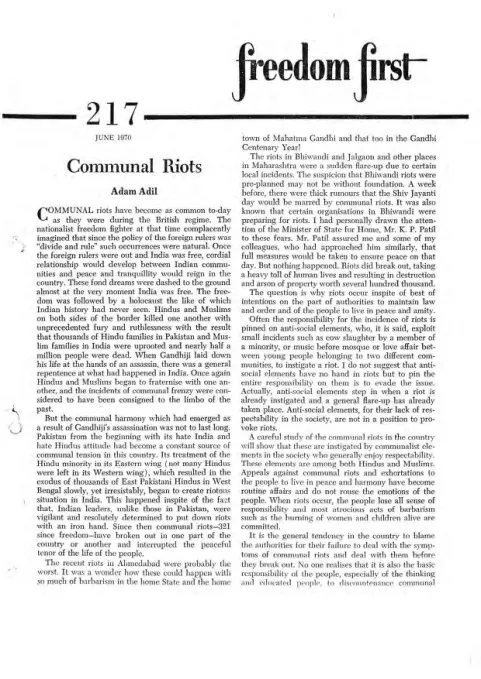
Communal Riots
By Adam Adil
Adam Adil surveys communal rioting in India since Independence, noting 321 riots since 1947 including recent severe outbreaks in Ahmedabad, Bhiwandi, and Jalgaon. He rejects the common explanation that anti-social elements alone instigate riots, arguing instead that such elements only exploit a climate already created by failures of the educated elite to modernise their communities and by communalists who hide inside secular parties. He is sceptical that banning organisations like the RSS or Muslim League would help, and dismisses the National Integration Council as ineffective because its own membership includes covertly communal party representatives. His proposed remedy is a slow, generational project of cultural and social modernisation led by an educated elite that abandons opportunistic lip-service to secularism, backed by supportive government administrative policy.
- Notes 321 communal riots in India since Independence, with recent severe outbreaks in Ahmedabad, Bhiwandi, and Jalgaon in 1970
- Argues anti-social elements exploit, but do not originate, communal tension
- Blames the educated elite for failing to genuinely modernise Hindu and Muslim communities despite professed allegiance to socialism and secularism
- Argues banning communal parties (RSS, Muslim League) would not work since communal elements also operate within secular parties
- Criticises the National Integration Council as structurally unable to solve the problem given its composition
- Calls for a determined, possibly generational effort by both elite and government to defeat Hindu, Muslim, and Sikh obscurantism
Nath Pai’s Bill
By R. N. Karnik
R. N. Karnik lays out the legal background to Shri Nath Pai’s Constitution (Amendment) Bill, introduced after the Supreme Court’s Golak Nath decision held that Parliament cannot amend Part III fundamental rights. He traces the doctrinal history from Sankari Prasad through Sajjan Singh to Golak Nath, quoting the majority and dissenting opinions, and reports that Indira Gandhi and Y. B. Chavan strongly favour the Bill while the Swatantra Party, Jana Sangh, Samyukta Socialist Party, and the Minute of Dissent by S. M. Joshi and Kameshwar Singh oppose it. Karnik concludes with an eight-point argument that the Prime Minister should not press the Bill, citing her government’s lack of a parliamentary majority, political instability, absence of any electoral mandate to amend fundamental rights, and the risk of perpetual conflict between Parliament and the Supreme Court.
- Explains the Golak Nath ruling: Parliament cannot amend Part III fundamental rights from 27-2-1967 onward
- Traces prior case law: Sankari Prasad (1952) and Sajjan Singh (1965), and the split judgments in Golak Nath itself
- Reports the Joint Committee’s 15 sittings (7-9-1967 to 13-7-1968) on Nath Pai’s Bill and its eventual report
- Notes Indira Gandhi and Y. B. Chavan’s strong support for the Bill versus opposition from Swatantra, Jana Sangh, and the Samyukta Socialist Party
- Quotes the Joshi-Kameshwar Singh Minute of Dissent warning the Bill risks abridging civil liberties under cover of economic reform
- Gives eight reasons the Bill should not be pushed through, including lack of electoral mandate and political instability
Bengal Report: Waiting For 1972 Elections
By Analyst
Writing under the byline ‘Analyst,’ this Bengal Report column surveys Governor’s Rule in West Bengal, describing the Governor’s Advisors settling into administrative work, transfers of officers, an anticipated land reform policy, and efforts to woo back industrial investors. It assesses the weakening of Naxalite violence in rural areas like Debra and Gopiballabhpur following police action, contrasted with the CPM’s cautious shift back toward front organisations and economic agitation. The piece anticipates that agitation on land, teacher pay, and education funding will converge by October-November into a push for mid-term elections, and reports that a pro-Soviet CPI proposal to revive the 14-party United Front with conditions on CPM leadership has failed, leaving Bengal’s political realignment still unsettled ahead of expected 1972 elections.
- Governor’s Advisors are consolidating administrative control, with officer transfers and a land reform policy in the offing
- Central Reserve Police deployment continues; Presidential Rule appears likely to continue until 1972
- Naxalite terror campaign has weakened after police action in Debra and Gopiballabhpur, with villagers in one case beating Naxalites to death for trying to kill a jotedar
- CPM is cautiously re-engaging front organisations and economic agitation rather than confrontation
- A pro-Soviet CPI proposal (linked to Dange) to revive the 14-party United Front on condition of CPM accepting Ajoy Mukherjee’s leadership and giving up the Home portfolio has failed
- Congress (R) faces a difficult balancing act supporting the Advisors’ policies while remaining ideologically committed to leftism
Freedom Of The Press
By C. D. Deshmukh
A short item titled ‘Incompetence or Venality?’ quotes C. D. Deshmukh’s speech on ‘Social Change in India’ at the Gokhale Institute of Public Affairs, Bangalore, in which he estimates that a quarter to a third of state development funds are wasted through incompetence or venality. He illustrates this with an anecdote from a public-sector steel plant construction contract, where a Rs. 12 lakh lowest tender was passed over in favour of a Rs. 30 lakh bid from the National Construction Corporation (per standing government preference rules), which then sub-contracted the same work to a private contractor for Rs. 28 lakhs, pocketing Rs. 2 lakhs without doing any work.
- Deshmukh estimates 25-33% of state development funds are wasted through incompetence or venality
- Cites a public-sector steel plant tender: a Rs. 12 lakh lowest bid was passed over for a Rs. 30 lakh bid from a state-preferred corporation
- That corporation then sub-contracted the same work for Rs. 28 lakhs, retaining Rs. 2 lakhs profit for no work
- Predicts the case would eventually be flagged by Parliament’s Public Accounts Committee
Review: The Restless Brahmin / Political Memoirs / Kushwant Singh’s India
By K.V.B. / V. K. Karkaria
A contributed report on a Freedom of the Press seminar held in Srinagar (May 8-11) under the Leslie Sawhny Programme of Training for Democracy in collaboration with the Friedrich Naumann Stiftung. Participants included M. R. Masani, Piloo Mody, Frank Moraes, Kuldip Nayar, Khushwant Singh, and others, with I. K. Gujral also addressing the seminar. The group affirmed unanimous support for press freedom as essential to democracy, debated whether press monopoly existed given a readership of only seven million against All India Radio’s much larger reach, discussed the risks of both government and private-ownership interference with editorial independence, and called for better journalist training at pre-entry, in-service, and specialisation levels.
- Seminar organised by the Leslie Sawhny Programme with the Friedrich Naumann Stiftung, held in Srinagar May 8-11
- Unanimous agreement that freedom of the press is essential to democracy, though concern was raised about erosion of that freedom
- Debate over whether newspaper monopoly exists, given a readership of about seven million versus All India Radio’s 70% population reach
- Divergent views on private ownership: seen by some as a threat via owner interference, by others as necessary for economic viability and independence from government pressure
- Seminar opposed any measure increasing direct or indirect government influence over the press
- Called for improved journalist training at pre-entry, in-service, and specialisation levels
Letters to the Editor (Coalition of Likeminded Parties; People and Politicians)
By R. J. Desai / N. J. Tavaria
Two reader letters. R. J. Desai of Gulbarga argues no party seriously pursues political stability and calls for like-minded parties, especially the Swatantra Party, Jana Sangh, and Congress (O), to unite ahead of the general election, invoking C. Rajagopalachari’s counsel. N. J. Tavaria of Bombay criticises the drift of Indian politics toward vote-driven ‘Socialism a la Indira,’ class-war rhetoric against ‘monopolists’ and princes, and a state radio monopoly that only presents one side of issues, arguing Parliament has become subordinate to unaccountable political expediency.
- R. J. Desai calls for coalition among like-minded parties (Swatantra, Jana Sangh, Congress (O)) ahead of the general election
- Desai invokes C. Rajagopalachari’s warning against totalitarianism and subversion
- N. J. Tavaria criticises ‘Socialism a la Indira’ as vote-seeking rather than principled
- Tavaria blames a state radio monopoly for presenting only one side of political issues to ‘the ignorant masses’
- Tavaria argues Parliament has become subordinate to unaccountable political expediency
Essay 7
Three book reviews. K.V.B. reviews Samaren Roy’s ‘The Restless Brahmin’ (Allied Publishers), a study of M. N. Roy’s early revolutionary life in Bengal from roughly 1905-1915, covering the Indo-German conspiracy to arm a revolt against British rule and Roy’s ideological debts to Vivekananda, Bankim Chatterjee, and Aurobindo Ghosh; the same reviewer covers Jamnadas Dwarkadas’s ‘Political Memoirs’ (United Asia Publications), which recounts Dwarkadas’s rise as a Bombay public idol, his break with Gandhi’s mass civil disobedience campaign in favour of Annie Besant’s more cautious position, and the personal cost to his popularity, ending with his 1919 departure for England. V. K. Karkaria reviews ‘Khushwant Singh’s India,’ edited by Rahul Singh (India Book House), praising its balanced, humorous treatment of India’s achievements and shortcomings and singling out its chapter on the historical roots of Hindu-Muslim mistrust and its critical portrait of Krishna Menon.
- ‘The Restless Brahmin’ by Samaren Roy covers M. N. Roy’s (Naren Bhattacharya’s) early life and the Indo-German conspiracy to arm anti-British revolt, c.1905-1915
- Reviewer notes the book traces Roy’s ideological roots to Vivekananda, Bankim Chatterjee, and Aurobindo Ghosh, and hopes for a fuller biography to follow
- ‘Political Memoirs’ by Jamnadas Dwarkadas recounts his rise as a Bombay public idol allied with Besant, Tilak, and Gandhi, and his fall in popularity after siding with Annie Besant against Gandhi’s mass civil disobedience
- Dwarkadas’s memoir ends at his 1919 departure for England, with a promised second volume
- ‘Kushwant Singh’s India,’ edited by Rahul Singh, is praised for objective treatment of the Hindu-Muslim divide and a critical chapter on Krishna Menon
Generated by the v1.5 extraction pipeline. Awaiting editorial review.
Metadata and summary are AI-extracted from the source PDF and reviewed for editorial accuracy. The original work is available via the Read PDF tab above (where present); paragraph-level citation inside the PDF is deferred to a future engagement.