essay · position paper
Car Prices
Swatantra Party National Headquarters · Bombay · 1969
2 pages
Summary
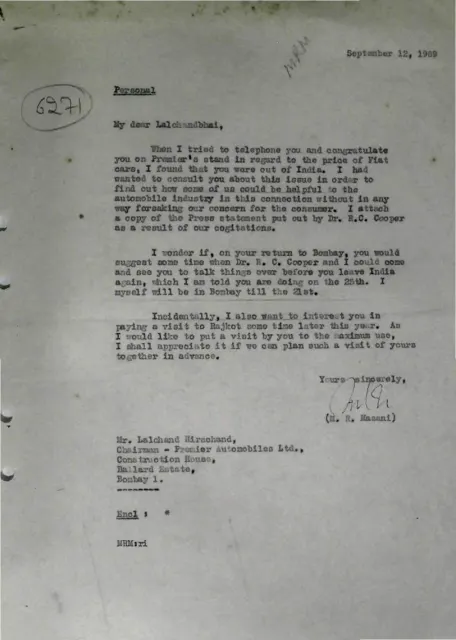
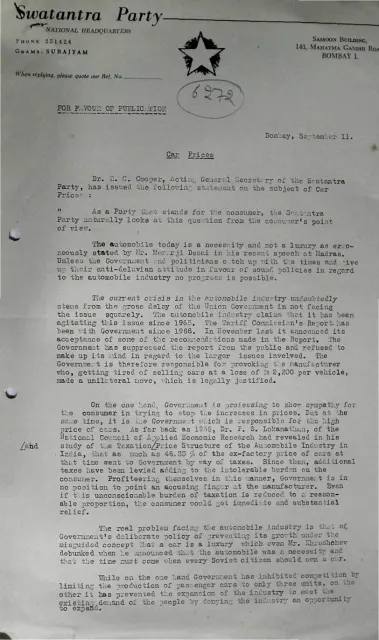
This two-page Swatantra Party statement, issued from its Bombay headquarters on September 11 (the year is not printed), presents the party’s position on rising automobile prices. It argues that cars have become a necessity rather than a luxury and attributes the crisis to the Union Government’s delay in addressing the industry’s problems, its restrictive policies, and its taxation of vehicles. The statement says the Government’s inaction forced manufacturers to sell cars at a loss of Rs. 2,200 per vehicle before making a unilateral, legally justified price increase.
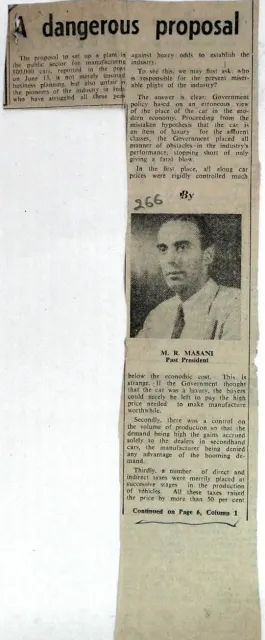
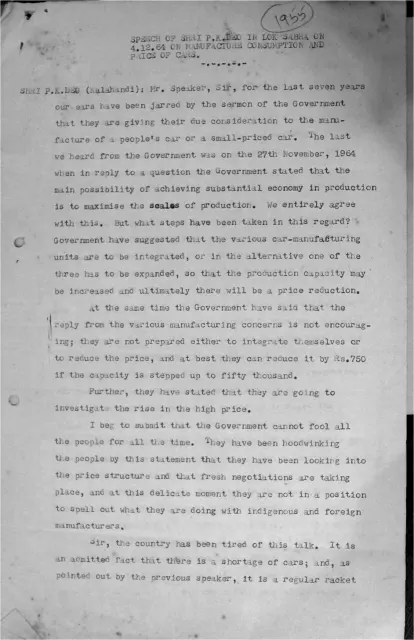
The statement places responsibility for high prices primarily on government policy rather than on manufacturers. It cites a 1956 study by Dr. P. S. Lokanathan of the National Council of Applied Economic Research, which reportedly found that as much as 46.33 percent of a car’s ex-factory price went to the Government through taxation. It also criticises the restriction of passenger-car production to three units and urges the Government to permit greater competition, including limited imports of used cars in good condition. The paper concludes that competition would pressure domestic manufacturers to improve quality and reduce costs.
Key points
- The Swatantra Party frames the automobile as a necessity for consumers, not a luxury.
- The statement blames the Union Government’s delayed response and restrictive policies for the automobile industry’s crisis.
- It argues that manufacturers raised prices only after selling cars at a loss of Rs. 2,200 per vehicle.
- A cited NCAER study reportedly found that 46.33 percent of a car’s ex-factory price went to the Government.
- The statement criticises taxation as an additional burden on consumers.
- It says the domestic industry has failed to improve quality and reduce costs over the previous twelve years.
- It advocates allowing limited imports of well-maintained used cars to stimulate competition.
Metadata and summary are AI-extracted from the source PDF and reviewed for editorial accuracy. The original work is available via the Read PDF tab above (where present); paragraph-level citation inside the PDF is deferred to a future engagement.