Summary
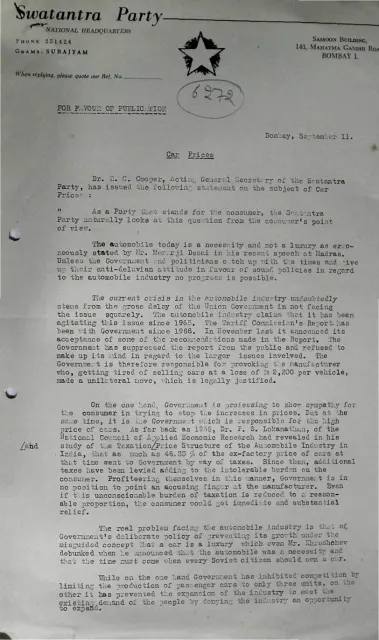
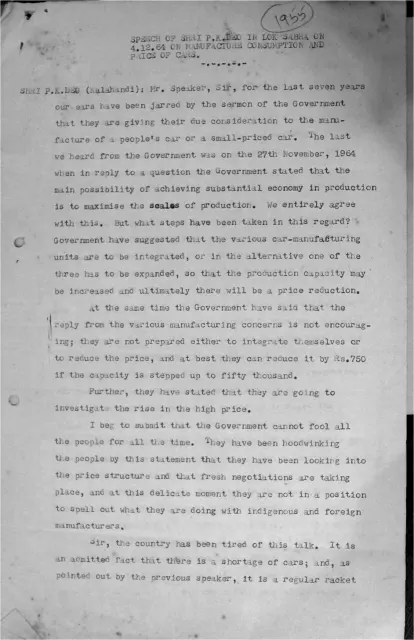
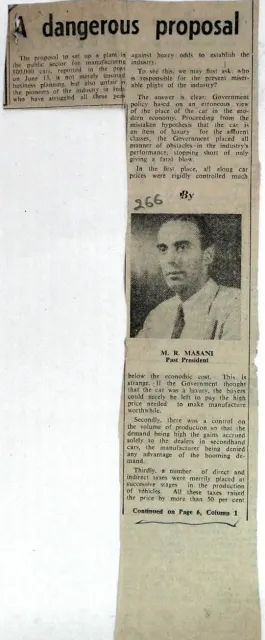
In the rendered pages, M. R. Masani argues against the proposal to establish a 100,000-car manufacturing plant through government initiative. He attributes the Indian automobile industry’s difficulties to government policy: an erroneous view of the car as a luxury for affluent consumers, extensive price and production controls, and taxation that raised vehicle prices by more than 50 per cent. The article contends that buyers should bear the price necessary to make manufacture worthwhile rather than have the state suppress prices and demand.
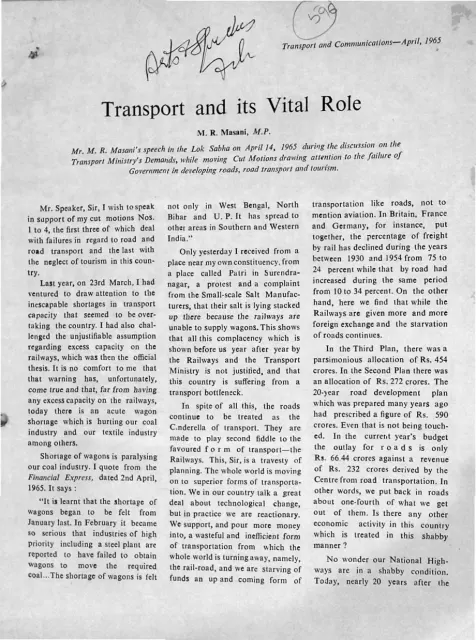
In the rendered pages, Masani also challenges the case for public-sector expansion. He identifies finance and market size as the principal obstacles, arguing that private firms lack funds because policy prevents them from earning a margin, while a new public-sector plant would require even greater investment. He further claims that the proposed expansion is technologically premature: existing firms could expand more cheaply, and the quality of imported components and locally supplied steel remained inadequate. The article concludes, in the rendered pages, that the government should reconsider the proposal and instead create conditions for private manufacturers to undertake expansion.
Key points
- Masani opposes a government-backed proposal for a 100,000-car manufacturing plant.
- He argues that government policy wrongly treats cars as luxury goods for affluent consumers.
- Price controls, production controls, and successive taxes are presented as major causes of the industry’s difficulties.
- He maintains that prices should be allowed to rise enough to make automobile manufacture commercially viable.
- The article identifies inadequate finance and the existing market size as barriers to expansion.
- Masani argues that private manufacturers are better placed than the public sector to carry out expansion.
- He says the proposed plant would be more expensive than upgrading existing facilities.
- Technological constraints include the quality of imported components and domestically supplied steel.
Metadata and summary are AI-extracted from the source PDF and reviewed for editorial accuracy. The original work is available via the Read PDF tab above (where present); paragraph-level citation inside the PDF is deferred to a future engagement.