correspondence
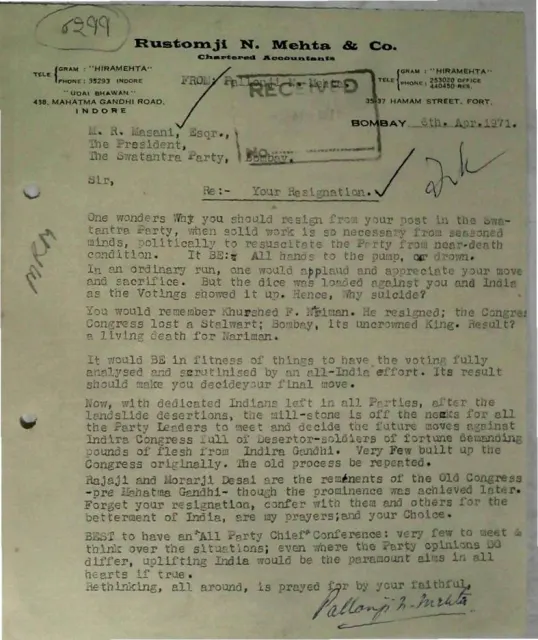
Letter to Mr Minoo Masani
Bombay · 1971
4 pages
Summary
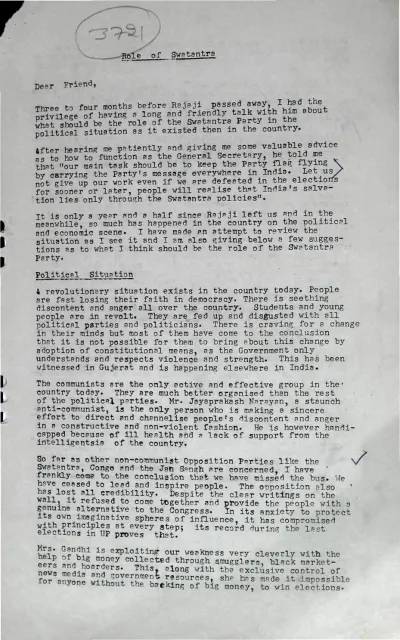
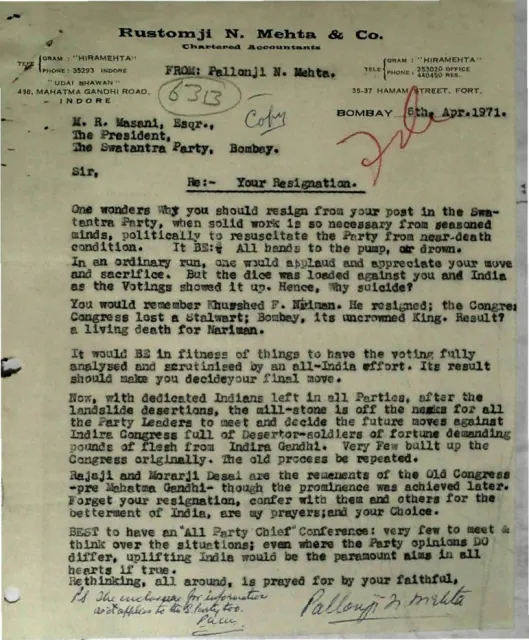
This four-page correspondence file contains two letters dated 5 April 1971 by Pallonji N. Mehta. The first, addressed to M. R. Masani, argues that Masani should reconsider his resignation from the Swatantra Party. Mehta presents the party as urgently needed to revive opposition politics after defections and electoral setbacks, and urges an all-party conference to determine a future strategy against Indira Gandhi’s Congress. He invokes the earlier resignation of Khurshed F. Nariman as a warning that the departure of a leading figure can produce a party’s “living death.”
The second letter, addressed to the Congress Working Committee, proposes practical political responses to food shortages, high prices, black marketing, and public dissatisfaction. Mehta recommends a “Food and Water first and last” programme, investigations into food distribution and wholesale pricing, house-to-house searches for hoarded food, and direct solicitation of citizens’ complaints. The letter also attacks the Congress leadership’s relationship to Nehru’s legacy, questions Indira Gandhi’s claims of popular support, and calls on Congress members to decide whether they will serve the country or merely a political leader. The pages present a strongly partisan critique of contemporary Congress politics and an appeal for organisational renewal and practical governance.
Key points
- Mehta asks Minoo Masani to reconsider his resignation from the Swatantra Party.
- The first letter portrays the opposition’s fragmentation and defections as a crisis requiring experienced leadership and coordination.
- Mehta recommends an all-party conference to formulate a common response to Indira Gandhi’s Congress.
- The second letter links political legitimacy to addressing food shortages, high prices, hoarding, and black marketing.
- It proposes investigations into wholesale food prices and direct action against hoarded supplies.
- Mehta advocates soliciting citizens’ complaints as a means of rebuilding Congress credibility.
- The correspondence criticises personal leadership, Nehru-era political legacies, and what it presents as Congress’s dependence on Indira Gandhi.
Metadata and summary are AI-extracted from the source PDF and reviewed for editorial accuracy. The original work is available via the Read PDF tab above (where present); paragraph-level citation inside the PDF is deferred to a future engagement.