lecture
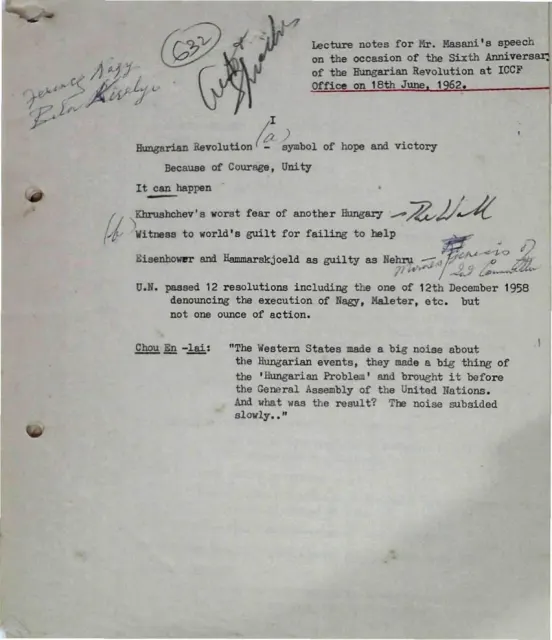
Lecture notes for Mr. Masani's speech on the occasion of the Sixth Anniversary of the Hungarian Revolution at ICCF Office on 18th June, 1962.
By Minoo Masani
1962
5 pages
Summary
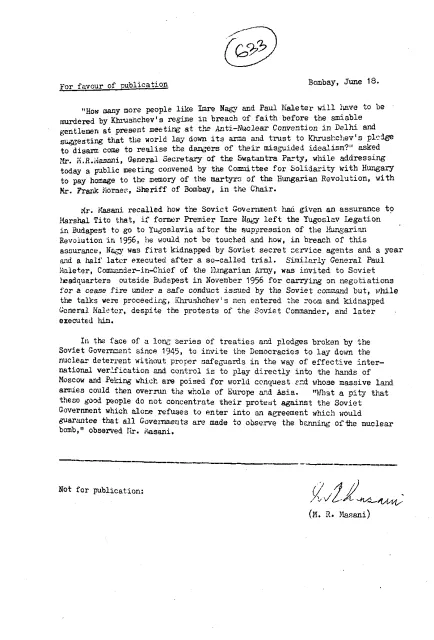
These typed lecture notes prepare Minoo Masani's speech for the sixth anniversary of the Hungarian Revolution, delivered at the ICCF Office on 18 June 1962. The outline presents the revolution as a symbol of hope, courage, and unity, and argues that its central lessons include opposition to double standards on colonialism, support for self-determination and free elections under United Nations supervision, and recognition that Soviet assurances and pledges could not be trusted. The notes condemn the failure of Western governments and the United Nations to act despite resolutions denouncing the executions of Imre Nagy and fellow revolutionaries Paul Maleter and others.
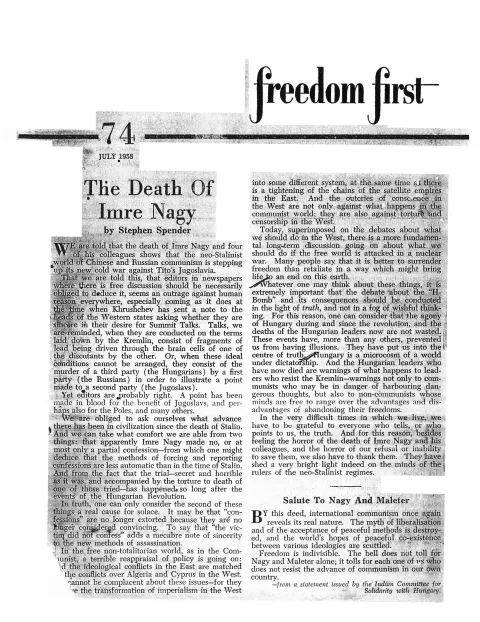
The speech also links Hungary to contemporary international politics, warning against trusting Khrushchev while democratic governments pursued disarmament initiatives and conventions that, in the notes' view, ignored the danger of Soviet treachery. The final two rendered pages contain a related printed statement, “Salute to Nagy and Maleter,” issued by the Indian Committee for Solidarity with Hungary. That item extends the argument into a broader indictment of international communism, broken pledges, and the moral failure of governments that remain silent before political murder. The document is fully visible, although pages 4–5 are a clipped related item rather than the lecture notes themselves.
Transcript
Summary
These typed lecture notes prepare Minoo Masani’s speech for the sixth anniversary of the Hungarian Revolution, delivered at the ICCF Office on 18 June 1962. The outline presents the revolution as a symbol of hope, courage, and unity, and argues that its central lessons include opposition to double standards on colonialism, support for self-determination and free elections under United Nations supervision, and recognition that Soviet assurances and pledges could not be trusted. The notes condemn the failure of Western governments and the United Nations to act despite resolutions denouncing the executions of Imre Nagy and fellow revolutionaries Paul Maleter and others.
The speech also links Hungary to contemporary international politics, warning against trusting Khrushchev while democratic governments pursued disarmament initiatives and conventions that, in the notes’ view, ignored the danger of Soviet treachery. The final two rendered pages contain a related printed statement, “Salute to Nagy and Maleter,” issued by the Indian Committee for Solidarity with Hungary. That item extends the argument into a broader indictment of international communism, broken pledges, and the moral failure of governments that remain silent before political murder. The document is fully visible, although pages 4–5 are a clipped related item rather than the lecture notes themselves.
Key points
- The Hungarian Revolution is framed as a symbol of hope, victory, courage, and unity.
- The notes reject double standards in applying the principles of self-determination and withdrawal of foreign troops.
- They argue that Soviet safe-conduct assurances to Imre Nagy and Paul Maleter were deliberately betrayed.
- The United Nations is criticized for passing resolutions without taking effective action.
- Western governments, including Eisenhower and Hammarskjold, are presented as culpable for failing to help Hungary.
- The notes warn that trusting Khrushchev is dangerous and portray disarmament diplomacy as insufficient without international verification.
- The related statement condemns international communism for violating solemn pledges and failing to denounce executions.
Metadata and summary are AI-extracted from the source PDF and reviewed for editorial accuracy. The original work is available via the Read PDF tab above (where present); paragraph-level citation inside the PDF is deferred to a future engagement.