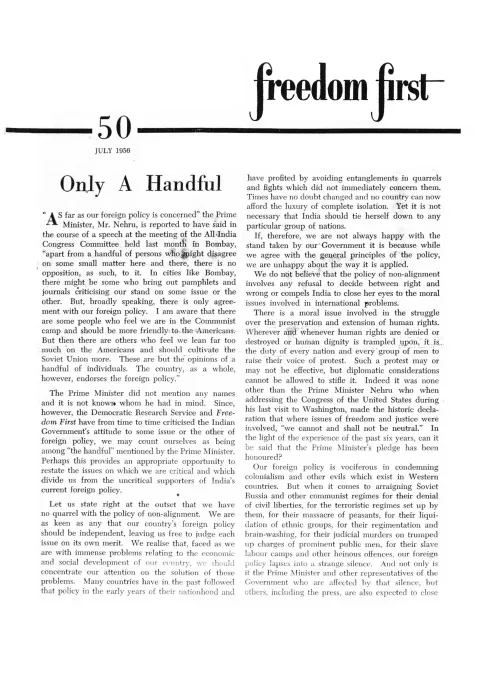
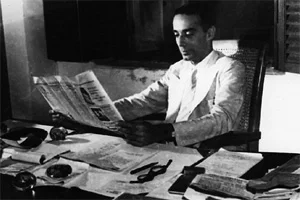
periodical issue
Freedom First
By Stephen Spender, V. B. Karnik, S. Sharangpani, Adam Adil, Sadi, Atreya
Edited, printed & published for the Democratic Research Service by V. B. Karnik at The Kanada Press, 109 Parsi Bazar Street, Bombay 1. / Maneckji Wadia Building, 4th Floor, 127 Mahatma Gandhi Road, Bombay 1. · Bombay · 1958
12 pages
Freedom First
Summary
This is the complete July 1958 issue (No. 74) of Freedom First, published in Bombay by the Democratic Research Service and edited by V. B. Karnik. The issue is dominated by reactions to Cold War events: the execution of Hungarian leader Imre Nagy and General Paul Maleter, which draws a lead editorial by Stephen Spender, a Congress for Cultural Freedom statement, a citizens’ statement of homage signed by Bombay public figures including Asoka Mehta, Minoo Masani, and N. G. Gore, and a Patna resolution of the Indian Committee for Cultural Freedom. The unsigned ‘Notes’ section comments on the AFPFL split in Burma, Tito-Khrushchev relations after the Nagy executions, a new communist-organised world peace conference, a Bombay municipal strike settled through a political party caucus, and physical attacks on journalists in India. V. B. Karnik contributes a long essay arguing the Praja Socialist Party is the only credible democratic alternative to the Congress, framing the core political choice as centralisation versus decentralisation rather than socialism versus capitalism. S. Sharangpani’s ‘Communists on War-path’ analyses E. M. S. Namboodiripad’s warnings of civil war if a united anti-communist front forms in Kerala. Adam Adil examines General de Gaulle’s plan to integrate Algeria with France. A review by ‘Sadi’ covers Howard Fast’s disillusionment memoir The Naked God. ‘Atreya’ reports on the Praja Socialist Party’s Fourth Annual Convention, surveying state-by-state party attitudes toward alliances with the Congress and the Communist Party.
Key points
-
Stephen Spender’s lead piece condemns the secret trial and execution of Hungarian Premier Imre Nagy and General Paul Maleter, joined by a Congress for Cultural Freedom statement, a Bombay citizens’ homage signed by Asoka Mehta and M. R. Masani, and a Patna I.C.C.F. resolution calling the killings “the return of Stalinism.”
-
The Notes section covers the AFPFL split in Burma, Nehru’s declining to criticise either side of the Tito-Khrushchev rift, and criticises a new communist-backed “Congress for Disarmament and International Co-operation” in Stockholm, noting C. Rajagopalachari shared a platform with E. M. S. Namboodiripad at a preparatory conference.
-
V. B. Karnik’s “An Alternative To The Congress” argues the Praja Socialist Party is India’s only credible democratic alternative to Congress, quoting M. N. Roy’s view that the true conflict is between totalitarianism and democracy, and Jayaprakash Narayan’s letter explaining his break from party socialism toward Sarvodaya.
-
S. Sharangpani’s “Communists On War-path” analyses E. M. S. Namboodiripad’s warning that a united anti-communist front in Kerala risks civil war, arguing the Communist Party’s own “united front” tactic aims to divide opponents rather than build genuine coalition.
-
Adam Adil examines General de Gaulle’s plan to integrate Algeria with France, detailing the deep economic interdependence of the two countries and floating a wider French-Algerian-Tunisian-Moroccan federation to exploit Saharan resources.
-
A review signed “Sadi” covers Howard Fast’s The Naked God, crediting it with documenting Communist infiltration of American unions while criticising Fast’s “final understanding” as insufficient atonement, and noting his erasure from Soviet public life after his 1957 break with the Party.
-
Writing as “Atreya,” a report on the Praja Socialist Party’s Fourth Annual Convention surveys sharply divergent state attitudes toward alliances with Congress and Communists, from Kerala’s uncompromising anti-communism to Maharashtra’s accommodation, following Ram Manohar Lohia’s defection and Jayaprakash Narayan’s retirement.
Essays
The Death Of Imre Nagy
By Stephen Spender
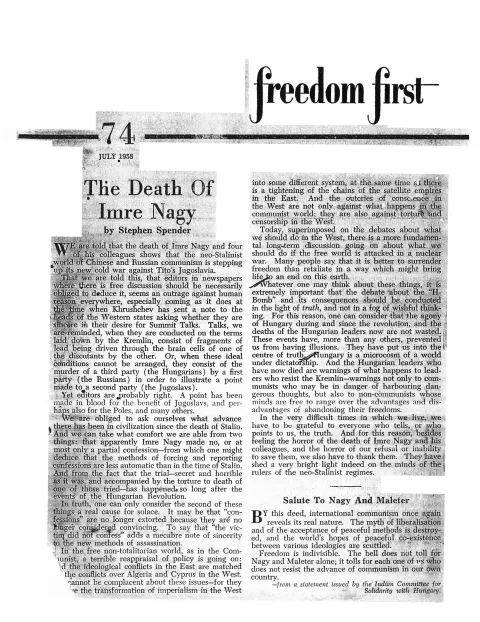
Stephen Spender’s lead piece condemns the secret trial and execution of Hungarian Premier Imre Nagy and his colleagues as an outrage that exposes the continuing brutality of Soviet-bloc communism even after Stalin’s death. Spender argues the killings should end illusions in the West about the nature of the Kremlin’s rule, situates the episode alongside the contemporaneous H-Bomb debate, and insists that any Western debate about nuclear weapons must be conducted ‘in the light of truth’ rather than wishful thinking. The piece is followed on the same pages by a Congress for Cultural Freedom statement mourning Nagy as ‘a brave and an honest man and a true patriot,’ a statement of homage from prominent Bombay citizens condemning the executions as a breach of safe-conduct guarantees, and a report on an Indian Committee for Cultural Freedom (Patna group) resolution describing the killings as heralding ‘the return of Stalinism.’
- Spender argues editors are right to link Nagy’s execution to the broader pattern of neo-Stalinist repression in the Eastern bloc.
- He frames the killings as evidence against complacency in Cold War debates, including the H-Bomb disarmament debate.
- The CCF statement calls the executions ‘both tragic and terrible’ and stresses they followed a secret trial after guarantees of safe conduct from Yugoslavia.
- A Bombay citizens’ statement of homage (signed by Asoka Mehta, M. R. Masani, N. G. Gore, and others) frames the deaths as a warning about Soviet imperialism.
- The Patna resolution of the Indian Committee for Cultural Freedom explicitly names the executions a return to Stalinism and a threat to freedom worldwide.
Murder of Imre Nagy (Statement issued by the Congress for Cultural Freedom)
The unsigned ‘Notes’ section (pp. 3-4) is a set of short editorial comments. It covers the split within Burma’s ruling AFPFL coalition and warns that continued communist exploitation of the rift could destabilise Burmese democracy; it discusses the cooling of Tito-Khrushchev relations following the Hungarian executions and Nehru’s carefully neutral public stance on the dispute; it criticizes a new communist-organized ‘Congress for Disarmament and International Co-operation’ in Stockholm as a rebranded front organisation, noting C. Rajagopalachari shared a platform with communist figures at a preparatory conference in Madras; it describes the settlement of a Bombay municipal workers’ strike as having been dictated improperly by a party caucus rather than elected corporators; and it condemns physical attacks on journalists, including on M. S. M. Sharma, editor of Searchlight in Patna.
- The AFPFL split in Burma is described as historically inevitable given the coalition’s heterogeneous ideological composition, with communists positioned to benefit most from the disunity.
- Tito is portrayed as caught between Soviet pressure and his own non-aligned ambitions; Nehru’s declining to criticize either side in the Tito-Khrushchev rift is quoted at length.
- A new communist-backed ‘Congress for Disarmament and International Co-operation’ in Stockholm is characterized as replacing the depleted Peace Congress, with the same personnel repackaged under a new name.
- C. Rajagopalachari is noted as having shared a conference platform in Madras with communist figures such as E. M. S. Namboodiripad, a marked change from his earlier anti-communist stance as Madras Chief Minister.
- A Bombay municipal strike’s resolution via a political party caucus (rather than through elected corporators) is criticized as an affront to local self-government.
- Attacks on journalists including the editor of Searchlight (Patna) and the editor of Tribune (Ambala) are condemned as attempts to silence political opinion through violence.
Homage To Hungarian Patriots (statement by prominent citizens of Bombay)
V. B. Karnik argues that the Praja Socialist Party (P.S.P.), following its Poona conference, is the only viable democratic alternative to the ruling Congress, since a Communist Party ascendancy would risk polarising Indian politics into two anti-democratic blocs. Karnik contends the traditional distinguishing feature of socialism — nationalisation of production, distribution and exchange — no longer separates the P.S.P. from either Congress or the Communists, since all parties now profess some form of socialism. He reframes the real political choice as one between a centralised, statist Leviathan and a decentralised, cooperative democracy that protects individual freedom, citing the intellectual influence of the late M. N. Roy and Jayaprakash Narayan’s break with orthodox socialism in favour of Sarvodaya.
- Karnik frames the P.S.P. as the most competent party to fill the political vacuum left by a disintegrating Congress, citing its ‘deep roots’ and rank-and-file energy.
- He warns that a Congress-versus-Communist polarisation would be disastrous for Indian democracy and could push Congress itself toward dictatorial methods.
- He argues nationalisation and socialist rhetoric no longer distinguish the P.S.P. from Congress or the Communists, since all now claim socialist credentials.
- He cites M. N. Roy’s conclusion that the true conflict of the age is between totalitarianism and democracy, not capitalism and socialism.
- He quotes Jayaprakash Narayan’s letter explaining his departure from party socialism toward Sarvodaya, describing socialism as unable to deliver freedom, equality and brotherhood.
- Karnik urges the P.S.P. to champion decentralisation, cooperative living, and individual rights against the Congress’s drift toward concentrated state power despite its Gandhian tradition.
Notes (Rift In Burma; The “Only Road” For Yugoslavia; Another Communist Front; Rule Of Party Caucus; Attacks On Journalists)
S. Sharangpani’s article analyses a warning issued by Kerala Chief Minister E. M. S. Namboodiripad — that if non-communist parties unite against the Communist Party, India risks a fratricidal civil war akin to China’s. Sharangpani argues this threat reveals the Communist Party’s self-image as the sole legitimate guardian of national unity and progress, and that Namboodiripad’s rhetorical distinction between the Communists’ own ‘united front’ tactics and the anti-communist coalition forming in Kerala is disingenuous, since the former aims to divide and neutralise opponents while the latter is a genuine defensive democratic alliance. He concludes that resistance to communism, as Kerala P.S.P. leader Pattom Thanu Pillai argued, is now the central and most urgent question for Indian democracy.
- Namboodiripad warned that if communists fail to gain power democratically and non-communist parties unite against them, India faces a civil war similar to China’s.
- Sharangpani situates this alongside earlier threats from communist leaders like Sunderayya after Kerala’s 1957 electoral victory.
- Namboodiripad frames socialism as the nation’s ‘declared objective’ and equates opposition to communism with being anti-national.
- Sharangpani argues the Communist Party’s ‘united front’ concept, per Hungarian leader Matyas Rakosi, aims ‘to divide our enemies and neutralise them,’ unlike genuine democratic coalitions.
- Pattom Thanu Pillai, the Kerala P.S.P. leader, is cited as saying resistance to communism is now the clearest and most urgent programme for democratic unity in Kerala and India.
An Alternative To The Congress
By V. B. Karnik
Adam Adil examines General de Gaulle’s rise to power and his proposed plan to integrate Algeria with metropolitan France, noting mixed reactions across North Africa. He argues the plan, which would grant Algerians equal rights and parliamentary representation with metropolitan Frenchmen without granting outright independence, could be a step toward a durable settlement given the deep economic interdependence between France and Algeria, including 4,000,000 Algerian workers in France and French investments supporting over 100,000 Arab workers in Algeria. Adil suggests a broader French-Algerian-Tunisian-Moroccan federation could jointly exploit Saharan mineral and oil wealth, and hopes de Gaulle’s policy leads toward such an outcome.
- De Gaulle’s rise and his Algeria integration plan received mixed reception: cautious hope among Tunisians, Moroccans, and some Algerian nationalists, but disappointment among extremist French settlers and rebel army leaders in Algeria.
- The plan proposes equal rights, benefits and parliamentary representation for Algerians alongside metropolitan Frenchmen, without granting Algeria full independence.
- Adil documents the deep economic interdependence between France and Algeria, including 4,000,000 Algerian workers in France and considerable French capital invested in Algeria.
- He estimates 1,500,000 million francs would be needed to further develop Algeria’s economy for its Arab majority, achievable only with continued French involvement.
- Adil floats the possibility of a wider federation encompassing France, Algeria, Tunisia and Morocco to jointly exploit Saharan mineral and oil resources.
- He notes the disparity in nationalist military strength (Algeria’s 40,000-strong army vs. Tunisia’s 3,000) as a possible source of future friction between Algeria and its neighbours.
Communists On War-path
By S. Sharangpani
A review signed ‘Sadi’ covers Howard Fast’s memoir The Naked God, an account of his disillusionment with and break from the Communist Party of the United States following Khrushchev’s secret speech denouncing Stalin. The reviewer finds Fast’s confession valuable for documenting the operation of the communist apparatus in the U.S. and the party’s infiltration of unions and professions, but argues the ‘final’ remorse of disillusioned communists comes too late given the scale of suffering communism has caused, and highlights Fast’s account of being erased from Soviet public life — including his correspondence and republished works — immediately after his break with the Party.
- The review situates Fast’s memoir as a response to Khrushchev’s 1956 secret speech to the Twentieth Congress denouncing Stalin’s crimes.
- Fast argues the U.S. Communist Party lost its integrity by delaying its 1956 convention to avoid confronting the crisis of conscience triggered by the revelations.
- The reviewer credits the book with giving a clear picture of Communist Party operations and infiltration of unions, students, and professionals in the U.S.
- The review criticizes disillusioned communists’ ‘final understanding’ as insufficient atonement given the toll of Stalinism.
- Fast recounts being erased from Soviet public and literary life — correspondence, book sales, and dramatizations — immediately after his February 1957 break with the Communist Party.
General de Gaulle, France And Algeria
By Adam Adil
Writing under the byline ‘Atreya,’ this report on the Praja Socialist Party’s Fourth Annual Convention (Poona, late May) surveys the party’s mood following the defection of Dr. Ram Manohar Lohia and the retirement of Jayaprakash Narayan from party politics. The report catalogues sharply divergent state-level attitudes toward alliances with the Congress and the Communist Party — from Kerala’s uncompromising anti-communism to Maharashtra and West Bengal’s more accommodating stance toward united fronts with communists — and highlights a strong speech by Asoka Mehta arguing the party must establish policy priorities beyond a reflexive socialism, given that the Congress’s decline would not automatically translate into a victory for democratic socialism.
- The convention met amid setbacks: Ram Manohar Lohia’s defection to form a rival Socialist Party, and Jayaprakash Narayan’s retirement from party politics for Bhoodan and Sarvodaya work.
- State units showed sharply divergent lines: Kerala uncompromisingly anti-communist and pro-Congress collaboration; Maharashtra and West Bengal leadership more sympathetic to communist alliances; Andhra fully backing the Kerala line; Uttar Pradesh described as the strongest unit despite the Lohia-induced split.
- Asoka Mehta’s speech argued the party could no longer avoid establishing clear policy priorities and that a Congress downfall would not necessarily be a victory for democratic socialism.
- The report identifies organisational weakness — lack of know-how on organisational technique — as the party’s greatest ongoing challenge, more severe than its ideological vacillation.
Generated by the v1.5 extraction pipeline. Awaiting editorial review.
Metadata and summary are AI-extracted from the source PDF and reviewed for editorial accuracy. The original work is available via the Read PDF tab above (where present); paragraph-level citation inside the PDF is deferred to a future engagement.