lecture · parliamentary
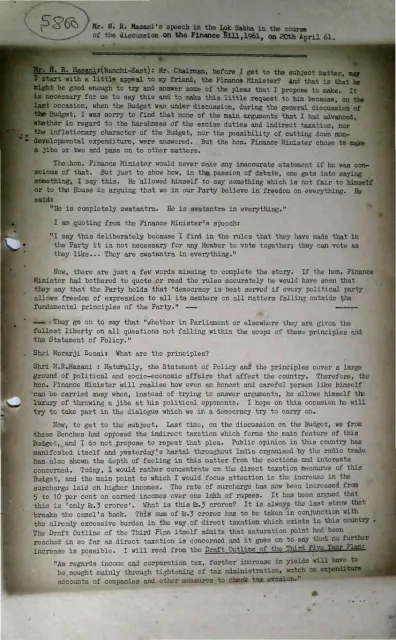
Lecture notes for speech on the Finance Bill, 1961, on 20-4-1961 in the Lok Sabha.
1961
10 pages
Summary
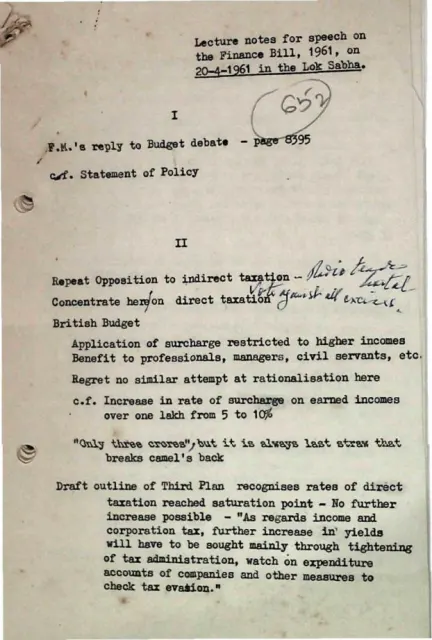
These lecture notes, prepared for a 20 April 1961 Lok Sabha speech on the Finance Bill, argue that India’s tax policy is already excessively punitive and risks weakening saving, investment, enterprise, and economic growth. The notes oppose indirect taxation in favour of direct taxation, criticize proposals to raise the burden on higher incomes, and frame progressive taxation as potentially hostile to individual initiative and the right to the fruits of one’s labour. They compare Indian tax rates with those in the United Kingdom, West Germany, France, the United States, Canada, Japan, and Norway, arguing that India’s marginal rates are among the world’s highest.
A substantial portion of the notes draws on reports by the Committee for Economic Development and the National Council of Applied Economic Research to argue that private savings have stagnated, public-sector savings have declined, and private enterprise remains essential to capital formation. The notes criticize egalitarian policies that reduce incentives to earn and accumulate wealth, while citing developments in the USSR as evidence that even socialist systems rely on incentives and private initiative. Later sections propose amendments concerning gratuity, entertainment allowances, development rebates, foreign technicians, and exemptions from double super-tax for iron-and-steel products. The final section is headed “Conclusion” and contains only a reference to Schumacher, an adviser to the National Coal Board.
Transcript
Summary
These lecture notes, prepared for a 20 April 1961 Lok Sabha speech on the Finance Bill, argue that India’s tax policy is already excessively punitive and risks weakening saving, investment, enterprise, and economic growth. The notes oppose indirect taxation in favour of direct taxation, criticize proposals to raise the burden on higher incomes, and frame progressive taxation as potentially hostile to individual initiative and the right to the fruits of one’s labour. They compare Indian tax rates with those in the United Kingdom, West Germany, France, the United States, Canada, Japan, and Norway, arguing that India’s marginal rates are among the world’s highest.
A substantial portion of the notes draws on reports by the Committee for Economic Development and the National Council of Applied Economic Research to argue that private savings have stagnated, public-sector savings have declined, and private enterprise remains essential to capital formation. The notes criticize egalitarian policies that reduce incentives to earn and accumulate wealth, while citing developments in the USSR as evidence that even socialist systems rely on incentives and private initiative. Later sections propose amendments concerning gratuity, entertainment allowances, development rebates, foreign technicians, and exemptions from double super-tax for iron-and-steel products. The final section is headed “Conclusion” and contains only a reference to Schumacher, an adviser to the National Coal Board.
Key points
- The notes oppose indirect taxation and call for concentration on direct taxation.
- They contend that Indian direct-tax rates, especially on high incomes, are already exceptionally high by international comparison.
- They argue that high taxation can suppress saving, investment, entrepreneurship, and the incentive to work and accumulate wealth.
- They use Committee for Economic Development and National Council of Applied Economic Research material to support private saving and private-sector investment.
- They criticize equality-driven fiscal policy when it lowers incentives and impedes economic growth.
- They cite Soviet examples and statements by Stalin and Kosygin to argue that socialist systems also recognize incentives and private enterprise.
- They request amendments relating to gratuity, entertainment allowances, development rebates, foreign technicians, and double super-tax exemptions for iron-and-steel products.
Metadata and summary are AI-extracted from the source PDF and reviewed for editorial accuracy. The original work is available via the Read PDF tab above (where present); paragraph-level citation inside the PDF is deferred to a future engagement.