press note
LONDON PRESS CONFERENCE
(Morning of 15th Feb.61)
London · 1961
3 pages
Summary
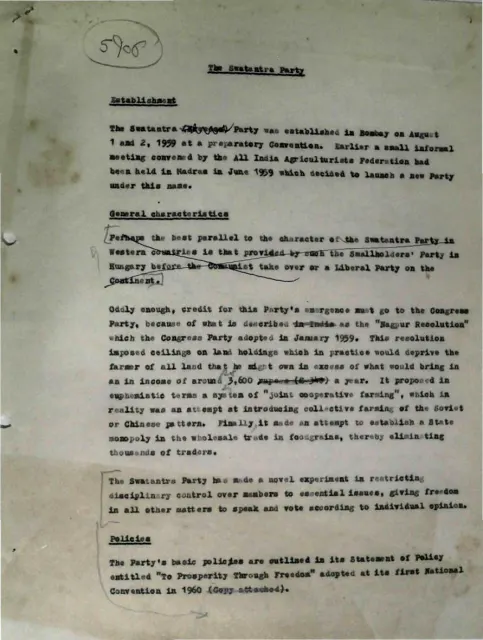
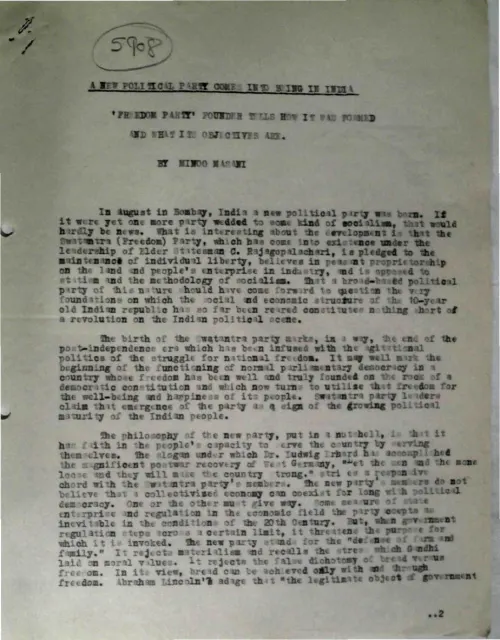
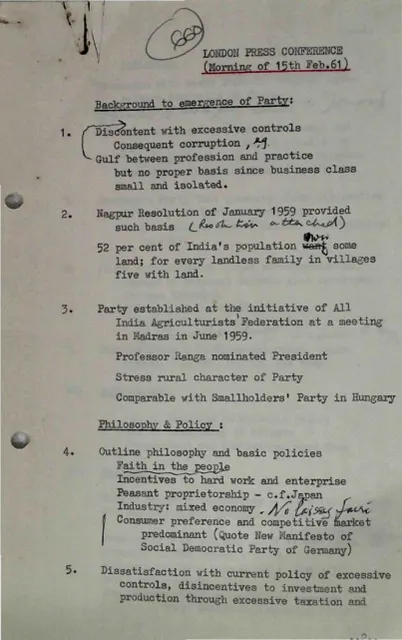
This three-page typed briefing for the London press conference of 15 February 1961 presents the background, philosophy, policies, achievements, and prospects of the Swatantra Party. It attributes the party’s emergence to discontent with excessive controls, corruption, the gap between professional ideals and practice, and the absence of an organised political base for business and rural interests. The Nagpur Resolution of January 1959 is identified as providing that basis, while the party’s establishment is traced to an initiative of the All India Agriculturists’ Federation at a Madras meeting in June 1959, with Professor Ranga as president.
In the rendered pages, the party is presented as advocating faith in the people, incentives to hard work and enterprise, peasant proprietorship, a mixed economy, and consumer choice through a predominantly competitive market. The briefing criticises excessive taxation, inflation, centralised planning, and an excessive emphasis on heavy industry at agriculture’s expense; it argues that command economies and political democracy cannot coexist for long. It also describes the party as a clear alternative to existing parties, links its foreign-policy repositioning to the Chinese invasion and the collapse of Panchsheel, and reports growing electoral representation and membership alongside serious organisational and financial weaknesses. The document concludes with an expectation that the party’s October convention will adopt an election manifesto and that success in the 1962 parliamentary election could transform India’s political situation.
Key points
- The briefing explains the Swatantra Party’s emergence as a response to excessive controls, corruption, and dissatisfaction with prevailing economic policy.
- It identifies the Nagpur Resolution of January 1959 and the June 1959 Madras meeting of the All India Agriculturists’ Federation as foundations of the party.
- Its stated programme combines peasant proprietorship, a mixed economy, enterprise incentives, and a predominantly competitive market shaped by consumer preference.
- The document attacks centralised planning, heavy-industry priorities, excessive taxation, inflation, and controls that discourage investment and production.
- It frames Swatantra as a previously unavailable political alternative and connects its defence policy to the Chinese invasion and the collapse of Panchsheel.
- Reported achievements include stimulating second thoughts on economic policy, ending a conspiracy of silence, and reducing fear among Congressmen and businessmen.
- The party is said to have encouraging public support and substantial legislative representation, but insufficient organisation, money, and business confidence.
- The briefing anticipates an October election manifesto and expresses optimism about transforming Indian politics through success in 1962.
Metadata and summary are AI-extracted from the source PDF and reviewed for editorial accuracy. The original work is available via the Read PDF tab above (where present); paragraph-level citation inside the PDF is deferred to a future engagement.