
essay
India's Ambitious New Plan
1961
2 pages

Summary
This two-page extract, attributed to Richard Fry and dated January 26, 1961, examines India’s economic performance during the transition from the Second to the Third Five-Year Plan. It reports that national output had grown by rather less than 4 per cent annually during the Second Plan, while population growth reduced the increase in output per head to about 2 per cent. The Third Plan’s stated objective was to raise national output by 5 per cent annually, or approximately 3 per cent per head.
The extract presents India’s industrial expansion as substantial, citing iron and steel, chemicals, electrical and mechanical machinery, railway equipment, lorries, cars, and bicycles. At the same time, it contrasts the performance of public and private enterprise: public projects had fallen 10 per cent short of their target, whereas private enterprise had exceeded its target by nearly 40 per cent. The page also reproduces contemporary commentary on India’s widening income disparity with the United States and on the need for international assistance to be directed toward countries capable of using it effectively.
Key points
- The Second Five-Year Plan produced annual national-output growth of less than 4 per cent, with population growth limiting per-capita growth to about 2 per cent.
- The Third Plan aimed for 5 per cent annual growth in national output, or roughly 3 per cent per head of population.
- The extract describes broad industrial development in steel, chemicals, machinery, transport equipment, and other sectors.
- It presents simultaneous advances in public and private enterprise against a background of state planning.
- Public projects reportedly missed their target by 10 per cent, while private enterprise exceeded its target by nearly 40 per cent.
- A cited comparison states that the income-per-head ratio between Indians and Americans worsened from one to fifteen in 1938 to one to thirty-five in 1952.
- A cited Spectator comment argues that development assistance should go to recipients able to use it effectively rather than be allocated according to an indiscriminate notion of equal shares.
Metadata and summary are AI-extracted from the source PDF and reviewed for editorial accuracy. The original work is available via the Read PDF tab above (where present); paragraph-level citation inside the PDF is deferred to a future engagement.
Related across the archive
 Primary workNotes on the II and III Plans for use at the Meeting of the British Group of the Liberal International on 15th February, 1961.
 Primary workFUNDAMENTAL CHANGES NEEDED IN ECONOMIC POLICY
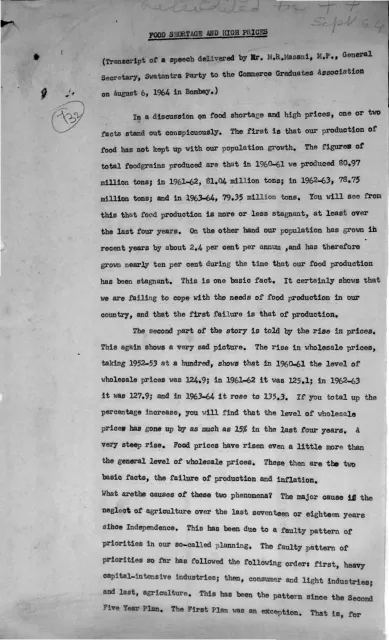 Primary workFOOD SHORTAGE AND HIGH PRICES
 ExcerptFifteen Years of Indian Planning
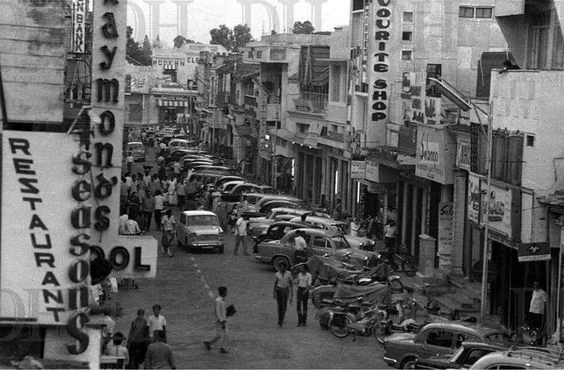 ExcerptFree Enterprise in Danger - B.R. Shenoy