essay
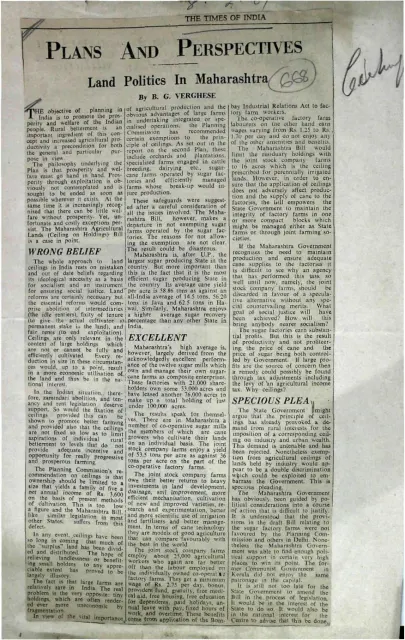
PLANS AND PERSPECTIVES
Land Politics In Maharashtra
THE TIMES OF INDIA
1 pages
Summary
In the rendered page, B. G. Verghese examines Maharashtra’s proposed land-ceiling policy and argues that uniform limits on agricultural holdings could damage productive sugar-factory farms. The article distinguishes between the social objective of reducing landlessness and the practical consequences of breaking up large, efficiently managed units. It presents the Planning Commission’s proposed ceiling—land yielding an annual income of Rs. 3,600—as an arbitrary figure and contends that ceilings should be assessed in relation to cultivation, productivity, and local conditions rather than acreage alone.
In the rendered page, Verghese uses Maharashtra’s sugar industry as his central case. He cites higher productivity on joint-stock company farms than on co-operative farms, as well as their investment in irrigation, mechanisation, drainage, improved seed, and fertiliser. He criticises the Maharashtra Bill for exempting sugar-factory farms only ambiguously and for empowering the State Government to reorganise them, arguing that such intervention could reduce production, jeopardise factory supplies, and undermine both economic efficiency and social justice. The article closes by questioning whether the policy could achieve socialism through administrative controls while leaving the underlying productivity problem unresolved.
Key points
- The article supports the objective of promoting Indian prosperity and welfare but questions whether land ceilings are an effective instrument of social justice.
- It argues that acreage-based ceilings ignore differences in land quality, cultivation, productivity, and the economic role of large farms.
- The Planning Commission’s proposed ceiling, based on an annual family income of Rs. 3,600, is presented as arbitrary and poorly related to contemporary agricultural methods.
- The article contrasts joint-stock company sugar farms with co-operative farms, citing higher yields and greater investment by the former.
- It warns that breaking up factory farms could reduce sugar production and disrupt supplies of cane to processing plants.
- The Maharashtra Bill is criticised for giving the State Government broad power to reorganise company farms into State farms or compact blocks.
- The article argues that price controls and ceilings may produce neither adequate social justice nor efficient agricultural production.
Metadata and summary are AI-extracted from the source PDF and reviewed for editorial accuracy. The original work is available via the Read PDF tab above (where present); paragraph-level citation inside the PDF is deferred to a future engagement.