speech
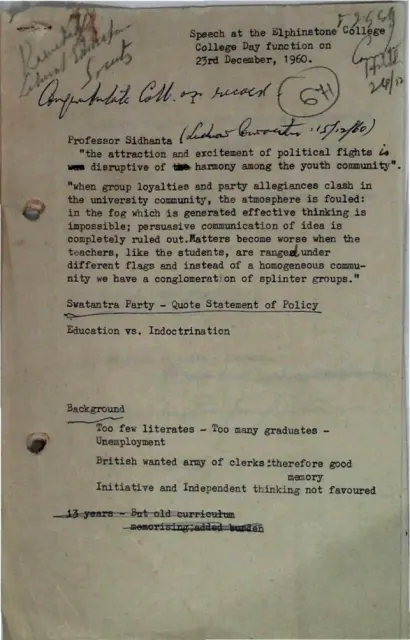
Speech at the Elphinstone College College Day function on 23rd December, 1960.
1960
5 pages
Summary
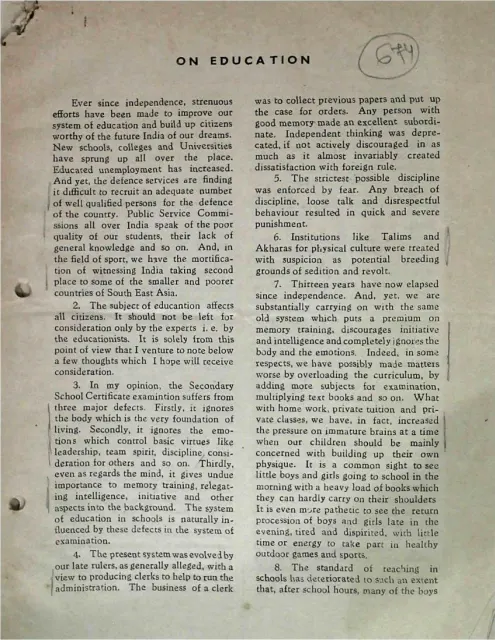
These five pages are typescript notes for a speech delivered at Elphinstone College’s College Day function on 23 December 1960. The speaker connects political conflict on campus with the purposes of education, contrasting inherited, examination-oriented instruction with an education that develops initiative, independent thinking, leadership, character, health, and specialised competence. The notes identify unemployment among graduates and an outdated curriculum as background problems, while also quoting a Swatantra Party statement on education versus indoctrination.
The speech then calls for intellectual curiosity, critical questioning, disciplined inquiry, and intellectual humility. It invokes the Socratic method, Gandhi’s injunction that India must learn to say “NO,” and examples involving George Washington, Mark Twain, and Tennyson to illustrate the need to test received stories and claims. The final pages broaden education to physical and emotional development: discipline, sports, games, and character formation. A proposal attributed to B. K. Gokhale would assign marks for physical health, games and sports, and conduct and discipline. The pages do not identify the speaker by a clear printed byline; “Professor Sidhanta” appears in the source material but cannot be confirmed as the author.
Key points
- Political fights, group loyalties, and party allegiances are presented as disruptive of harmony and communication in university life.
- The notes criticise an education system associated with clerical training, rote memory, unemployment, and an outdated curriculum.
- Higher education is assigned the goals of intellectual development, leadership, and specialisation for function.
- The speech calls for initiative, independent thinking, integrity, courage, service, compassion, discipline, and good health.
- Critical questioning is illustrated through the Socratic method and challenges to familiar stories about a curate’s egg and George Washington.
- Democratic discussion requires tolerance, patient listening, cooperative work, and readiness to accept criticism.
- Physical education, sports, and games are treated as means of building character and discipline.
Metadata and summary are AI-extracted from the source PDF and reviewed for editorial accuracy. The original work is available via the Read PDF tab above (where present); paragraph-level citation inside the PDF is deferred to a future engagement.