pamphlet
ON EDUCATION
Printed at Rajaguru Press, Poona 2. · Poona 2
11 pages
Summary
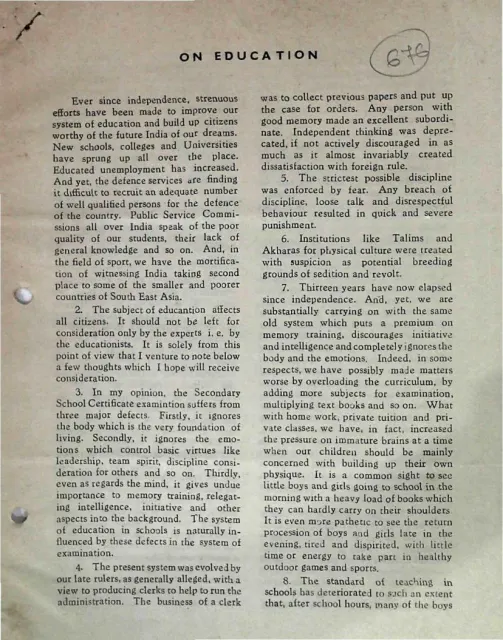
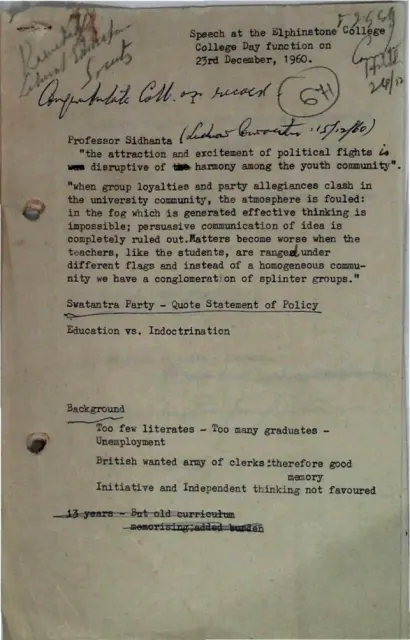
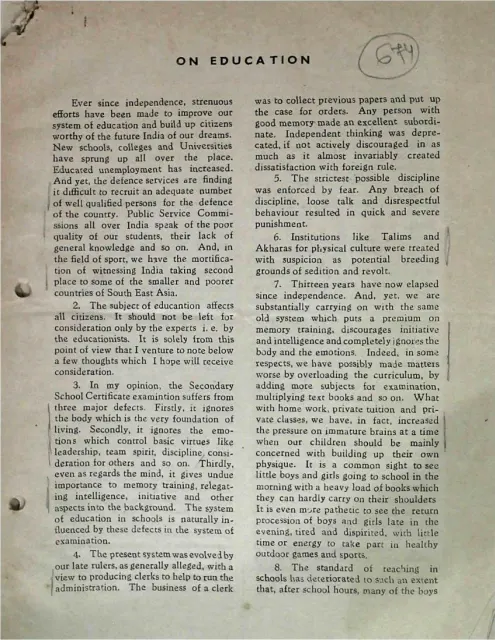
In the rendered pages, B. K. Gokhale argues that post-independence India has expanded its educational infrastructure without correcting the deeper defects of its inherited examination-centred system. The note criticises the Secondary School Certificate examination for neglecting physical development, emotional formation, leadership, discipline, initiative, general knowledge and independent thinking, while rewarding memory and encouraging dependence on guides, notes, private tuition and rote learning. The author links these failures to deteriorating teaching standards, student indiscipline, overloaded curricula and the premature intellectual pressure placed on children.
In the rendered pages, Gokhale proposes a broader conception of education directed toward the coordinated development of body, mind and emotions. He calls for physical health, recreation, games, good conduct and discipline to become compulsory examination subjects, with marks awarded for each. He also recommends limiting university admissions by institutional capacity and examination performance, while allowing concessions for disadvantaged groups. The accompanying annexures specify a long-term “Progress Book” recording academic achievement, conduct, physical health, games, sports and extracurricular activity from approximately age ten to twenty-one, and provide detailed marking schemes for health, games and discipline.
The rendered pages include the complete pamphlet and both annexures, but no publication year or formal pamphlet table of contents is visible. The table of contents reproduced in Annexure II belongs to the proposed pupil Progress Book, not to the pamphlet itself.
Key points
- The pamphlet attributes educational underperformance and educated unemployment to defects in the examination-centred school system.
- The Secondary School Certificate examination is criticised for privileging memory over intelligence, initiative, general knowledge and current affairs.
- Gokhale argues that education should develop physical health, emotional maturity, discipline, leadership, team spirit and independent thinking.
- The author proposes adding 200 marks for physical health, recreation and games, and good conduct and discipline to the written examination.
- The pamphlet recommends replacing fear-based discipline with discipline grounded in love, self-respect, patriotism and civic sense.
- University and college admissions should reflect institutional capacity, staffing and examination performance, with concessions for backward classes and scheduled tribes.
- Annexure II proposes Progress Books recording pupils’ academic, disciplinary, physical and extracurricular development from age ten to twenty-one.
Metadata and summary are AI-extracted from the source PDF and reviewed for editorial accuracy. The original work is available via the Read PDF tab above (where present); paragraph-level citation inside the PDF is deferred to a future engagement.