speech · convention address
PROBLEMS OF DEMOCRACY IN INDIA
Bombay · 1960
15 pages
Summary
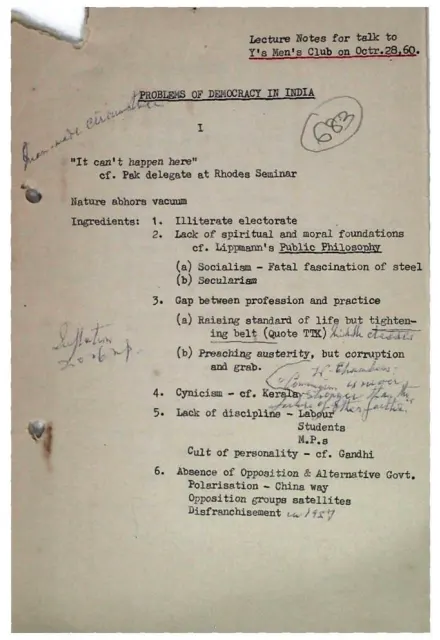
This undated-author lecture-note packet, prepared for a talk to the Y’s Men’s Club in Bombay on 28 October 1960, presents Indian democracy as threatened by an illiterate electorate, weak spiritual and moral foundations, a widening gap between public preaching and private practice, cynicism, indiscipline, personality cults, and the absence of an effective opposition. Its central institutional concern is the concentration of power associated with the Third Plan and state capitalism. The notes argue that a politically dominant state, an incompetent Parliament, and the erosion of autonomous social forces create conditions in which democratic forms may coexist with political dictatorship. They invoke Vinoba’s warning about power being concentrated in the hands of five or six people, Trotsky’s account of opposition under state employment, and concerns that planning and ideological conformity prepare the ground for communism.
The packet then switches to a separate set of notes for an Advertising Club, Bombay talk on the same date. These pages engage John Kenneth Galbraith and Friedrich Hayek on affluent-society consumption, advertising, inequality, public versus private expenditure, and inflation. The notes challenge the idea that consumer wants are wholly independent and argue that advertising and production can manufacture demand, while also resisting egalitarian policies that suppress incentives and economic progress. The inflation section presents inflationary planning as a threat to both democracy and individual freedom: attempts to control symptoms through bureaucracy, price controls, and regulation allegedly enlarge state power and undermine the market’s information function. The packet ends by framing the choice as one between monetary stability with a balance between state and private action, and an inflationary path that forces democracies to sacrifice either freedom, capital formation, or rapid material progress.
Key points
- The first lecture identifies illiteracy, weak moral foundations, cynicism, indiscipline, corruption, personality cults, and the absence of opposition as problems for Indian democracy.
- The notes criticize the concentration of political and economic power under state capitalism and the Third Plan.
- They argue that autonomous social forces, a competent Parliament, and effective opposition are necessary safeguards against political dictatorship.
- The second lecture links modern advertising and mass production to the creation of consumer wants rather than merely their satisfaction.
- The notes contrast private consumption with neglected public goods such as schools, parks, sanitation, housing, and urban infrastructure.
- They distinguish the effects of inequality and taxation in poor and affluent societies, while rejecting indiscriminate egalitarianism as a cure for poverty.
- The inflation discussion presents centralised planning and bureaucratic controls as mechanisms that conceal economic costs and erode democratic freedom.
- The final dilemma is stated as a choice among abandoning freedoms, tolerating inflation, or slowing material progress and capital formation.
Metadata and summary are AI-extracted from the source PDF and reviewed for editorial accuracy. The original work is available via the Read PDF tab above (where present); paragraph-level citation inside the PDF is deferred to a future engagement.