Summary
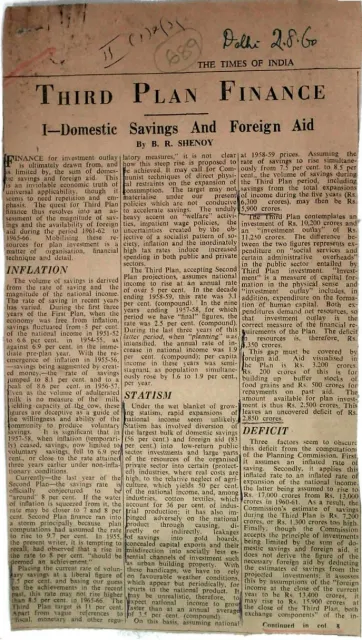
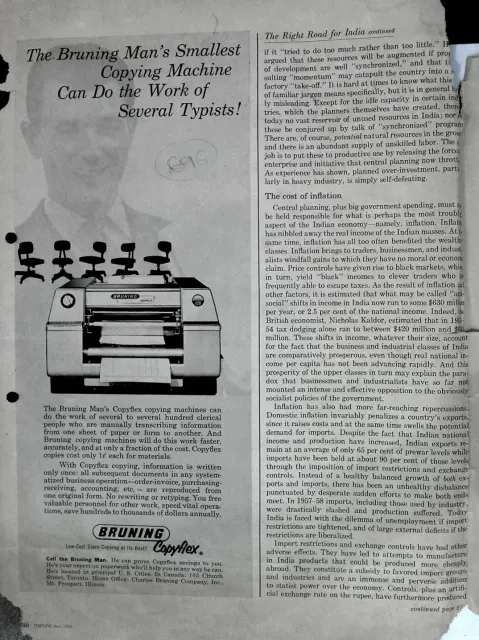
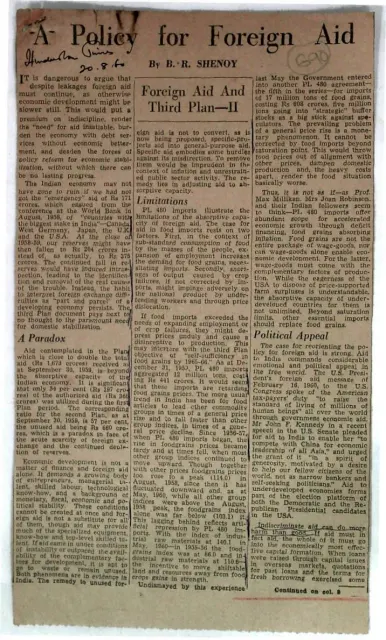
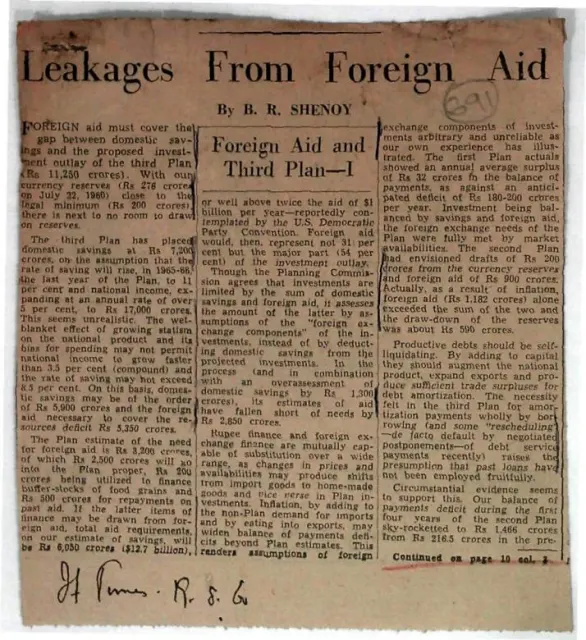
In the rendered pages, B. R. Shenoy argues that foreign aid is being absorbed inefficiently within India’s Third Plan. He contends that the Plan’s investment requirements exceed available domestic savings and foreign assistance, while inflation, import restrictions, and exchange-control distortions weaken the productive value of aid. He contrasts the Third Plan’s assumptions with the experience of the Second Plan, citing large reserve losses, payment deficits, and the diversion of aid toward consumption and inventories rather than productive investment.
In the rendered pages, Shenoy identifies several channels through which aid “leaks”: over-expansion of the public sector, under-utilised industrial and irrigation capacity, import licensing, over-invoicing and under-invoicing, and corruption. He argues that public-sector investment has generated insufficient returns and that foreign aid may end up financing the foreign-exchange counterpart of domestic savings that have been misdirected. The article therefore presents aid not as a substitute for sound fiscal and monetary management, but as a resource whose benefits are undermined by planning, controls, waste, and weak administrative accountability.
Key points
- Shenoy argues that the Third Plan’s investment targets exceed the resources available from domestic savings and foreign aid.
- The article links foreign-exchange shortages and payment deficits to inflation, import controls, and inefficient investment.
- Second Plan experience is used to show reserve depletion, rising debt-service pressures, and a widening balance-of-payments problem.
- Aid-funded imports are said to include consumption goods and other items that do not directly expand productive capacity.
- The article criticises public-sector expansion, pointing to under-utilised industrial and irrigation capacity.
- Import licensing, fictitious resale margins, over-invoicing, and under-invoicing are presented as mechanisms that divert or waste aid.
- Shenoy warns that public-sector expansion creates conditions favourable to corruption and easy spending.
Metadata and summary are AI-extracted from the source PDF and reviewed for editorial accuracy. The original work is available via the Read PDF tab above (where present); paragraph-level citation inside the PDF is deferred to a future engagement.