essay
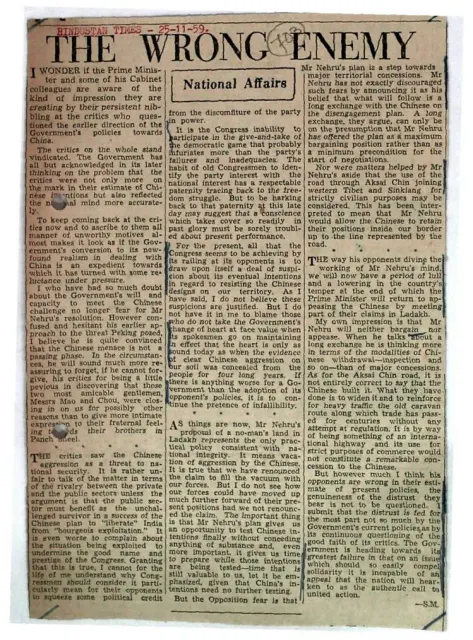
THE WRONG ENEMY
HINDUSTAN TIMES · 1959
2 pages
Summary
In the rendered article, the unidentified writer argues that criticism of the Nehru government has been substantially vindicated, especially criticism of its handling of China and the border dispute. The article contends that the government has conceded too much to China, failed to recognize the strategic significance of Aksai Chin and Sinkiang, and risks allowing Chinese forces to retain positions inside Indian territory. It also rejects the claim that the critics are motivated by partisan hostility, pointing instead to their earlier warnings and their record of supporting the government when they believed it was right.
The article also criticizes the Congress government’s internal political posture. It questions whether Congress is genuinely committed to democratic practice, suggesting that its leaders have treated dissent as disloyalty and have been reluctant to accept responsibility for policy failures. The writer nevertheless expresses confidence in the government’s good faith, while warning that good intentions cannot substitute for sound judgment, especially in foreign policy. Page 2 contains unrelated newspaper material and does not continue the article.
Key points
- The article says earlier critics of the Nehru government’s policies have largely been vindicated.
- It argues that the China policy and the Aksai Chin-Sinkiang road issue reveal serious failures of judgment.
- It claims that Chinese territorial concessions were being accepted under the guise of negotiation.
- It rejects the idea that criticism of the government is primarily partisan or motivated by hostility.
- It questions Congress’s commitment to democratic debate and its willingness to accept responsibility for failures.
- It distinguishes the government’s good faith from the correctness of its policies.
Metadata and summary are AI-extracted from the source PDF and reviewed for editorial accuracy. The original work is available via the Read PDF tab above (where present); paragraph-level citation inside the PDF is deferred to a future engagement.