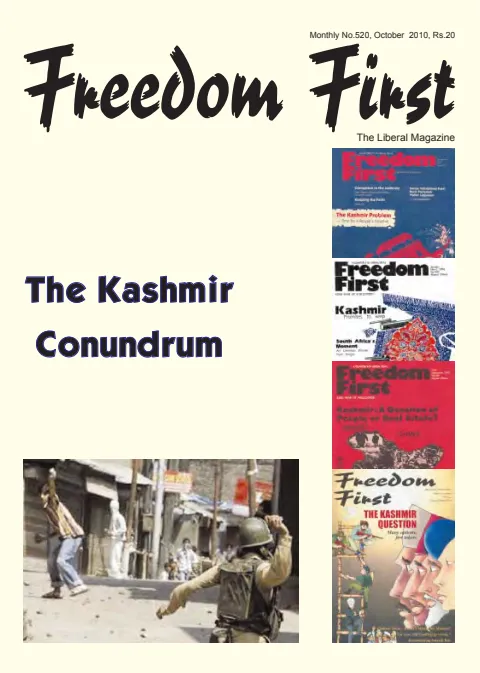
periodical issue
Freedom First
The Liberal Monthly
Edited by S. V. Raju
Publisher: Indian Committee for Cultural Freedom (ICCF), 3rd Floor, Army & Navy Building, 148, Mahatma Gandhi Road, Mumbai 400 001. Published by J. R. Patel for the Indian Committee for Cultural Freedom (ICCF) and printed by him at Union Press, 13 Homji Street, Fort, Mumbai 400 001. · Mumbai · 2010
44 pages
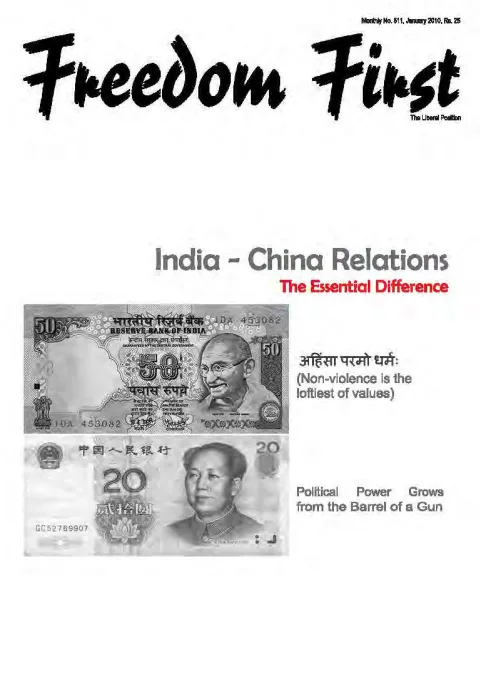
Freedom First
Summary
The rendered pages show the January 2010 issue of Freedom First, a liberal monthly entering its 58th year, with an editorial appeal about the magazine’s finances, reader letters on civic and political questions, brief obituaries, and a large cover feature on India-China relations. The issue frames liberal public life as a mix of civic responsibility, free expression, national security, and institutional competence: it mourns liberal and literary figures, records readers’ anxieties about intolerance and political opportunism, and turns the cover feature into a seminar-style debate on China’s power, India’s border posture, Tibet, Arunachal Pradesh, South Asia, soft power, and economic strategy.
Key points
-
The editor’s “Between Ourselves” appeals for reader support amid rising production costs and thin revenue, proposing subscriptions, donations, and issue sponsorship to sustain the magazine as it enters its 58th year.
-
The cover feature on India-China relations opens with Maj. Gen. Eustace D’Souza’s continuation of “Are We Heading for a 1962 Repeat,” drawing on personal military encounters to argue India should hold firm through winter along the frontier while improving equipment and infrastructure.
-
Brig. S. C. Sharma surveys China’s border disputes and regional strategy, portraying it as expansionist but pragmatic, using Pakistan, Myanmar, Sri Lanka, and Nepal to widen its influence and constrain India.
-
Ashok Karnik argues India should not read weakness into the government’s public ambiguity toward China, welcoming firmness on the Dalai Lama’s Tawang visit and warning against arguments that ask India to concede ground on Aksai Chin for the sake of appearing reasonable.
-
A recorded seminar “Discussions” section debates the McMahon Line, Panchsheel, Aksai Chin, and whether India should combine military deterrence with economic and soft-power projection against China, extending the rivalry to the Indian Ocean and Africa.
-
Nitin Pai’s “Why Fixing Drains Will Help Counter Terrorism” argues counterterrorism cannot be separated from ordinary governance, rejecting both military retaliation and the idea that security agencies can function well while public works and policing remain weak.
-
Reader letters mix support for the magazine with warnings against political fasts used coercively, calls for Hindu-Muslim reconciliation following the Liberhan Report on Ayodhya, and proposals to bring voting facilities closer to voters.
Essays
Between Ourselves
By Editor
The opening editorial, ‘Between Ourselves…’, wishes readers a peaceful New Year but immediately turns to the uncertain future of Freedom First. The editor says the magazine has gained reader recognition and a fuller article pipeline, yet costs are rising while revenue remains thin; the piece asks readers to help through subscriptions, donations, sponsorship, and advertising support.
- The editor presents Freedom First as increasingly valued by readers and contributors.
- The magazine’s financial problem is described as rising production costs alongside weak revenue.
- The proposed remedies include regular-sized issues, higher subscription rates, life-subscriber donations, issue sponsorship, and better advertising tariffs.
From Our Readers
The rendered reader letters mix support for Freedom First with criticism of contemporary politics and public culture. They praise the magazine’s independence, complain about intolerance and negative media incentives, warn against politicians using fasts for coercive ends, call for reconciliation around Hindu-Muslim tensions, and suggest practical electoral reforms such as bringing voting facilities closer to voters.
- Several readers defend Freedom First as an independent, timely, and valuable liberal publication.
- One letter argues that religious identity should not be worn as a political badge and that ethical conduct matters more than outward religiosity.
- Another criticizes political fasts over Telangana as coercive tactics unlike Gandhi’s self-purifying fasts.
- A letter on Ayodhya and the Liberhan Report calls for truth and reconciliation rather than revenge.
- A letter on EVMs argues that low voting rates undermine democratic representation.
Are We Heading for a 1962 Repeat (2)
By Maj.Gen. Eustace D’Souza
Maj. Gen. Eustace D’Souza’s ‘Are We Heading for a 1962 Repeat (2)’ answers fears of another border disaster with first-hand military memory and recent observation. He recounts encounters with Chinese troops from Natu La onward, stresses that Indian troops in the eastern sector show quiet confidence rather than panic, and argues that India should hold firm through winter while improving equipment, intelligence, local infrastructure, and political will.
- D’Souza uses personal military encounters to contrast 1950s-60s unpreparedness with later Indian readiness.
- He insists that India has no plan to attack China but must be prepared to hold its positions.
- He emphasizes infrastructure in Arunachal Pradesh and the confidence of soldiers and families stationed near the frontier.
- He calls for the main lessons of the Henderson Brooks Report to be made public, while protecting sensitive material.
China’s Relations with South Asia
By Brig. S. C. Sharma
Brig. S. C. Sharma’s ‘China’s Relations with South Asia’ surveys China’s border disputes, regional bargains, and strategic use of neighboring states. He portrays China as expansionist but pragmatic, willing to settle disputes when useful, while using Pakistan, Myanmar, Sri Lanka, Nepal, Bangladesh, Afghanistan, and Central Asian ties to widen its influence and constrain India.
- Sharma opens with the claim that China has borders with 16 countries and has had disputes with all of them.
- He argues that China seeks territorial integrity over Taiwan, Tibet, Xinjiang, Mongolia, and the South China Sea while suppressing anti-Chinese movements abroad.
- Pakistan is presented as China’s all-weather partner and a lever against India.
- For India, Sharma recommends stronger relations with states not friendly to China, offensive capability, attention to border states, and realistic cost-benefit analysis of conflict.
Political Will in India vis-à-vis China
By Ashok Karnik
Ashok Karnik’s ‘Political Will in India vis-a-vis China’ argues that India should not infer weakness from the government’s public ambiguity, but should welcome signs of firmness on visas, the Dalai Lama’s visit to Tawang, Arunachal Pradesh, and Chinese activity in Pakistan-occupied Kashmir. Karnik revisits Tibet, Panchsheel, Nehru’s Forward Policy, the McMahon Line, the Deng Package, and Chinese negotiating habits to warn against intellectual arguments that ask India to give up ground for the sake of appearing reasonable.
- Karnik says China used promises about Tibetan autonomy and later territorial claims to draw India into a poor strategic position.
- He defends the historical need for Indian check-posts along the border, even while acknowledging the controversy around Nehru’s Forward Policy.
- He treats the Deng Package as ambiguous and warns that accepting it could mean conceding Aksai Chin without a reliable reciprocal settlement.
- He argues that India’s intellectual class should stop weakening the government’s negotiating posture when the government is taking a firmer line.
Discussions
The ‘Discussions’ section records a lively seminar exchange rather than a consensus. Participants debate whether the McMahon Line is Indo-Tibetan or Sino-Indian, whether Panchsheel foreclosed India’s options, why China values Aksai Chin, how China combines hard power and soft power, whether India should use moral authority over Tibet and Myanmar, how the global financial crisis affects China, and whether India’s development of the North East is itself a strategic necessity.
- The editor says the seminar did not seek consensus but revealed confusion and multiple strategic perspectives.
- Participants repeatedly return to Tibet, Aksai Chin, Arunachal Pradesh, and Nepal as linked strategic questions.
- Some speakers urge India to combine military deterrence with economic and soft-power projection.
- Economic discussants argue that China needs markets, faces internal financial strains, and may use India both as a competitor and as a commercial partner.
- The discussion ends by treating India-China rivalry as worldwide, extending to the Indian Ocean, Africa, Latin America, and raw-material competition.
Why Fixing Drains Will Help Counter Terrorism
By Nitin Pai
Nitin Pai’s ‘Why Fixing Drains Will Help Counter Terrorism’ argues that counterterrorism cannot be separated from ordinary governance. Beginning from the anger after the Mumbai 26/11 attacks, Pai rejects both impulsive military retaliation and the idea that security agencies can function well while public works, health, education, environment, policing, and electoral accountability remain weak.
- Pai argues against bombing Muridke or otherwise doing exactly what the Pakistani military-jihadi complex wants India to do.
- He says Mumbai’s acceptance of poor public goods sends the state a signal that governance failures are tolerable.
- He links competent policing and intelligence to the broader quality of civil administration.
- His remedy is political participation: voting, legitimate campaign finance, and holding politicians to account.
Generated by the v1.5 extraction pipeline. Awaiting editorial review.
Metadata and summary are AI-extracted from the source PDF and reviewed for editorial accuracy. The original work is available via the Read PDF tab above (where present); paragraph-level citation inside the PDF is deferred to a future engagement.