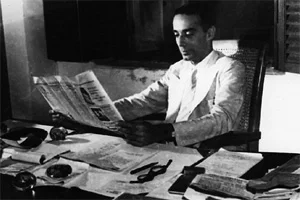
letter
Letter to Mr Minoo Masani
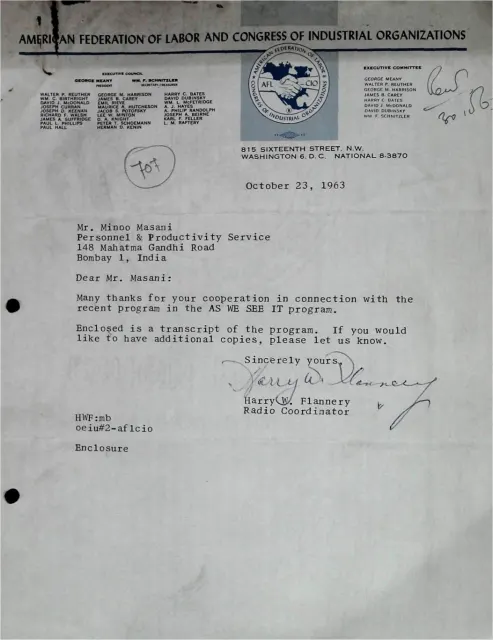
AMERICAN FEDERATION OF LABOR AND CONGRESS OF INDUSTRIAL ORGANIZATIONS · WASHINGTON 6, D. C. · 1963
13 pages
Summary
This October 23, 1963 AFL-CIO letter from Radio Coordinator Harry W. Flannery to Minoo Masani thanks Masani for cooperating with the “AS WE SEE IT” public-service program and encloses its transcript. The enclosure, a four-page ABC radio interview dated October 27, 1963, is titled “Non-Nehru View from India” and presents Masani as a parliamentary opponent of Jawaharlal Nehru’s Congress Party and general secretary of the Swatantra Party.
In the interview, Masani argues that the 1962 Chinese attack on India exposed the weaknesses of Indian non-alignment and widened the gap between public opinion and Nehru’s government. He criticizes the government’s continuing diplomatic stance toward Communist China and discusses the Kamaraj Plan, cabinet changes, possible succession politics, and Krishna Menon’s influence. He then identifies population growth, inadequate capital, weak economic incentives, collectivization, and excessive taxation as central problems, advocating increased productivity, private enterprise, peasant proprietorship, and a mixed economy. Masani also presents the Swatantra Party as liberal rather than conservative, defending trade-union rights, collective bargaining, the right to strike, and the need for a genuine two-party system.
Key points
- The primary document is a cover letter dated October 23, 1963, from Harry W. Flannery to Minoo Masani.
- The letter encloses an ABC/AFL-CIO radio transcript dated October 27, 1963, titled “Non-Nehru View from India.”
- Masani criticizes India’s continued non-alignment and support for Communist China’s admission to the United Nations after the Chinese attack on India.
- He argues that Indian public opinion had moved further from Nehru’s government than official policy indicated.
- The interview examines the Kamaraj Plan, cabinet resignations, Khrushchev-related speculation, and possible succession involving Indira Gandhi and Krishna Menon.
- Masani attributes India’s economic difficulties to population growth, insufficient capital, weak incentives, inflationary taxation, and collectivist agricultural policies.
- He advocates a mixed economy, private enterprise, peasant proprietorship, stronger productivity, and agricultural policies modeled partly on Japan and Formosa.
- He defines the Swatantra Party as liberal, supports trade-union freedoms and the right to strike, and calls for a competitive two-party parliamentary system.
Metadata and summary are AI-extracted from the source PDF and reviewed for editorial accuracy. The original work is available via the Read PDF tab above (where present); paragraph-level citation inside the PDF is deferred to a future engagement.