speech · convention address
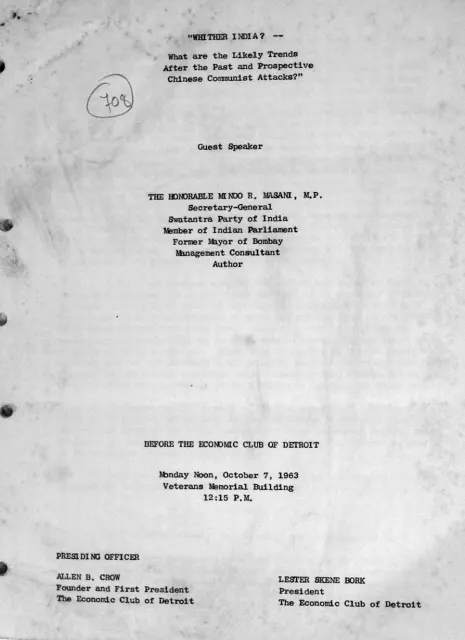
WHITHER INDIA?
What are the Likely Trends After the Past and Prospective Chinese Communist Attacks?
Detroit · 1963
17 pages
Summary
In this October 1963 address to the Economic Club of Detroit, Minoo Masani assesses India’s position after China’s 1962 attack and warns that the crisis exposed the weaknesses of post-independence foreign and defence policy. He argues that India’s commitment to non-alignment and Panchsheel was undermined by inadequate recognition of Chinese intentions, the government’s concealment of territorial losses, and the misplaced concentration of military planning on Pakistan rather than China. Masani treats the attack as a national shock that ended India’s political “dreamland,” but also as an education that strengthened public awareness, patriotic feeling, democratic cooperation, and ties with the democratic countries.
Masani’s balance sheet is mixed. He credits India with learning more about Chinese communism, maintaining civil freedoms during the emergency, and demonstrating that opposition parties could act loyally in a crisis. Against this, he places continued diplomatic indulgence toward Communist China, failure to build an accommodation with Pakistan, reluctance to accept useful military assistance, and renewed dependence on Krishna Menon’s advice. The speech then turns to economics: Masani criticizes excessive planning, control, taxation, and inflation, and calls for private enterprise, foreign capital, managerial expertise, and technical skill to address India’s population and capital shortage. In the question-and-answer session, he predicts that India will not be taken over by Chinese or Soviet communism, though he expects a long struggle; he also discusses Congress’s electoral advantage, the Moscow–Peking contest within Indian communism, the abandoned Bokaro steel proposal, and the dim immediate prospects for India-Pakistan friendship.
Key points
- The 1962 Chinese attack is presented as a decisive shock that ended India’s post-independence political complacency.
- Masani criticizes non-alignment and Panchsheel when practiced without adequate attention to Chinese power and intentions.
- India’s military defeat is attributed to poor strategic judgment, political interference, inadequate equipment, and preparation for the wrong frontier.
- The crisis also revealed patriotic energy, democratic maturity, civil freedoms, and support from the democratic countries.
- Masani identifies continued tension with Pakistan and reluctance to accept foreign defence assistance as major strategic weaknesses.
- He argues that excessive planning, state control, taxation, and inflation burden an otherwise vigorous Indian economy.
- He advocates private enterprise, equity capital, managerial knowledge, technical skill, and infrastructure investment.
- In the Q&A, he rejects an imminent Communist takeover while stressing that the struggle for India’s political freedom will be long and difficult.
Metadata and summary are AI-extracted from the source PDF and reviewed for editorial accuracy. The original work is available via the Read PDF tab above (where present); paragraph-level citation inside the PDF is deferred to a future engagement.