Summary
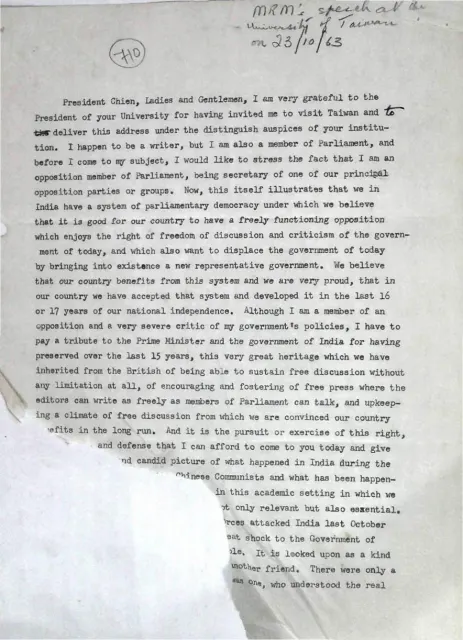
In this speech at the University of Taiwan on 23 October 1963, Minoo Masani presents India’s parliamentary democracy and its culture of free discussion as valuable inheritances that should be defended even by opposition politicians. He then examines the consequences of China’s 1962 attack on India. He attributes the military defeat to mistaken strategic assumptions about China, political interference in the armed forces, inadequate equipment for Himalayan warfare, and the government’s decision not to use air power. The defeat, he argues, exposed India’s loss of contact with international reality and produced a sharper public awareness of the communist threat.
Masani describes the war as a political and ideological turning point. Western military assistance, contrasted with Soviet and other Asian governments’ neutrality, forced Indians to reconsider non-alignment and the belief that communist China was a peaceful neighbour. He argues that India must distinguish between the Chinese people and the Chinese communist dictatorship, support Tibet’s right to self-determination, and establish closer relations with the Republic of China in Taiwan. The speech closes by portraying India as “half cured”: the public has become more politically conscious, opposition parties have gained support, and changing popular attitudes may eventually permit Indians and Chinese to cooperate for freedom and peace.
Key points
- Masani defends parliamentary democracy, a functioning opposition, free discussion, criticism of government, and a free press.
- He attributes India’s 1962 military defeat to faulty strategic planning, politicisation of the army, inadequate mountain-war equipment, and the non-use of air power.
- The Chinese attack is presented as a shock that ended India’s post-1947 political “dreamland” and exposed its detachment from international reality.
- Western military assistance altered Indian perceptions of political friendship and challenged the assumptions behind non-alignment.
- Masani argues that coexistence with China’s communist dictatorship was based on a misunderstanding of the regime’s intentions.
- He insists that India should distinguish the Chinese people from the Chinese communist government.
- He presents support for Tibetan self-determination and renewed friendship with Taiwan as lessons India should draw from the crisis.
- He claims the attack strengthened opposition politics and encouraged Indian voters to think more independently.
Metadata and summary are AI-extracted from the source PDF and reviewed for editorial accuracy. The original work is available via the Read PDF tab above (where present); paragraph-level citation inside the PDF is deferred to a future engagement.