Summary
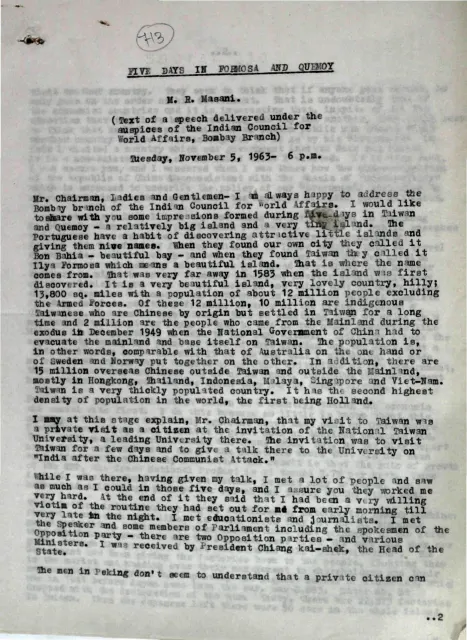
In this speech delivered in Bombay on 5 November 1963, M. R. Masani reports on a five-day private visit to Taiwan and Quemoy (Kinmen). He describes Taiwan’s population, economic development, agricultural productivity, land reform, education, infrastructure, and industrial growth, presenting its rural transformation as the product of tenant-oriented land reform, capital investment, fertiliser use, and practical agricultural administration. He contrasts Taiwan’s development with the economic and military condition he attributes to Communist China, while also noting Taiwan’s dependence on American aid and its heavy defence expenditure.
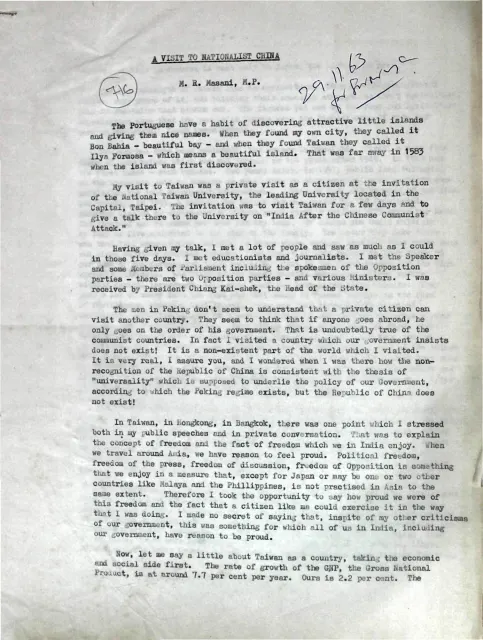
Masani’s central political concern is the contrast between India’s civil freedoms and the restrictions he observes or hears about in Taiwan. He discusses opposition parties, parliamentary debate, press freedom, censorship, and cases involving Lei Chen and Wang Chen, while arguing that political liberty is essential to national strength. The latter part of the speech turns to the China–Taiwan conflict, the strategic role of Quemoy and Matsu, Tibet’s right to self-determination, India’s relations with the Republic of China, and the possibility of liberating mainland China. Masani urges Indians to distinguish the Chinese people from the Communist regime, improve unofficial contacts with Taiwan, and reconsider what he regards as an overly accommodating Indian foreign policy.
Key points
- Masani presents Taiwan as a densely populated society that had achieved substantial economic growth, improved living standards, expanded education, and rising agricultural productivity.
- He attributes Taiwan’s agricultural success chiefly to post-1949 rent control, redistribution of public and surplus land, smallholder ownership, credit, and intensive fertiliser use.
- The speech praises Taiwan’s civil liberties in comparison with Communist China and argues that freedom of speech, press, discussion, and opposition should be defended even during wartime.
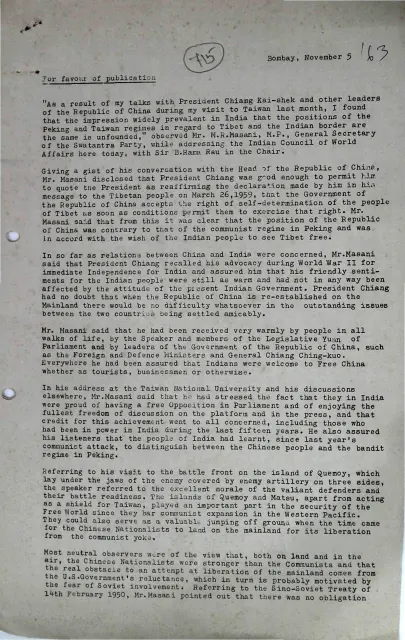
- Masani describes Quemoy and Matsu as strategically important military outposts that contain Communist forces and support the defence of Taiwan.
- He portrays Communist China as weakened by industrial and military deterioration, while cautioning that political liberation must ultimately depend on the Chinese people rather than foreign military action alone.
- Masani advocates recognition of the Chinese people’s right to self-determination in Tibet and rejects a permanent two-China arrangement that would leave most of China under Communist rule.
- He calls for greater unofficial Indian–Taiwanese contact through travel, journalism, education, business, and the exchange of ideas despite the absence of diplomatic relations.
Metadata and summary are AI-extracted from the source PDF and reviewed for editorial accuracy. The original work is available via the Read PDF tab above (where present); paragraph-level citation inside the PDF is deferred to a future engagement.