Summary
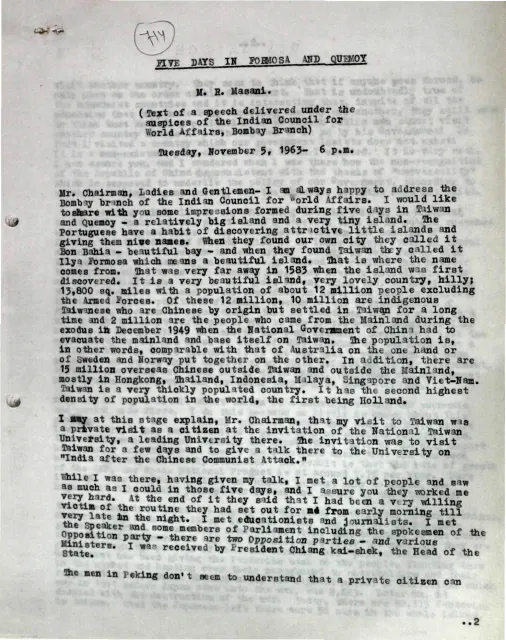
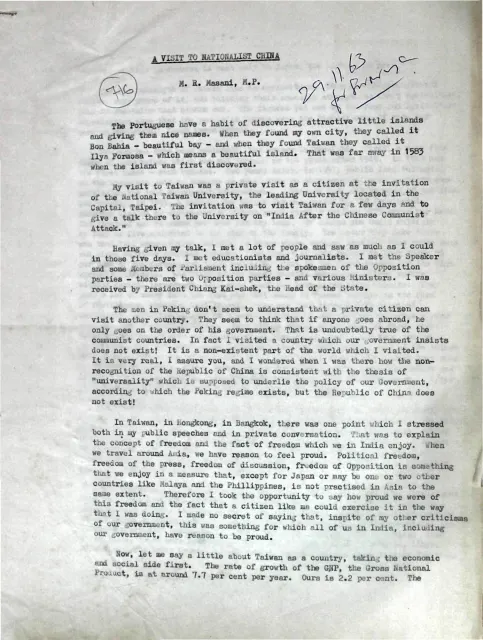
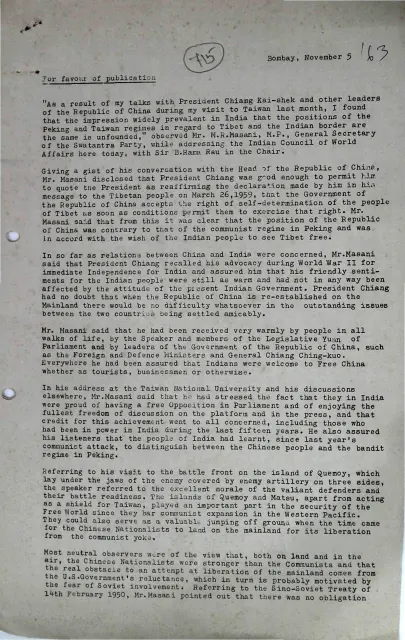
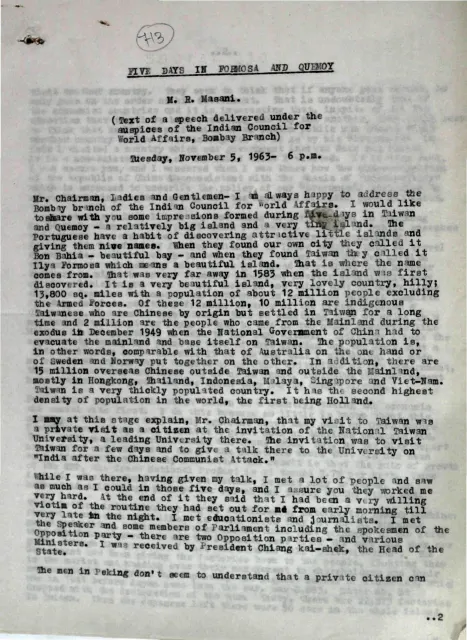
In this speech, delivered in Bombay on 5 November 1963 after a five-day visit to Taiwan and Quemoy, M. R. Masani presents Taiwan as a striking example of economic development combined with political freedom. He describes land reform, intensive agricultural production, expanding industry, improved transport and communications, near-universal schooling, and rising living standards. He attributes Taiwan’s agricultural success especially to rent control, the transfer of land to tenant farmers, compensation for dispossessed landlords, substantial capital investment, and the expansion from single-crop farming to multiple annual crops. He also notes Taiwan’s agricultural exchanges with Asian and African countries and its role in training farmers and agricultural experts.
The speech then turns to Taiwan’s political and strategic position. Masani praises the existence of opposition parties, parliamentary debate, freedom of the press, and public criticism of the government, while acknowledging restrictions on civil liberty and the absence of national elections until the mainland is recovered. He discusses Taiwan’s military importance, the defensive role of Quemoy and Matsu, the weakness he attributes to Communist China’s industrial and military systems, and the uncertain Sino-Soviet relationship. The concluding argument is for an India–Taiwan relationship conducted by individuals, journalists, businesses, and civil society even without formal diplomatic recognition, alongside a distinction between the Chinese people and the Communist regime in Peking.
Key points
- Masani reports that Taiwan combines economic growth with political freedoms that he considers unusually extensive in Asia.
- He credits Taiwan’s agricultural productivity to post-1949 land reform, tenant ownership, capital investment, fertiliser use, and diversified cropping.
- The speech highlights Taiwan’s industrial expansion, export earnings, electrification, education system, and agricultural cooperation with Asian and African countries.
- Masani describes Taiwan’s parliamentary opposition, press, and public debate while also identifying limitations on civil liberty and electoral representation.
- Quemoy and Matsu are presented as defensive outposts, barriers to Communist expansion, and possible bases for a future Nationalist return to the mainland.
- Masani argues that reports of Communist China’s economic and military weakness make Nationalist liberation of the mainland a plausible, though uncertain, prospect.
- He advocates practical India–Taiwan contacts despite the absence of diplomatic relations and urges India to distinguish between free Chinese and the Peking regime.
Metadata and summary are AI-extracted from the source PDF and reviewed for editorial accuracy. The original work is available via the Read PDF tab above (where present); paragraph-level citation inside the PDF is deferred to a future engagement.