
Summary
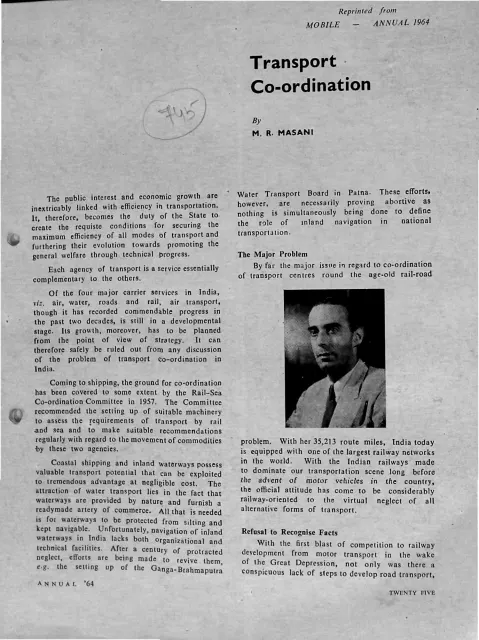
In the rendered pages, M. R. Masani argues that public interest and economic growth depend on efficient transportation, and that the State should create conditions for all modes—rail, road, water and air—to develop in a complementary relationship. He highlights the neglected potential of coastal shipping and inland waterways, while identifying India’s railway-centred transport policy as the central problem of co-ordination.
In the rendered pages, Masani criticises the political and administrative privileges accorded to the railways at the expense of road transport. He points to restrictive licensing, route limits, multi-State permits, high and overlapping taxes, weight restrictions, inadequate roads and insufficient investment. The essay also challenges the claim that railways alone can carry bulky industrial materials, citing the technical capacity of road transport elsewhere.
In the rendered pages, Masani concludes that India faces a substantial transport shortage and that roads must be developed rapidly alongside the railways. He uses projected traffic volumes to argue that the railways cannot meet future demand by themselves, and calls for a bolder, economically grounded policy that co-ordinates the two services rather than preserving the railways’ monopoly.
Key points
- Efficient transportation is presented as essential to public welfare and economic growth.
- India’s transport policy is criticised for being excessively railway-oriented and for neglecting roads, waterways and other alternatives.
- Coastal shipping and inland waterways are described as inexpensive but underdeveloped resources.
- Road transport is constrained by licensing barriers, route restrictions, multiple taxes, weight limits and poor infrastructure.
- Masani challenges the claim that railways alone are suited to hauling bulky industrial and strategic materials.
- The essay argues that road and rail should compete where appropriate while being co-ordinated within a broader national policy.
- Projected traffic demand is used to argue that railway capacity will be insufficient without rapid road development.
Metadata and summary are AI-extracted from the source PDF and reviewed for editorial accuracy. The original work is available via the Read PDF tab above (where present); paragraph-level citation inside the PDF is deferred to a future engagement.
People in this work
Related across the archive
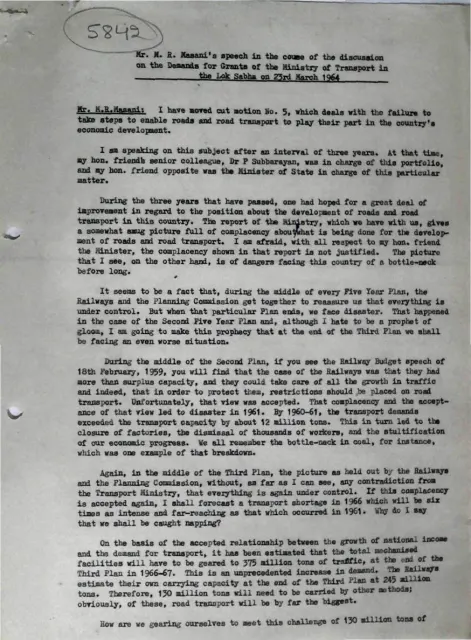 Primary workMr. M. R. Masani's speech in the course of the discussion on the Demands for Grants of the Ministry of Transport in the Lok Sabha on 23rd March 1964
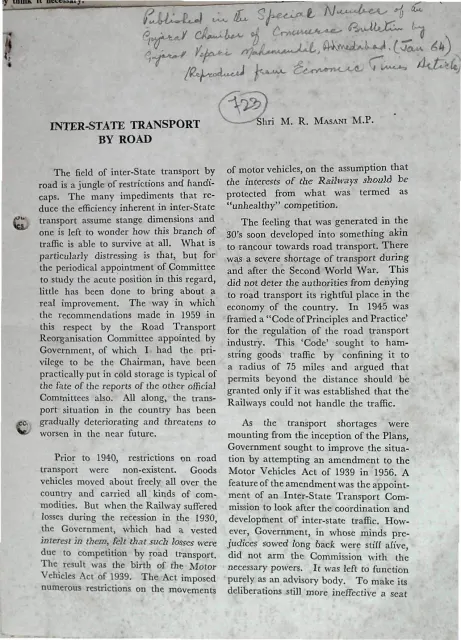 Primary workINTER-STATE TRANSPORT BY ROAD
 Primary workTransport in Our Developing Economy
 ExcerptEconomic Reforms In India: Where Are We And Where Do We Go?
 ExcerptHas Private Enterprise Failed?