
pamphlet
Transport in Our Developing Economy
By F. P. Antia
Published by M. R. PAI, for Forum of Free Enterprise, "Sohrab House", 235 Dr. Dadabhai Naoroji Road, Bombay 1, and Printed by B. G. DHAWALE at Karnatak Printing Press, Chira Bazar, Bombay 2. · Bombay · 1962
11 pages
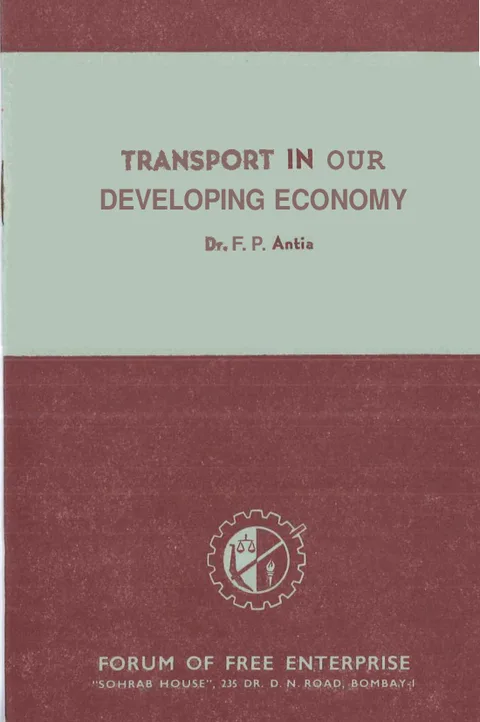
Transport in Our Developing Economy
By Dr. F. P. Antia
Summary
In this Forum of Free Enterprise booklet, Dr. F. P. Antia argues that efficient, adequate, and cheap transport is the sine qua non of India’s industrialisation, and that a developing economy cannot prosper if goods cannot move when and where they are needed. Surveying India’s four transport systems — railways, roads, air, and water — he documents how thin India’s network is relative to advanced economies: railway mileage per head is roughly a quarter of the U.S. figure, road density a fraction of Western levels, and inland water transport, once vibrant, has been deliberately crippled by railway-protective policy.
Antia’s central polemic is that the Government of India has wrongly treated transport as synonymous with rail transport, suppressing road transport to divert traffic to the railways. He marshals data showing road transport is the cheaper, faster, door-to-door agency for most freight, that road’s share has risen everywhere except India, and that the Third Five-Year Plan badly underestimates how much transport capacity (he calculates a need far above plan targets) the projected rise in national income will demand. He warns that an overall shortage of transport facilities threatens to make the Plan’s targets ‘illusory.’
He calls for a balanced, multi-agency transport policy that develops each mode in its legitimate sphere, with particular urgency on modernising and extending roads and on allocating foreign exchange for vehicle-manufacturing capacity. The booklet closes by insisting roads be accepted not as a luxury but as a full-fledged alternative agency of transport.
Key points
-
Efficient, cheap, and timely transport is presented as the precondition (sina qua non) of industrialisation and economic development.
-
India’s transport network is thin by international comparison: railway mileage per head ~25% of the U.S., road density as low as 6-10% of Western levels.
-
Inland water transport, historically important, has been deliberately crippled by railway-protective rate policy, citing the Acworth Committee (1920) and the Estimates Committee.
-
Government has wrongly equated transport with rail and suppressed road transport to divert traffic to the railways.
-
Road transport is shown to be cheaper, faster, and door-to-door, and its share has risen in every country except India.
-
The Third Five-Year Plan grossly under-provides for transport; Antia computes a required increase far above plan targets, risking an overall transport shortage.
-
Antia advocates a balanced multi-agency transport policy with urgent modernisation/extension of roads and foreign-exchange allocation for vehicle capacity.
-
Author footnote (p.1) identifies Antia as President of the Indian Roads and Transport Development Association.
Generated by the v1.5 extraction pipeline. Awaiting editorial review.
Metadata and summary are AI-extracted from the source PDF and reviewed for editorial accuracy. The original work is available via the Read PDF tab above (where present); paragraph-level citation inside the PDF is deferred to a future engagement.
People in this work
Related across the archive
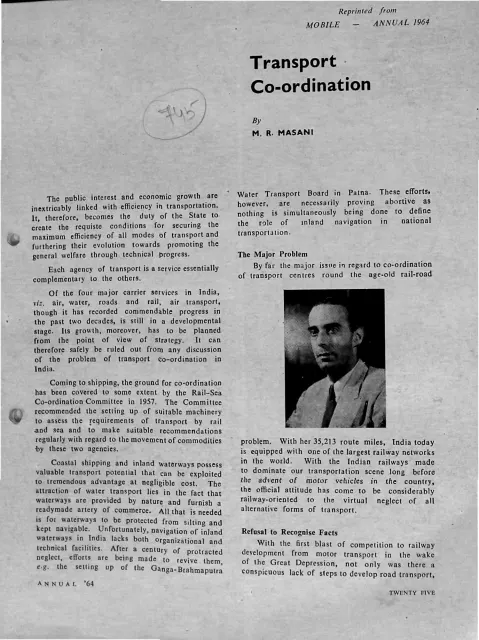 Primary workTransport Co-ordination
 Primary workMr. M. R. Masani's speech in the course of the discussion on the Demands for Grants of the Ministry of Transport in the Lok Sabha on 23rd March 1964
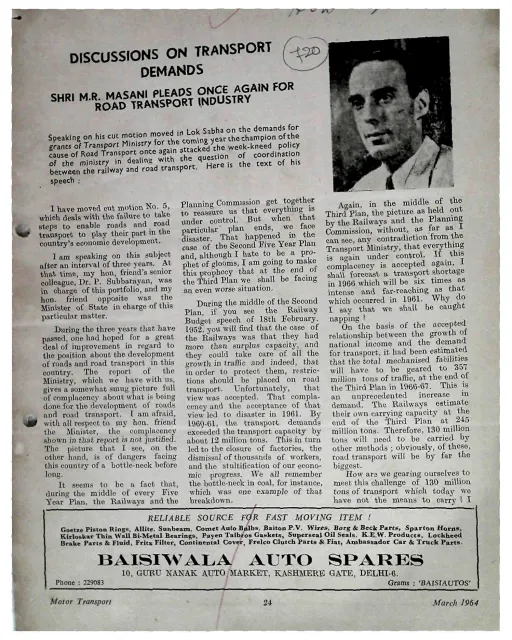 Primary workMotor Transport
 ExcerptEconomic Reforms In India: Where Are We And Where Do We Go?
 ExcerptThe Budget Versus The People