
press note · position paper
For Favour of Publication
SWATANTRA PARTY, National Headquarters, Madras. · Bombay · 1975
3 pages
Summary
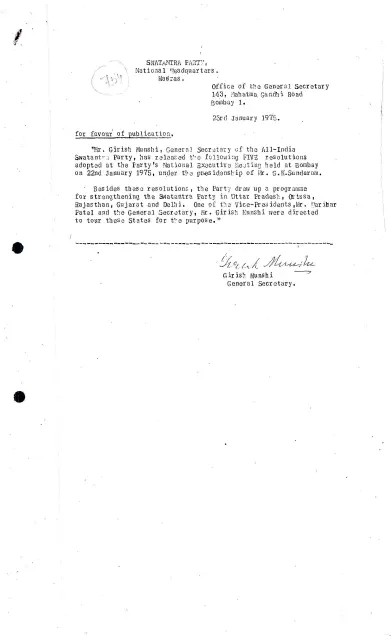
This three-page Swatantra Party press note, issued from its national headquarters on 23 January 1975, announces five resolutions adopted by the party’s National Executive in Bombay on 22 January. The resolutions endorse Jayaprakash Narayan’s movement against corruption, nepotism, and oppression, and urge citizens to join it across partisan divisions. They also support electoral reforms proposed by a committee appointed by Narayan, arguing that safeguards for free and fair elections are necessary to restore public confidence.
The remaining resolutions address food policy, electoral-roll preparation, and industrial production. The party argues that India has sufficient food-grain capacity if farmers receive adequate water, fertilisers, and improved seeds, and opposes inter-State restrictions, government procurement monopolies, and uneconomic levies on farmers. It criticises rushed electoral-roll procedures and calls for full enumeration and public notice, while attributing industrial stagnation to shortages of raw materials and working capital and to unnecessary controls over prices and distribution. The document concludes by demanding abolition of controls and quota systems that hamper production.
Key points
- The Swatantra Party pledges full cooperation with Jayaprakash Narayan’s anti-corruption movement.
- The party supports electoral reforms proposed by Narayan’s Electoral Reforms Committee.
- The resolutions call for safeguards to ensure free and fair elections and accurate electoral rolls.
- The party claims that India can produce sufficient food grains if farmers receive essential inputs and support.
- It opposes inter-State restrictions on food-grain movement, government procurement monopolies, and uneconomic levies on farmers.
- The document attributes industrial stagnation to shortages, inadequate working capital, and controls on prices and distribution.
- It calls for abolishing unnecessary controls and quota systems in order to increase industrial production and efficiency.
Metadata and summary are AI-extracted from the source PDF and reviewed for editorial accuracy. The original work is available via the Read PDF tab above (where present); paragraph-level citation inside the PDF is deferred to a future engagement.
Related across the archive
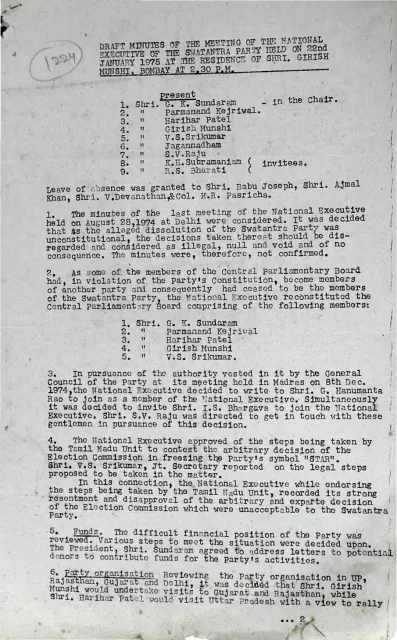 Primary workDRAFT MINUTES OF THE MEETING OF THE NATIONAL EXECUTIVE OF THE SWATANTRA PARTY HELD ON 22nd JANUARY 1975 AT THE RESIDENCE OF SHRI. GIRISH MUNSHI, BOMBAY AT 2.30 P.M.
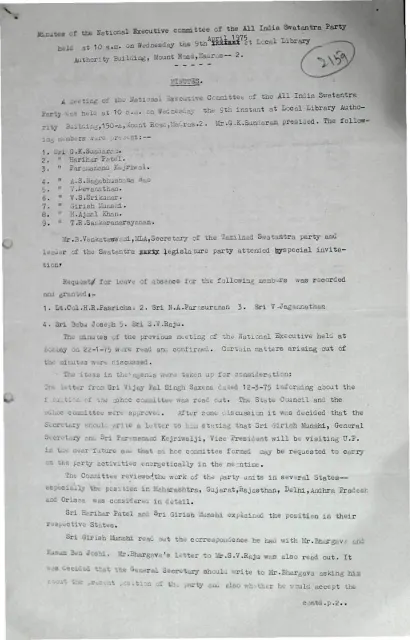 Primary workMinutes of the National Executive committee of the All India Swatantra Party
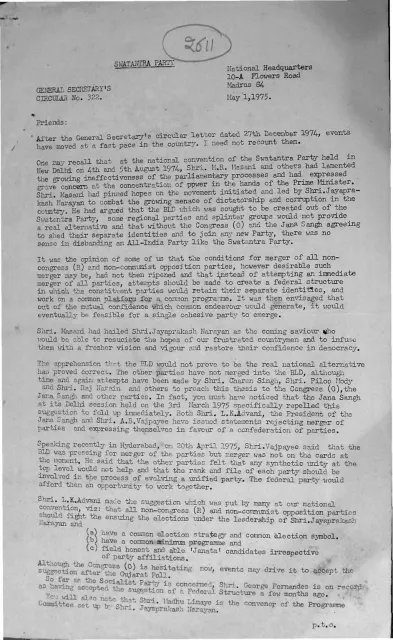 Primary workSwatantra Party National Convention
 ThePrintA shame-faced modesty pervades 1991 reforms. This is strange and inappropriate: Ashok Desai
 ExcerptAgricultural Policy of Swatantra Party