minutes · report
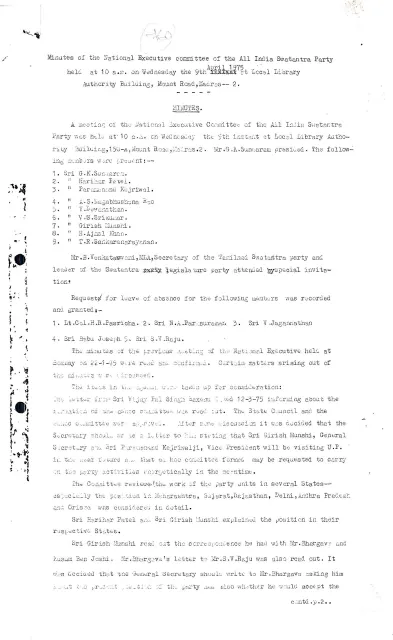
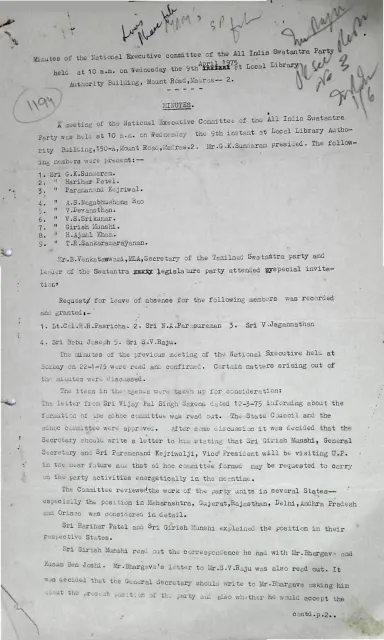
Minutes of the National Executive committee of the All India Swatantra Party
All India Swatantra Party · Madras · 1975
4 pages
Summary
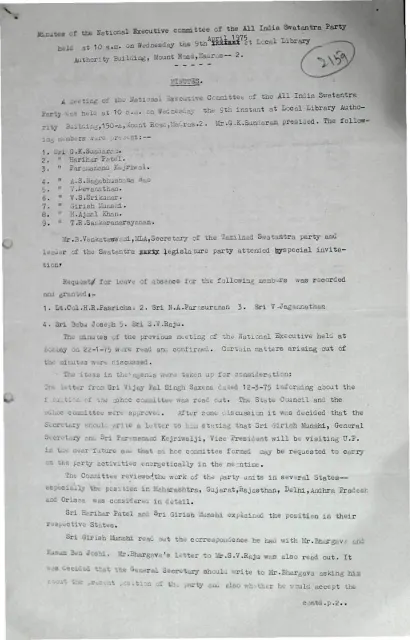
These four pages record the 9 April 1975 meeting of the National Executive Committee of the All India Swatantra Party in Madras, chaired by G. K. Sundaram. The minutes list attendees and absentees, confirm the previous meeting’s minutes, review party organisation in several states, discuss correspondence concerning party reorganisation, and note Sundaram’s appointment to the National Coordinating Committee of the People’s struggle under Jayaprakash Narayan. The committee also considers electoral coordination, deciding that the party should help form a democratic, non-Congress and non-communist front and pursue common Janata candidates for the 1976 general elections.
The resolutions recorded on pages 3–4 take positions on Morarji Desai’s fast, the state of emergency, the attack on Jayaprakash Narayan, Kashmir and Article 370, opposition-party cooperation, the mixed economy, and agricultural procurement. The document presents the party as defending parliamentary democracy and a mixed economy while condemning what it describes as increasingly authoritarian economic and political policies. It argues that compulsory procurement and low prices for agricultural produce harm farmers and reduce incentives for increased production.
Key points
- The National Executive met in Madras on 9 April 1975 under the chairmanship of G. K. Sundaram.
- The minutes review party organisation and activity in Maharashtra, Gujarat, Rajasthan, Delhi, Andhra Pradesh and Orissa.
- The committee supports cooperation among democratic opposition parties to create a common electoral front against the ruling Congress.
- The committee endorses the People’s struggle associated with Jayaprakash Narayan and records concerns about the state of emergency.
- The resolutions condemn the handling of the attack on Jayaprakash Narayan and call for accountability for officials involved.
- The party opposes the method by which Sheikh Abdullah was placed in power in Kashmir and criticises the continuation of Article 370.
- The committee defends the mixed economy as the sensible long-term policy for economic regeneration while criticising controls, shortages, black money and corruption.
- The final resolution calls for agricultural procurement policies that provide farmers with prices sufficient to encourage increased production.
Metadata and summary are AI-extracted from the source PDF and reviewed for editorial accuracy. The original work is available via the Read PDF tab above (where present); paragraph-level citation inside the PDF is deferred to a future engagement.