letter
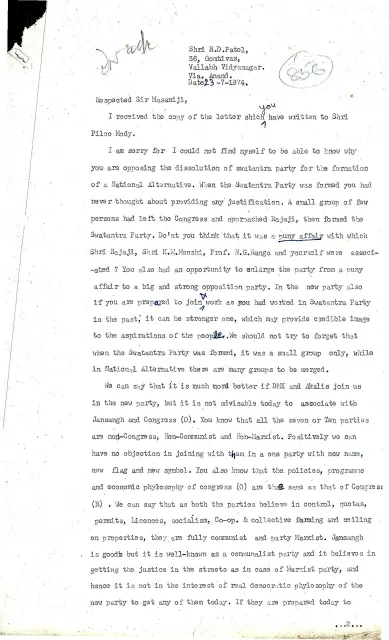
Letter to Mr Minoo Masani
1974
6 pages
Summary
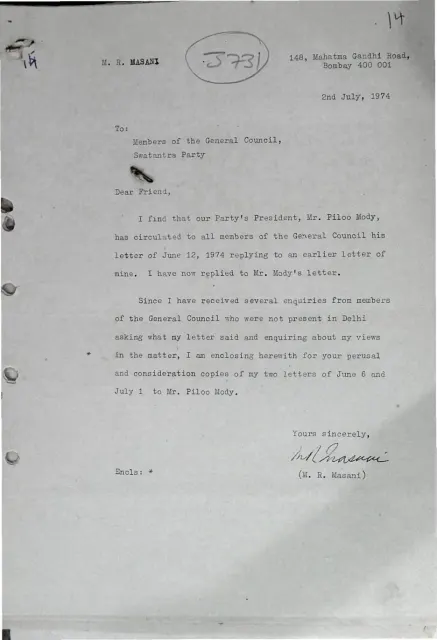
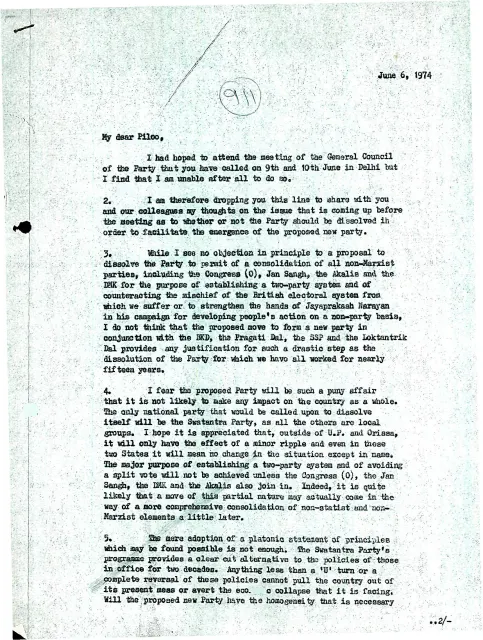
In this six-page letter dated 23 July 1974, R. D. Patel urges Minoo Masani to support dissolving the Swatantra Party and forming a broader “National Alternative.” Patel argues that Swatantra began as a small group but that a stronger opposition requires merging several non-Congress, non-Communist and non-Marxist parties under a new name, flag and symbol. He maintains that cooperation with the DMK and Akalis could be useful, while an immediate association with Jansangh and Congress (O) would compromise the new party’s principles because of their support for controls, quotas, permits, socialism, cooperative and collective farming, and property ceilings.
Patel also rejects Masani’s proposals for preserving Swatantra’s separate identity or converting it into a constructive service organisation. He points to the party’s financial weakness, organisational inactivity, inconsistent policy record in Orissa, and declining public credibility. Recalling the 1971 alliance and earlier discussions involving Rajaji, Piloo Mody and other leaders, Patel argues that dissolution is necessary to create a principled and electorally effective opposition. The letter closes by appealing to Masani to reconsider his opposition to the merger, which Patel presents as essential to restoring democratic political competition.
Key points
- Patel advocates dissolving the Swatantra Party to create a broader National Alternative.
- He presents the proposed formation as a coalition of non-Congress, non-Communist and non-Marxist groups.
- He warns that immediate cooperation with Jansangh and Congress (O) could dilute Swatantra’s principles because of their statist and socialist policies.
- He argues that Swatantra’s financial difficulties, organisational inactivity and weak public image make continuation in its existing form impractical.
- He rejects preserving the party’s separate identity under a common programme, citing the failure of unity within Swatantra itself.
- He criticises the party’s inconsistent record on land ceilings, textbook nationalisation and restrictions on agricultural markets.
- He portrays a strong, principled opposition as necessary to address what he calls the crisis of Indian democracy.
Metadata and summary are AI-extracted from the source PDF and reviewed for editorial accuracy. The original work is available via the Read PDF tab above (where present); paragraph-level citation inside the PDF is deferred to a future engagement.